




A new standard in microsurgery?
When peripheral nerves are severed - in the hand or fingers, for example - traditional reconstruction is challenging: nerve endings are coaptated (joined together) with extremely fine sutures under the operating microscope so that regeneration has any chance at all. This is precisely where an innovation that received a lot of attention in 2025 comes in: The US FDA has for the first time Sutureless system for peripheral nerve coaptation per De novo authorization released.
It is important to classify this precisely: it is not about „healing without surgery“, but about a new method within of a surgical procedure - with the aim of preventing the mechanical fixation of the nerve endings atraumatic, faster and more reproducible to make.
What exactly has the FDA approved?
The released product is called:
COAPTIUM® CONNECT with TISSIUM Light (Tissium) - authorized via the FDA De-Novo Path (a kind of „first-of-its-kind“ approval for novel medical device categories).
The focus is on peripheral nerves (i.e. nerves outside the brain and spinal cord), where precise adaptation of the ends is crucial for axons to grow in the right direction.
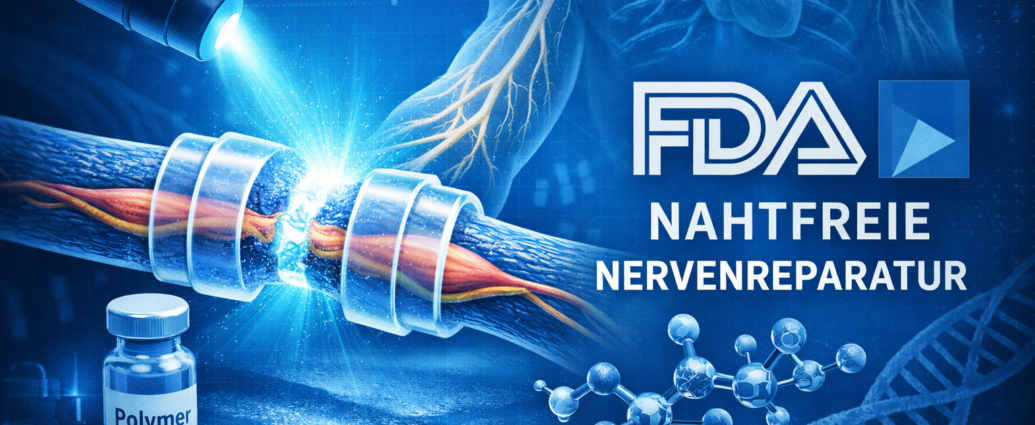
How it works: polymer + light instead of micro seams
The principle can be explained in three steps:
- Positioning of a flexible cuff/chamber
Around the injured nerve endings a 3D-printed cuff or chamber which keeps the ends stable in the desired position. - Application of a liquid prepolymer
Instead of placing sutures, surgeons wear a liquid prepolymer where the fixation is needed. - Light-activated curing in seconds
When exposed to light, the material hardens immediately and forms a Flexible sealing/fixation, which holds the nerve endings in position - without classic sutures.
According to reports, the material used is based on poly(glycerol sebacate acrylate) - a biocompatible, light-crosslinkable polymer approach that plays a central role in the MIT-related research history of this technology.
Why „bioresorbable“ is clinically exciting
A crucial point: the implant is used as a Fully bioresorbable described - i.e. designed in such a way that after the healing phase dismantled is used. This is intended to reduce the risks that can occur with permanent foreign materials (e.g. chronic irritation, inflammatory reactions or mechanical problems later on).
What do the (publicly communicated) study data say?
In its communication, Tissium reports on a clinical experience/study with 12 patients (digital nerve injuries) and mentions:
- 100 % „procedural success“ (as procedurally defined success of suture-free coaptation),
- to 12 monthsRecovery of function (flexion/extension) and No reported pain.
At the same time, it is fair to consider the classification: public announcements often only provide an excerpt. In the long term, independent publications, larger cohorts and comparative data (against standard sutures/other nerve cuffs) are crucial for clinical practice.
What is „revolutionary“ about it - and what is not?
Revolutionary it can be, because:
- the technology that Extremely demanding seam in terms of fine motor skills potentially replaced,
- the fixation faster and more standardizable will,
- the method atraumatic (less mechanical manipulation of the nerve).
Not revolutionary in the sense of „miracle healing“:
- Nerve regeneration remains biologically slow,
- Outcome still depends on injury type, distance, time to treatment, patient factors and rehabilitation,
- The method is not a substitute for surgical expertise, but a new tool in the operating theater.
Looking ahead: Can it also be used for vessels and hernias?
Both technical reports and MIT communications describe Tissium as the platform beyond nerve reconstruction for example, for applications in the cardiovascular sealing or with GI/hernia repairs.
It is important to note that not every indication mentioned is automatically already approved - in some cases it is a matter of development programs and clinical trial pathways.
A brief bridge: „light“ as a therapeutic principle - but in a completely different role
In frequency and light therapy, „light“ is often discussed as a biological stimulus. Here, however, light is primarily a technical trigger: It is used to create a polymer precise networking - i.e. as a „switch“ for material hardening in the operating theater, not as direct therapy on the nerve. It is precisely this clear distinction that is important for a clear classification.
Conclusion
The FDA de novo authorization for Tissiums COAPTIUM® CONNECT with TISSIUM Light marks a remarkable step: Suture-free, light-activated fixation could simplify and standardize peripheral nerve reconstructions and possibly make them gentler. Whether this will become a new standard now depends on broader clinical evidence, comparative data and practical integration into surgical procedures.
References (for the blog)A new standard in microsurgery?
When peripheral nerves are severed - in the hand or fingers, for example - traditional reconstruction is challenging: nerve endings are coaptated (joined together) with extremely fine sutures under the operating microscope so that regeneration has any chance at all. This is precisely where an innovation that received a lot of attention in 2025 comes in: The US FDA has for the first time Sutureless system for peripheral nerve coaptation per De novo authorization released.
It is important to classify this precisely: it is not about „healing without surgery“, but about a new method within of a surgical procedure - with the aim of preventing the mechanical fixation of the nerve endings atraumatic, faster and more reproducible to make.
What exactly has the FDA approved?
The released product is called:
COAPTIUM® CONNECT with TISSIUM Light (Tissium) - authorized via the FDA De-Novo Path (a kind of „first-of-its-kind“ approval for novel medical device categories).
The focus is on peripheral nerves (i.e. nerves outside the brain and spinal cord), where precise adaptation of the ends is crucial for axons to grow in the right direction.
How it works: polymer + light instead of micro seams
The principle can be explained in three steps:
- Positioning of a flexible cuff/chamber
Around the injured nerve endings a 3D-printed cuff or chamber which keeps the ends stable in the desired position. - Application of a liquid prepolymer
Instead of placing sutures, surgeons wear a liquid prepolymer where the fixation is needed. - Light-activated curing in seconds
When exposed to light, the material hardens immediately and forms a Flexible sealing/fixation, which holds the nerve endings in position - without classic sutures.
According to reports, the material used is based on poly(glycerol sebacate acrylate) - a biocompatible, light-crosslinkable polymer approach that plays a central role in the MIT-related research history of this technology.
Why „bioresorbable“ is clinically exciting
A crucial point: the implant is used as a Fully bioresorbable described - i.e. designed in such a way that after the healing phase dismantled is used. This is intended to reduce the risks that can occur with permanent foreign materials (e.g. chronic irritation, inflammatory reactions or mechanical problems later on).
What do the (publicly communicated) study data say?
In its communication, Tissium reports on a clinical experience/study with 12 patients (digital nerve injuries) and mentions:
- 100 % „procedural success“ (as procedurally defined success of suture-free coaptation),
- to 12 monthsRecovery of function (flexion/extension) and No reported pain.
At the same time, it is fair to consider the classification: public announcements often only provide an excerpt. In the long term, independent publications, larger cohorts and comparative data (against standard sutures/other nerve cuffs) are crucial for clinical practice.
What is „revolutionary“ about it - and what is not?
Revolutionary it can be, because:
- the technology that Extremely demanding seam in terms of fine motor skills potentially replaced,
- the fixation faster and more standardizable will,
- the method atraumatic (less mechanical manipulation of the nerve).
Not revolutionary in the sense of „miracle healing“:
- Nerve regeneration remains biologically slow,
- Outcome still depends on injury type, distance, time to treatment, patient factors and rehabilitation,
- The method is not a substitute for surgical expertise, but a new tool in the operating theater.
Looking ahead: Can it also be used for vessels and hernias?
Both technical reports and MIT communications describe Tissium as the platform beyond nerve reconstruction for example, for applications in the cardiovascular sealing or with GI/hernia repairs.
It is important to note that not every indication mentioned is automatically already approved - in some cases it is a matter of development programs and clinical trial pathways.
A brief bridge: „light“ as a therapeutic principle - but in a completely different role
In frequency and light therapy, „light“ is often discussed as a biological stimulus. Here, however, light is primarily a technical trigger: It is used to create a polymer precise networking - i.e. as a „switch“ for material hardening in the operating theater, not as direct therapy on the nerve. It is precisely this clear distinction that is important for a clear classification.
Conclusion
The FDA de novo authorization for Tissiums COAPTIUM® CONNECT with TISSIUM Light marks a remarkable step: Suture-free, light-activated fixation could simplify and standardize peripheral nerve reconstructions and possibly make them gentler. Whether this will become a new standard now depends on broader clinical evidence, comparative data and practical integration into surgical procedures.
References
- Tissium - Press release on FDA de novo authorization (24.06.2025)
- Chemical & Engineering News (Laura Howes) - Report on FDA clearance (14.07.2025)
- MIT News - Background to the platform and classification (01.08.2025)

Comments are closed, but trackbacks and pingbacks are open.