





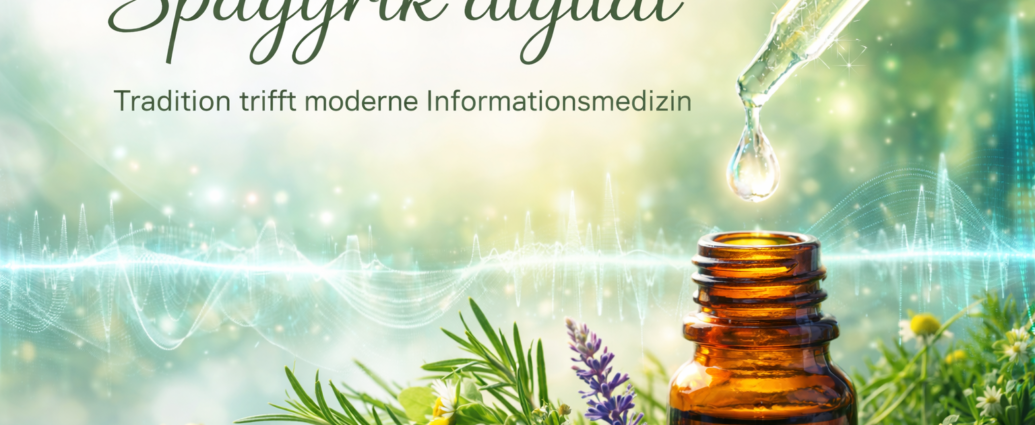
The Spagyric is one of those naturopathic systems that combine ancient healing knowledge, herbalism and alchemical symbolism in a special way. For many people, it is more than just a traditional form of preparation: it stands for the attempt to grasp the essence of a plant not only in terms of material, but also in its subtle order. This is precisely where its enduring fascination lies. While modern medicine thinks primarily in biochemical terms, spagyric medicine also focuses on structure, maturation, transformation and inner harmony.
Heute erlebt dieses traditionsreiche System eine neue Aufmerksamkeit. Der Grund dafür liegt nicht nur in der Rückbesinnung auf ganzheitliche Verfahren, sondern auch in der Frage, wie sich klassische Pflanzenheilkunde mit modernen Konzepten der Information medicine and Frequency therapy can be combined. This is precisely where the transition to spagyric frequency drops arises - i.e. preparations in which a traditional spagyric approach is combined with digitally recorded or frequency-based information patterns.
What is spagyric anyway?
The term spagyric is usually traced back to Paracelsus. The word is derived from Greek roots meaning „to separate“ and „to reunite“. This refers to a central basic principle: a starting substance is first broken down into its components, purified, refined and then reunited in a new form. In the spagyric tradition, this is intended to make the essence of a plant or substance more accessible.
Historically, spagyric medicine is closely linked to Paracelsus, who played an important role in combining chemistry and medicine. His way of thinking differed significantly from the dominant medical approach of the time. Instead of just looking at bodily fluids and symptoms, Paracelsus thought in terms of the wider context of nature, man, substance, transformation and order.
The historical roots of spagyric medicine
Spagyrics is not simply ancient herbal medicine. It arose from the interplay between alchemy, natural philosophy and early medicine. In the Paracelsian tradition, the aim was not only to use substances, but also to purify them through special processes. This included processes such as maceration, fermentation, distillation and calcination. These steps not only had a technical function, but were also understood as an expression of an inner maturing and refining process.
Over time, the Paracelsian way of thinking also influenced those branches of medicine that focused more on chemical processes. Spagyrics thus became part of a medical-historical development in which natural substances began to be prepared more systematically and the connection between substance, process and effect was rethought.
The importance of spagyric medicine from a holistic perspective
For many users, the importance of spagyric medicine lies not only in the plant itself, but also in the way it is prepared. A plant is not merely extracted, but processed, transformed and reassembled in several steps. This results in the typical spagyric understanding: not only individual ingredients, but the ordered whole should come into its own.
In the classical view, spagyric therefore stands for:
- the combination of plant knowledge and process knowledge
- the idea of purification, maturation and recombination
- a holistic view of the body, psyche and energetic order
- the idea that healing can also Resonance, regulation and inner balance
It is precisely this last point that makes spagyric medicine so interesting for modern holistic concepts. After all, terms such as information, vibration, resonance and order also play a major role in frequency therapy and information medicine today.
How are spagyric remedies traditionally understood?
Traditionally, spagyric preparations are understood as remedies that are intended to provide plant powers in a refined form. In contrast to purely phytotherapeutic preparations, the focus is not only on measurable plant substances, but also on the manufacturing process. The manufacturing process is therefore not just technology, but part of the concept.
From a modern perspective, it is important to make a distinction: Holistic or energetic interpretation models relating to spagyrics, information transfer or subtle order do not correspond to the same scientific proof as is required for pharmacologically clearly investigated active ingredients. This is precisely why a factual and responsible presentation is important.
Application of spagyric in today's practice
In der heutigen Practice wird Spagyrik häufig im Rahmen ganzheitlicher Konzepte eingesetzt – etwa begleitend in Phasen von Belastung, zur Unterstützung von Regulationsprozessen oder als Teil individueller naturheilkundlicher Begleitung. Viele Anwender schätzen an ihr die feine, ritualisierte Form der Anwendung und die symbolische Tiefe des Verfahrens.
Today, spagyric typically stands for the following fields of application in an extended holistic understanding:
- Support in times of stress and inner turmoil
- Support for regeneration and harmonization
- Naturopathic supplementation within individual concepts
- Combining plant knowledge with an energetic approach
However, it should remain clear that such applications are no substitute for medical diagnosis or evidence-based therapy. Medical clarification is essential, especially in the case of severe or persistent complaints.
The transition to modernity: spagyric and frequency information
This is precisely where the door opens to a modern development: the combination of spagyric thinking with frequency-based information transfer. While classical spagyric medicine assumes that a higher-ordered plant preparation is created through separation, purification and reunification, modern information medicine also asks whether characteristic patterns of a substance can also be digitally recorded, stored and transmitted.
In this context, some users speak of spagyric frequency drops. This refers to preparations in which not only the material aspect of a plant or mixture is important, but also a frequency or information spectrum assigned to it. This spectrum is digitized in corresponding concepts and then transferred to a carrier medium - such as water or globules.
From the user's point of view, this creates a bridge between the old and new worlds:
- Spagyric provides the archetypal understanding of plants and processes
- Frequency therapy supplements the level of information, resonance and vibration
- the carrier medium serves as a transmitter of the applied signature
Frequency spectrum digitized - embossed on globules or water
The idea of transferring a frequency spectrum to water or globules belongs to the field of frequency and information medicine concepts. It is assumed that characteristic patterns can be digitally recorded and imprinted on a neutral medium, which then serves as an information carrier.
For a serious presentation, this means that these methods can be described as holistic, information-oriented models, but should not be presented as a scientifically proven form of therapy. Anyone working with spagyric frequency drops is operating in a field that is strongly characterized by experience, practical philosophy and energetic interpretation.
Why many people still find this connection interesting
Despite unanswered scientific questions, many people find the combination of spagyrics and frequency information attractive. There are several reasons for this.
Firstly, it combines tradition and technology. Spagyric brings with it a centuries-old culture of refining and organizing, while digital frequency systems appeal to the modern desire for precision, pattern recognition and individualization.
Secondly, this connection fits well into a world view in which health is not only understood biochemically, but also as an expression of regulation, communication and resonance.
Thirdly, many people experience holistic methods as being personally compatible because they take into account not only symptoms, but also the rhythm of life, stress, constitution and subjective feelings.
Spagyric frequency drops as a bridge between plant beings and information medicine
Spagyric frequency drops can thus be described as a modern form of bridge: On the one hand, there are the classical ideas of plant refinement, quintessence and the ordered whole. On the other side are modern concepts of frequency therapy, in which information, signature and resonance take center stage.
In this view, frequency information based on globules or water is not simply a substitute for a herbal preparation, but an expression of a changed understanding of effect: less substance-centered, more information-oriented. Whether and how a person resonates with it is often regarded as individual in such concepts.
Conclusion
Spagyric is a fascinating traditional system with deep roots in Paracelsian medicine. Its core principle - separate, purify, reunite - makes it a special form of naturopathic preparation to this day. Historically, it stands at the interface of alchemy, medicine and plant knowledge; today, it is increasingly being reinterpreted in the light of modern information models.
The transition to spagyric frequency drops follows precisely this line: the traditional understanding of plant essence is supplemented by the idea that a frequency spectrum can be digitized and imprinted on globules or water. As a holistic model, this is exciting for many people. Scientifically, however, a clear distinction should be made between traditional use, subjective experience and reliable proof of efficacy.
Note: This article is for general information and does not replace a medical diagnosis or treatment. Holistic methods such as spagyric or frequency-based applications are not generally recognized by conventional medicine and should not be seen as a substitute for a necessary medical examination.
Spagyrics arrived in the digital age
On behalf of the NLS Information Medicine habe ich genau diesen wichtigen Brückenschlag zwischen der traditionsreichen History der Spagyrik und den modernen Möglichkeiten der Informationsmedizin umgesetzt. Dabei ging es darum, das über Jahrhunderte gewachsene Wissen der Spagyrik nicht nur zu bewahren, sondern es in eine zeitgemäße Form zu überführen. Die wertvollen Prinzipien der klassischen spagyrischen Essenzen wurden mit modernen digitalen Verfahren verbunden, sodass heute neue Wege der Anwendung eröffnet werden können.
On this basis, we have succeeded, offer all spagyric essences also digitally. This means that the focus is no longer exclusively on the material essence, but that its characteristic frequency spectrum can also be captured and harnessed for modern applications. This creates a combination of historical healing knowledge, energetic understanding and contemporary technological implementation.
This is how a traditional naturopathic approach became a modern concept that combines the experience of the past with the possibilities of the present. This is precisely where the special value of this bridge lies: Spagyric medicine retains its essence and at the same time is developed into a new, digital form through information medicine.


Comments are closed, but trackbacks and pingbacks are open.