
TLDR; Der Artikel erklärt verständlich, was Spike-Proteine sind und unterscheidet klar zwischen ihrer Rolle bei Infektion und Impfung. Er stellt nüchtern fest, dass es keine wissenschaftlichen Belege dafür gibt, dass Spike-Proteine durch Frequenztherapie „ausgeleitet“ werden können. Gleichzeitig wird gezeigt, wie Frequenztherapie und Frequency droplets als komplementäre, sanfte Begleitung nach COVID zur Unterstützung von Regeneration, Stressreduktion und Körperwahrnehmung beitragen können. Zentrale Empfehlung ist ein ganzheitlicher Ansatz mit medizinischer Abklärung, Geduld und unterstützenden Maßnahmen statt Angst oder Heilsversprechen.
Many people are looking for guidance after COVID-19. Complaints remain. Energy is lacking. The body feels strange. In this context, the question arises again and again: what is spike protein? And can spike proteins be eliminated with frequency therapy? This article takes you seriously. It explains things clearly, scientifically correct and without fear.
We take a look at what spike proteins are. We clarify the difference between infection and vaccination spike protein. We also talk openly about what frequency therapy can and cannot do. And we show what holistic support after COVID can look like that sees the person as a whole.
Clarity is particularly important for people with post-COVID symptoms, for therapists and for the chronically ill. False promises are harmful. Honest support strengthens. That is why we classify frequency therapy according to COVID scientifically and show practical ways in which well-being can be strengthened after COVID.
We incorporate findings from information medicine according to COVID, from immune research and from the practice of frequency therapy. The aim is not to promise a cure. The aim is orientation, safety and a sound basis for holistic regeneration after a viral infection.
What spike proteins really are - spike protein what is it explained clearly
The spike protein is a surface protein of the SARS-CoV-2 virus. It enables the virus to bind to human cells. Specifically, it binds to so-called ACE2 receptors. These are located in the lungs, blood vessels, intestines and brain, among other places.
It is important to note that the spike protein is biologically active. Even without a complete virus, it can trigger inflammation. This is where the discussion about post-COVID symptoms begins in a holistic way.
Current research shows that spike proteins can remain in the body longer than expected after an infection. Immune cells, vascular endothelial cells and border areas of the brain are particularly relevant. Studies indicate that spike fragments can trigger immune reactions there, even if active virus replication is no longer taking place. This explains why symptoms such as brain fog, fatigue or vascular problems can last for weeks to months.
At the same time, it is important to emphasize: Spike proteins are not an independent „poison“, but part of complex biological processes. Their effect depends on quantity, location, individual immune response and genetic factors. People with pre-existing conditions or a pre-existing tendency to inflammation often react more sensitively. This differentiated understanding is essential in order to avoid fear and still take the relevance seriously.
Our data also suggest that the persistence of spike protein at the borders of the brain may contribute to the long-term neurological effects of COVID-19 and Long COVID.
Here it becomes clear: spike proteins are not an esoteric concept. They are a biomedical topic. Anyone looking for holistic regeneration after a viral infection needs to know these facts.
Difference between infection and vaccination - spike protein what is it in comparison
The difference between infection and vaccination Spike protein is central. During an infection, the virus multiplies throughout the body. The spike protein is distributed systemically. Inflammatory reactions can be strong and affect different organ systems.
During an mRNA vaccination, the body is stimulated locally to produce spike proteins. This production is limited in time, controlled and serves exclusively to activate the immune system. Studies show that the amount of spike protein produced is significantly lower than in a natural infection and is broken down more quickly.
Another difference lies in the immune response. Vaccination focuses on the formation of neutralizing antibodies, whereas infection often leads to an excessive inflammatory reaction. Epidemiological data show that Long COVID-like symptoms are significantly less common after vaccination than after infection. This is important for an objective classification in the consultation.
| Aspect | Infection | Vaccination |
|---|---|---|
| Distribution | Systemic | Predominantly local |
| Persistence | Up to 4 years | Significantly lower |
| Inflammation | High | Reduced |
These differences are important for therapeutic classification. Blanket statements do not help. A differentiated approach is part of serious holistic support after COVID.
Can spike proteins be eliminated with frequency therapy?
Clarity is crucial here. Spike proteins cannot be eliminated with frequency therapy. Point.
Why? Spike proteins are located at the molecular level. Their relevant vibrations are in the range of microwave frequencies. These cannot be reached with therapeutic frequency therapy. There is no clinical study that proves that they can be eliminated.
In addition, targeted „elimination“ would be biologically problematic. The body breaks down proteins via complex enzymatic processes, not via external vibrational stimuli. Anyone who claims otherwise is mixing physical terms with biological processes and creating false expectations.
This clear demarcation protects patients and therapists. Frequency therapy post-COVID experiences show an effect on symptoms, not on the protein itself. It is precisely this honesty that forms the basis of responsible complementary support.
This reduction is an important step. Although our results are derived from mouse models and can only be transferred to humans to a limited extent, they point to the need for additional therapies.
How frequency therapy can still provide useful support
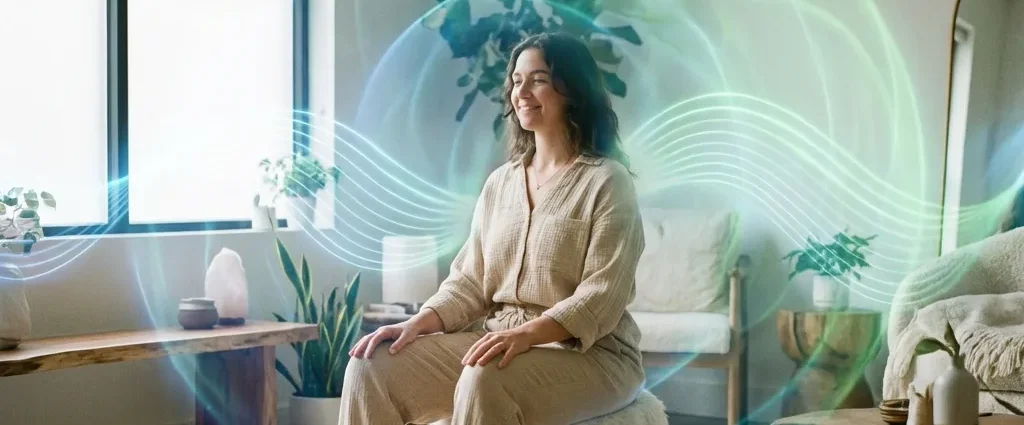
Even if spike proteins cannot be eliminated, frequency therapy has a place. It has a regulatory effect. It supports the nervous system, the mitochondria and stress processing.
Many post-COVID symptoms are not caused by active viruses, but by dysregulation: an overexcited nervous system, disrupted energy production and persistent stress. This is precisely where regulative frequency applications come in. They can promote parasympathetic processes, improve heart rate variability and reduce subjectively experienced exhaustion.
In addition, studies on pulsed electromagnetic fields show improvements in fatigue and exhaustion. A case study on PubMed documented significant effects after ten sessions (PubMed). It is important to note that the effects are supportive, not curative.
This is about complementary methods after COVID. Not as a substitute, but as a supplement to basic medical care. It is also worth taking a look at Frequency therapy palliative care: Gentle support for terminal illnesses.
Frequency drops as a gentle accompaniment
Frequency drops are an exciting approach. These do not contain substances in the classic sense, but frequency information that is used according to the principle of information transfer.
Frequently used spectra are:
- N-acetylcysteine
- Nattokinase
- L-arginine
These substances are known from orthomolecular medicine. In frequency form, they are intended to give the body impulses for regulation without biochemical intervention. This can be an advantage, especially for sensitive people or those with multiple intolerances.
It is also important to be realistic here: frequency drops are not aimed at elimination. They support regulatory processes. Many users report better resilience, more stable well-being and a gentler adaptation to stress, especially in the context of holistic concepts.
Holistic regeneration after a viral infection
Holistic regeneration after a viral infection means more than just one method. It is about sleep, nutrition, the nervous system and emotions.
According to studies, post-viral exhaustion affects up to 10 percent of all infected people. Successful concepts are multimodal: respiratory therapy, gentle exercise, micronutrient support, psychological stabilization and regulatory procedures all work together.
Current trends show multimodal approaches. A pilot study by the AGTCM reported a 62% improvement in symptoms with integrative support (AGTCM).
Frequency therapy makes sense here. Regulation is more important than stimulation, especially for people with autoimmune diseases. The goal is not performance, but stability.
In addition, we recommend further content such as Autoimmune diseases and frequency therapy, Frequency therapy effect and Breast cancer and frequency therapy.
Typical challenges in practice
Many of those affected are exhausted by therapies. Distrust is understandable. After months of changing approaches, the fear of being disappointed again grows.
Typical challenges include excessive demands, financial burdens and contradictory information. This is precisely where clear structure, realistic goals and comprehensible steps are needed. Small steps forward are more important than spectacular promises.
Serious energetic support after COVID avoids promises of salvation. It explains boundaries. It strengthens personal responsibility. The therapeutic relationship and transparency are often just as important as the method itself.
Differentiation is also important for therapists. Anyone learning frequency therapy should be familiar with the scientific principles, think in an interdisciplinary way and refer patients to medical services if necessary.
The future of complementary support after COVID
Research continues to develop. Topics such as epigenetics, the vagus nerve and information medicine after COVID are becoming increasingly important.
In the long term, post-COVID will probably be understood as a complex regulatory syndrome. This opens up scope for integrative models in which conventional medicine, psychoneuroimmunology and complementary methods work together.
Frequency therapy is increasingly understood as regulative medicine. Not as a substitute, but as a supplement. Digital applications, personalized frequency programs and better studies could further increase acceptance.
It is also worth taking a closer look at Frequency therapy for chronic pain.
Frequently asked questions
What is the Spike Protein simply explained?
The spike protein is part of the coronavirus. It helps the virus to attach to cells and can trigger inflammation.
Is there a difference between vaccination and infection with spike protein?
Yes, the spike protein often remains in the body longer after an infection than after a vaccination, and the inflammatory reaction is usually stronger.
Can frequency therapy spike proteins?
No. There is no scientific proof of this.
What can frequency therapy after COVID help with?
It can relieve fatigue, calm the nervous system, improve sleep and support regeneration.
Are frequency drops an alternative to medication?
No. They are a complementary accompaniment and do not replace medical therapy.
Orientation instead of fear, a clear path after COVID
Anyone looking for COVID support needs truth instead of promises. Spike proteins are real. It is not possible to eliminate them through frequency therapy.
What is possible is accompaniment. Regulation. Strengthening self-healing. Frequency therapy according to COVID can help to restore balance if it is used correctly.
For therapists, this means responsibility. For those affected, it means hope without illusion. Holistic support after COVID is a path, not a quick trick.
If you would like to delve deeper into serious frequency work, you will find well-founded information, training and practical approaches at Herbert Eder.
Regeneration takes time. And it starts with clarity.

Comments are closed, but trackbacks and pingbacks are open.