




Understanding alpha, beta, theta & delta
A book about consciousness, frequencies and the hidden language of the brain
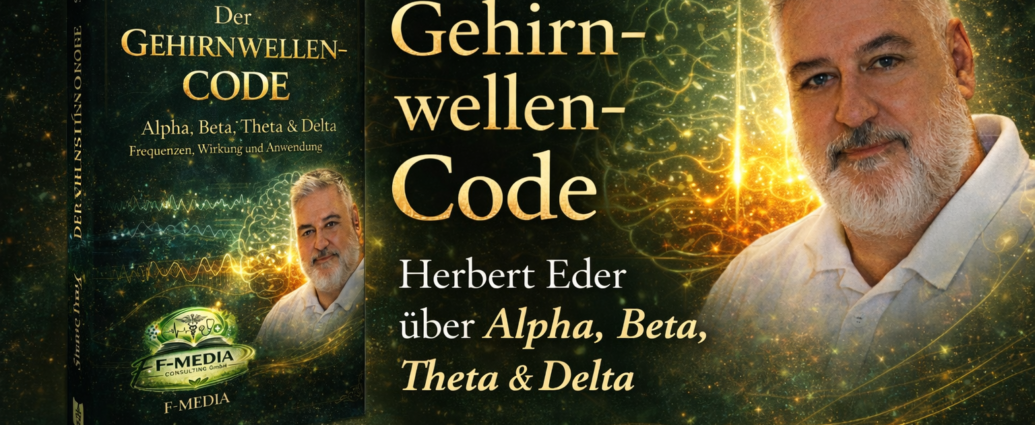
With the book „The brainwave code“ is dedicated to Herbert Eder a topic that has fascinated more and more people in recent years: the world of Brain waves and their possible significance for our thinking, feeling, regeneration and perception. The title already indicates that this is not just about sober theory, but about a deeper access to those rhythmic patterns that play a significant role in shaping our inner experience.
The focus is on the four best-known brainwave areas: Alpha, Beta, Theta and Delta. These frequency states have long been studied in brain research and are closely associated with wakefulness, relaxation, inner concentration, sleep, regeneration and transitions between conscious and unconscious states. Herbert Eder draws on this knowledge and combines it with a holistic perspective that views people not only as biochemical beings, but also as vibration-based beings.
Especially for readers who are familiar with Frequency therapy, This book opens up an exciting space for thought for those concerned with the development of consciousness, relaxation techniques or inner balance. It invites us to understand the brain not only as an organ, but also as a resonance system - finely tuned, dynamic and closely connected to our entire experience.
What is „The Brainwave Code“ about?
The book deals with the basic frequency patterns of the brain and the question of what role these patterns might play in everyday life and in human consciousness. Herbert Eder describes the various brain waves not in isolation as abstract measurement data, but as expressions of different states that everyone knows from their own experience.
We all experience phases of intense concentration, moments of calm clarity, states of deep relaxation and periods of regenerative sleep. The book shows that these states are related to certain Brain frequencies can be set. This creates a fascinating approach to the question of how consciousness is rhythmically organized and how much our quality of life could be linked to inner order, synchronization and balance.
Discussed in particular are:
Beta waves
Beta waves typically represent a state of active alertness. They are associated with thinking, planning, analyzing, problem solving and external attention. In a performance-oriented and stimulus-intensive world, many people spend a large part of their day in precisely this frequency range. The book encourages us to think about how sustained high mental activity affects our well-being and how important counterparts such as relaxation and regeneration have become.
Alpha waves
Alpha waves are considered a symbol of a relaxed but alert state. They are often associated with serenity, mental balance, creative openness and inner centering. In the book, they appear as a kind of bridge between active thinking and deeper letting go. For many readers, this area is likely to be particularly exciting because it is linked to topics such as mindfulness, meditative calm and emotional balance.
Theta waves
Theta waves are often associated with deep states of relaxation, inner images, intuition and transitional phases between wakefulness and sleep. Herbert Eder gives this area a special depth because theta can be understood not only as a physiological state, but also as a gateway to inner processes, unconscious patterns and deep levels of experience. This section is particularly stimulating for people who are involved in meditation, visualization or expanded states of consciousness.
Delta waves
Delta waves primarily stand for deep sleep and basic regeneration. They represent those areas in which the organism withdraws, regenerates and elementary recovery processes can take place. The book makes it clear how important these deep states are for the overall balance of the human being - physically, mentally and emotionally.
Why this book is more than an introduction to brainwaves
Many books on brain frequencies either remain purely technical or move exclusively in the realm of speculative interpretations. „The brainwave code“ chooses a different path. It connects Basic knowledge, understandable language and Holistic view. This is precisely the strength of the book.
Herbert Eder creates an approach that is interesting for beginners as well as for readers with previous experience. You don't need any special scientific training to follow the central theme. At the same time, the topic is presented in such a way that it goes far beyond superficial generalities. The book conveys a feeling for the fact that frequencies do not only occur in technical devices or mathematical models, but that they also play a central role in biological and mental processes.
This way of thinking fits in well with the view that Frequency therapy plays an important role: the idea that the human being is part of a complex field of vibration, Resonance and regulation. Brain waves appear to be a particularly impressive example of this because they make it clear that our inner experience is actually linked to rhythmic patterns.
Brainwaves in everyday life - why the topic is so relevant today
Modern life is characterized by information density, constant availability, inner restlessness and a constant change between stimulus intake and performance demands. Many people experience difficulty concentrating, sleep problems, nervousness, exhaustion or the feeling that they can hardly really calm down inside.
It is precisely at this point that the topic of brainwaves becomes particularly topical. Because it leads to a fundamental question: How does a person live in harmony with their natural inner rhythms?
The book makes it clear that states such as focus, serenity, deep regeneration or meditative concentration are not merely subjective impressions, but can be related to different activity patterns of the brain. Those who understand these connections better also gain a different understanding of themselves. You begin to realize why rest is not simply „doing nothing“, why sleep quality is of central importance and why relaxation can be an active organizing process of the organism.
The connection to frequency therapy
For readers with an interest in Frequency therapy this book is particularly valuable because it builds a bridge between neurological knowledge and a holistic approach. If brain waves can be understood as an expression of inner states, then it becomes clear how strongly the human being as a whole is characterized by vibration patterns.
Herbert Eder opens up a space for thought that goes beyond the classical view. The aim is not to provide hasty answers, but to expand perception: for resonance, for states of consciousness, for inner order and for the possibility of looking at health from the perspective of rhythm and frequency.
Complementary approaches in particular often assume that the body's regulatory processes are closely linked to patterns of attunement and balance. In this context, brain waves can be understood as a kind of readable surface of deeper processes. This is what makes the book so interesting: it combines physiological observability with an invitation to further reflection.
An exciting approach in the field of holistic health
The book appeals not only to people who are interested in the brain and consciousness, but also to those who want to look at health from a broader perspective. Topics such as sleep, stress, mental overload, concentration, recovery and emotional stability are closely linked to inner states. This is precisely why understanding brainwaves can have practical added value for many readers.
The topic also touches on the question of how people deal with chronic stress and how central regeneration is for the entire system. In holistic thinking, reference is often also made to far-reaching illnesses such as Cancer diseases because they focus more attention on regulation, recovery, stress factors and the quality of inner life processes. The book makes no simple promises of salvation, but should rather be seen as an invitation to take the importance of inner balance and conscious living more seriously.
It is precisely in dealing with such issues that it becomes clear how important it is to look at people not just in terms of symptoms, but more comprehensively: with their nervous system, their sleep, their mental resilience, their perception and their ability to regenerate.
Style, structure and readability
Another plus point of this book is its accessible and appealing presentation. Even the cover conveys a powerful symbolism: the human face, the implied brain, the lines of light and frequency, the connection between science, energy and personality. The design conveys exactly the same atmosphere as the content of the book: a mixture of knowledge, depth and fascination.
The subtitle „Alpha, beta, theta & delta - frequencies, effect and application“ gets to the heart of the matter. The reader immediately recognizes that this is not just about description, but also about meaning and practical relevance. This makes the work attractive for both curious beginners and readers with a holistic approach.
Linguistically, the topic is accessible without becoming banal. In terms of content, the book invites you to take your time, reflect and compare the connections described with your own experience. This is exactly what makes a good non-fiction book: They don't just provide information, they open up spaces of knowledge.
Who is „The Brainwave Code“ particularly suitable for?
This book is ideal for:
- People with an interest in Consciousness, brain and inner states
- Readers who are interested in Relaxation, sleep and mental balance employ
- Interested in Frequency therapy and holistic approaches
- Therapeutically working persons, coaches and companions in the health sector
- Readers who understand the connections between Vibration, resonance and human experience want to understand better
- People who are not only looking for facts, but also for larger contexts
The book is particularly valuable for people who want to understand themselves better. Why am I sometimes clear and alert, sometimes restless, sometimes creatively open and sometimes exhausted? Why is deep sleep so crucial? Why does real rest feel so different from mere passivity? Such questions run through the book and also make it existentially relevant.
What this book can trigger in the reader
A good book is characterized not only by its content, but also by the effect it leaves on the reader. „The brainwave code“ can help you to see your own life in a new light. Those who begin to understand states of tension, serenity, deep relaxation or tiredness not only subjectively, but also as rhythmically organized processes, often develop more mindfulness for themselves.
This applies to everyday life as well as phases of stress, concentration, retreat and regeneration. The book raises awareness of the importance of inner states - and that alone is a valuable contribution at a time when many people have partially lost contact with their natural rhythms.
Conclusion: An inspiring book for anyone who wants to understand frequencies and consciousness more deeply
With „The brainwave code“ has Herbert Eder has created a book that goes far beyond a simple introduction to alpha, beta, theta and delta waves. It is a work about Rhythm, consciousness, regulation and the subtle patterns of inner experience. It combines factual orientation with holistic thinking and opens up perspectives that are likely to be inspiring and insightful for many readers.
Who is interested in Brain waves, inner balance, Frequency therapy and the question of how consciousness could be organized in rhythmic patterns will find this a worthwhile read. The book is suitable as an introduction, for deepening and for further reflection. It invites you to look at people not only functionally, but also in terms of their inner vibrational order.
This is precisely its particular strength.
Discover and order now:
The brainwave CODE | he-brainwaves
Author
NLS Information medicine GmbH, Herbert Eder
Disclaimer
The content presented is for information purposes and refers in part to complementary and holistic perspectives. Frequency therapy is not recognized by conventional medicine and does not replace diagnosis or treatment by trained doctors or alternative practitioners.

Comments are closed, but trackbacks and pingbacks are open.