





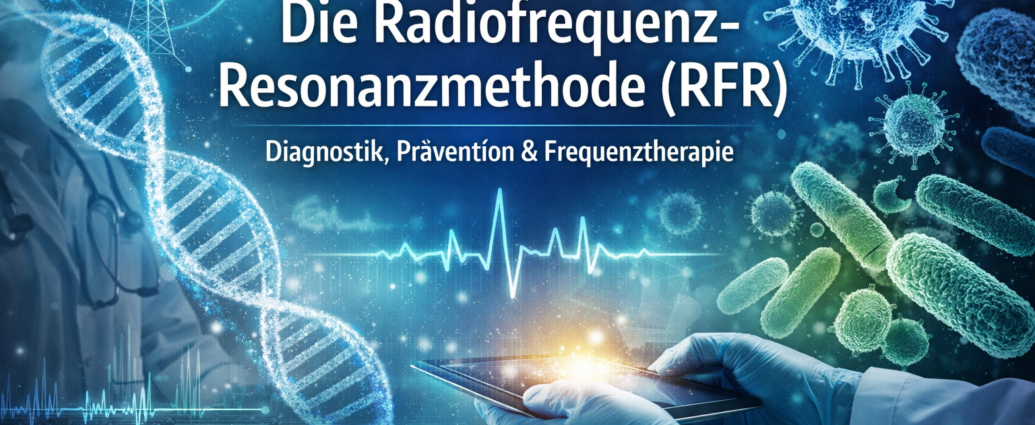
Basics, conceptual model and possible significance for diagnostics, prevention and frequency therapy
Author: NLS Informationsmedizin GmbH, Herbert Eder
The so-called Radio frequency resonance method, short RFR, is one of those concepts at the interface of physics, biology and frequency therapy that have been the subject of controversial debate for decades. At its core is the assumption that microorganisms such as viruses, bacteria or fungi react to certain electromagnetic frequency ranges in a characteristic way and that these reactions could be used both diagnostically and therapeutically.
In practical discussions, the RFR method is often abbreviated, misunderstood or mixed up with vague terms such as „bioresonance“. However, the classical RFR model is based on a comparatively clear technical approach: certain biological structures should respond to defined frequencies - similar to electrical resonance systems. This could make it possible to recognize pathological processes more precisely and, under certain conditions, to influence them in a targeted manner.
Especially in the area of Frequency therapy this topic is of particular interest. This is because the focus has always been on the question of whether vibration, resonance and electromagnetic signals not only trigger measurable biological effects, but can possibly also be used for prevention, regulation and therapeutic support. In this context, it is particularly exciting to consider whether chronic processes, immunological dysfunctions or even Cancer diseases can be recognized or influenced earlier if harmful microbial factors are identified in good time.
What is the radiofrequency resonance method?
The radio frequency resonance method is based on the idea that biological systems have frequency-dependent properties. In the classic description of the method, it is assumed that low-organized microorganisms in particular - such as viruses, bacteria and lower fungi - can be detected in certain areas of the body. Radio frequency spectrum can show resonance phenomena.
This is done with a Frequency generator which generates signals in the low high-frequency range. In historical descriptions, a range of approx. 200 to 1200 kHz called. These signals are used with low current intensity. According to the theoretical model, it should be possible to detect or trigger resonance bands of certain microorganisms.
An important point is the distinction between strong high-energy radio frequency sources and the weak signals used in medical or experimental applications. While powerful transmitters can cause health problems in the vicinity of large transmitters, RFR concepts refer to much weaker, controlled frequency signals.
The basic idea is therefore not to stress the organism with high power, but to detect or influence biological resonance phenomena with relatively weak, targeted signals.
Resonance as a basic physical principle
To understand the method, it is worth taking a look at the physical principle of the Resonance. Resonance occurs when an external excitation causes a system to vibrate more strongly at a frequency that is characteristic of this system. This principle is known from many areas of physics: from musical instruments and mechanical oscillation systems to electrical oscillating circuits.
In RFR theory, it is assumed that biological molecular structures - especially DNA-related structures - can also exhibit resonance-like properties under certain conditions. In analogy to the electrical resonance circuit, it is argued that the resistance or the electrical properties of a system change at resonance. These changes could then be measured.
The theoretical appeal of this model lies in the fact that biological information can be analyzed not only chemically or morphologically, but also Vibration physics considered. For frequency therapy, this opens up a way of thinking in which biological processes are not understood exclusively as biochemical reaction chains, but also as dynamic patterns of order, vibration and resonance.
Why should microorganisms react differently to human tissue?
A central argument of the classic RFR literature is that Viruses, bacteria and lower fungi have simpler and less complexly organized structures than human tissue or more highly organized organisms. From this it is deduced that their resonance ranges could lie in a different, sometimes lower frequency window.
According to this idea, pathogenic microorganisms react differently to certain frequency bands than the body's own cells. This would be the prerequisite for frequency-based differentiation to be possible at all. Only if the resonance characteristics differ sufficiently could pathogens theoretically be „targeted“ without affecting the surrounding tissue in the same way.
Whether and to what extent such differences can be used reproducibly in practice is a challenging scientific question. Nevertheless, it is precisely this assumption that forms the core of many historical and modern considerations on frequency therapy: that biological systems are not arbitrary, but structure-specific respond to electromagnetic patterns.
The role of DNA in the theoretical RFR model
Of particular interest in the original text is the description of the DNA as a kind of „biological coil“ or resonant structure. This is not a classic textbook term, but a model to explain why microorganisms might respond to certain frequencies.
As is well known, DNA consists of two complementary strands that form a Double helix form. In RFR theory, this spatial structure is regarded as the starting point for resonance properties. The helical shape, the coiling and the electrodynamic properties of the molecular structure should result in a kind of biological resonance behavior.
The model assumes that the resonance frequency changes when the spatial structure of this biological „coil“ changes. If the structure is only temporarily affected, it could return to its original form and respond to the same frequency again. However, if there is an irreversible change - such as damage or disruption to the structure - repeated resonance would no longer be possible. This way of thinking then explains the destruction of the microorganism.
Whether this model is sufficiently experimentally validated in all details is another matter. However, it is central to understanding the historical RFR literature because it describes the conceptual mechanism by which frequency effects are supposed to have a biological impact.
RFR in diagnostics: Can resonance indicate pathogens?
An essential claim of the radiofrequency resonance method is not only the possible treatment, but above all the Detection of resonating pathogens. The idea behind this is that certain infections or stresses can already be detected when clinical symptoms are still vague or when classic tests have not yet provided complete clarity.
In this sense, RFR is not intended as an isolated procedure, but as a complementary approach. The information obtained is to be used with:
- the patient's complaints,
- microbiological tests,
- clinical laboratory values,
- imaging procedures,
- and other conventional medical findings
be set in relation to each other.
This also formulates an important claim: The method should not stand in a vacuum, but should be integrated into a Overall clinical concept be embedded. This is precisely where their potential strength lies. After all, chronic illnesses, recurrent infections, systemic stress or diffuse inflammatory processes are often complex and multifactorial. Any method that could provide additional indications of hidden stress factors is of interest from the perspective of integrative medicine.
In information medicine and frequency therapy in particular, we often think in terms of networks: Not a single germ alone, but a combination of environmental change, regulatory disorder, immunological weakness and chronic stress could prepare the ground for illness.
Therapeutic principle: Why radio frequencies are therapeutically interesting at all
The therapeutic idea behind the RFR method is based on two central assumptions. Firstly Radio waves penetrate deep into tissue can. Secondly, they could - at least theoretically - reach microorganisms in places where drugs are only effective to a limited extent.
In the source text, the example of the Brain called. There, the blood-brain barrier represents a significant barrier for many active substances. Even if an antibiotic overcomes the barrier, it does not always reach a sufficient concentration in every affected area. From the perspective of the RFR theory, a frequency-based effect could offer an advantage here because electromagnetic signals are not subject to the same distribution restrictions as chemical substances.
This argument is understandable from a conceptual point of view and explains why frequency therapy has been discussed for decades as a complementary approach in complex chronic processes. The idea behind this is that if a pathogen or pathological pattern can be selectively weakened through resonance, this would be a form of support that combines chemical and physical approaches.
Cause instead of mere symptom - a classic medical guiding principle
Particularly noteworthy is the emphasis in the text on the Cause-effect principle. Important representatives of medicine have repeatedly pointed out that successful therapy should ideally address the cause and not just suppress the symptoms.
This is precisely where the RFR method comes in. It claims to make possible pathogenic contributors to a disease visible and to address them in a targeted manner - especially when:
- a pathogen has not yet been clearly identified,
- classic medications do not work sufficiently,
- resistances are present,
- or chronic courses require an additional diagnostic perspective.
This thinking is still highly topical today. This is because chronic complaints, autoimmune developments, silent inflammation and degenerative processes in particular often cannot be reduced to a single cause. Rather, they are the expression of a complex interplay. This is precisely where frequency therapy and information medicine attempt to open up additional levels of observation.
Significance for prevention and early detection
One particularly far-reaching idea in the RFR literature is the preventive approach. According to this, certain chronic diseases - including Tumor diseases, vascular diseases and immunological or autoimmune processes - are prepared over a long period of time before they become clinically manifest.
In this model, microorganisms or microbial load patterns play a role as Necessary, but not solely sufficient factors. This means that a disease does not develop automatically just because a single pathogen is present. Rather, it depends on the constellation of several factors. The full clinical picture only develops when several stressful influences become effective at the same time.
From the perspective of frequency therapy, this opens up a fascinating preventive idea: if harmful microorganisms or resonance patterns could be identified and regulated at an early stage, it might be possible to delay the development of chronic diseases or at least influence the regulatory environment more favorably.
Especially with Cancer diseases this idea is particularly important for many therapists. Not in the sense of a simple cause-pathogen equation, but as an indication that chronic stress, inflammatory processes, toxic influences, immunological imbalances and microbial factors together can create a tumor-promoting environment. In such contexts, frequency therapy is often understood as a regulative accompanying approach that is intended to help stabilize the biological environment.
Differentiation from vague esoteric concepts
Another important aspect of the original text is the deliberate Differentiation from mystifying or blurred applications. The author emphasizes that it is not about a diffuse, nebulous „bioresonance“ in the esoteric sense, but about an approach based on physics, measurement technology and medical observation.
This distinction is essential. In public discourse, very different methods are often grouped together under one collective term. This makes an objective assessment difficult. A physically oriented resonance approach must be discussed differently than purely speculative promises of healing without a comprehensible model.
For serious frequency therapy, this means that the more precise the terms, measurement methods, clinical references and documentation are, the more likely it is that a procedure can be taken seriously in professional terms. A modern examination of RFR should therefore always endeavor to clearly separate technology, observation and clinical reality from each other and at the same time relate them to each other.
RFR and frequency therapy - why the topic is still fascinating today
The enduring fascination with the radiofrequency resonance method lies in the fact that it gets to the heart of the basic principle of frequency therapy: Biology is not just chemistry, but also vibration and information.
This does not mean that every frequency-related hypothesis is automatically correct. But it does mean that the question of vibration-based regulatory mechanisms remains biologically and medically relevant. Many modern developments - from biophysics and new imaging techniques to cell communication research - show that living systems are highly complex dynamic information systems.
Frequency therapy attempts to address precisely this point. It views the organism not just as a collection of organs and laboratory values, but as a finely tuned network of communication, resonance and regulation. In this context, the RFR method does not appear as an isolated curiosity, but as part of a larger search process: How can pathological processes be recognized earlier, classified more specifically and influenced more gently?
Opportunities and limitations from today's perspective
As fascinating as the concept is, a sober classification is also important. RFR should not be seen as a substitute for sound diagnostics, conventional medical therapy or microbiological clarification. Rather, the method - where it is used responsibly - can be used as a Complementary thinking and observation approach be considered.
The opportunities lie primarily in the following areas:
- in the additional consideration of chronic stress,
- in the search for possible microbial co-factors,
- in preventive considerations,
- in supporting a holistic understanding of regulation,
- and in the expansion of the medical perspective through physical models.
The limits lie where hypotheses are prematurely turned into absolute certainties. Care is crucial, especially in medicine. Not every resonance observation is automatically a clinical diagnosis. Not every frequency application is automatically a proven therapy. And not every chronic illness can be reduced to microbial factors.
Responsible use of the RFR method therefore always requires a combination of clinical experience, laboratory diagnostics, follow-up and careful interpretation.
Outlook: A topic with a future?
Whether the radiofrequency resonance method will receive new scientific attention in the coming years depends above all on whether its assumptions can be investigated in a precise, reproducible and clinically relevant manner. In any case, the basic topic remains exciting: can electromagnetic resonance phenomena help to better understand biological processes?
For the Information medicine and Frequency therapy this question is of fundamental importance. This is because it touches on the core of a medical vision of the future in which diagnosis and therapy are not only thought of in material terms, but also in terms of information and vibration.
Especially in relation to chronic inflammation, immune disorders, regulatory blockages and also tumor-associated milieus in-depth research could help to make new connections visible. Perhaps not as a replacement for existing medicine, but as an extension of a more detailed biological understanding.
The RFR method thus symbolizes a major paradigm shift: away from a purely symptom-oriented approach towards a deeper understanding of cause, resonance, biological information and systemic regulation.
Conclusion
The radiofrequency resonance method is a sophisticated, sometimes controversial concept that combines frequency physics, biological structural models and medical issues. Its theoretical core is based on the assumption that microorganisms exhibit characteristic resonance patterns that can be detected diagnostically and, under certain circumstances, influenced therapeutically.
The method is particularly relevant where traditional explanations reach their limits: in cases of chronic stress, recurrent infections, complex regulatory disorders and preventative issues. It is therefore still discussed as an interesting model in frequency therapy today - above all because it opens the door to a deeper understanding of illness as a dynamic information process.
Further research will show whether this will develop into more widely recognized medical applications in the future. Regardless of this, the RFR method remains a remarkable contribution to the question of how vibration, resonance and biological order are connected - and what role frequency therapy could play in this context in the future.
Disclaimer: Frequency therapy is not recognized by conventional medicine and cannot replace therapy by trained doctors or alternative practitioners. This article is for information purposes only and describes concepts, thought models and historical and theoretical contexts. Diagnostics and therapy belong in the hands of appropriately qualified medical specialists.


Comments are closed, but trackbacks and pingbacks are open.