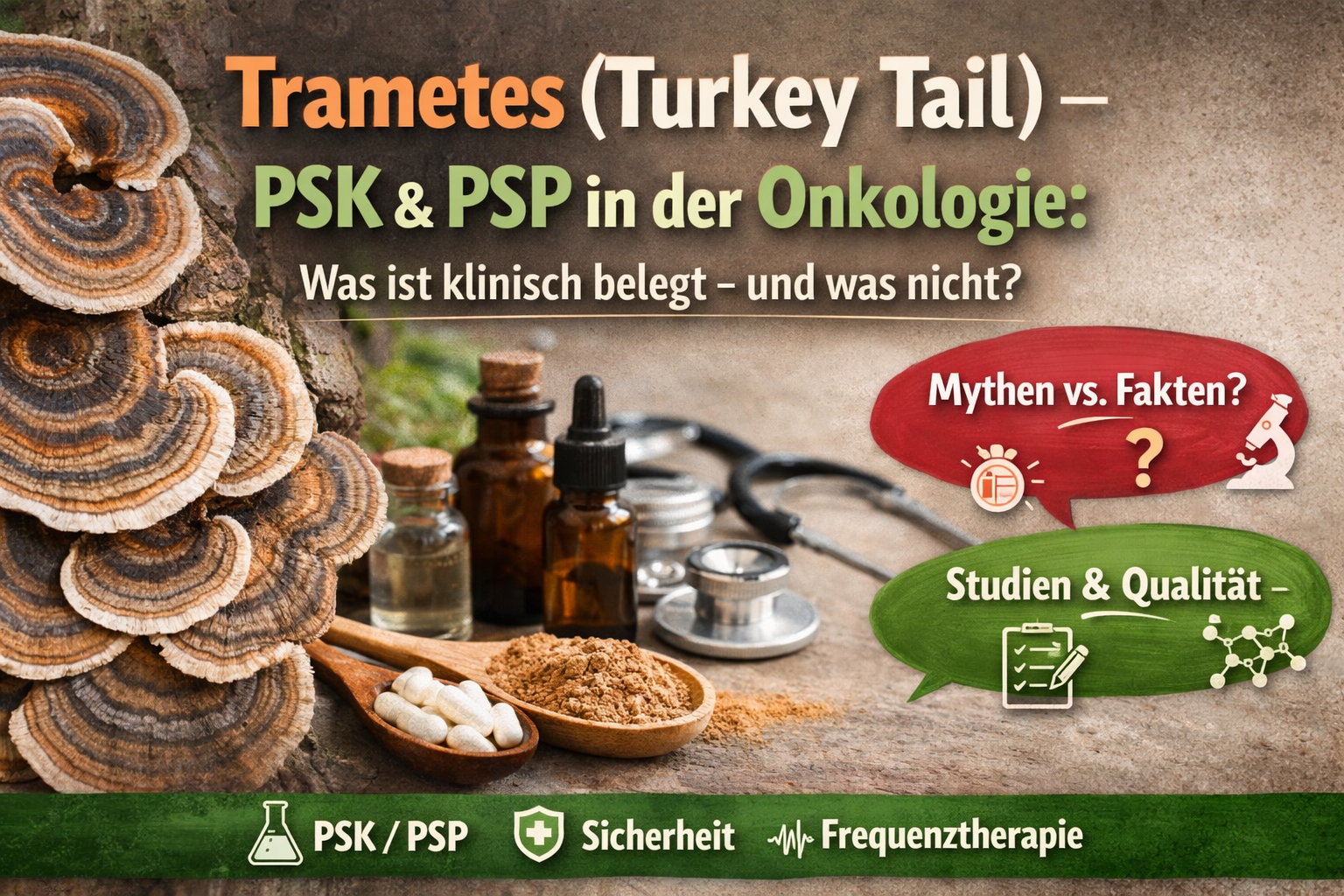
When mycotherapy talks about Trametes versicolor (formerly often Coriolus versicolor, Turkey Tail„), two abbreviations are almost always used: PSK and PSP. And this is where the confusion begins - because Mushroom powder, Hot water extract and Pharmacologically standardized extracts are not the same.
To keep your content clean, scientific and understandable at the same time, let's take a look: What do human clinical studies actually show? What are just indications? And what is marketing?
1) First the basics: What is PSK, what is PSP - and why is it so important?
PSK (Polysaccharide-K, „Krestin“)
- A standardized extract (protein-bound polysaccharides/proteoglycans) from Trametes.
- Was in Japan was developed and used as an adjuvant (accompanying) preparation in cancer therapy.
PSP (polysaccharopeptides)
- Also a Trametes extract, but other strain/manufacturing process, often from China; often associated with food supplements.
The sticking point
Many positive clinical data refer to not on „Turkey Tail as mushroom powder“, but on PSK as a standardized product. At the same time, many over-the-counter products are not standardized, which makes comparability and expectation management more difficult.
2) What is the best clinical evidence?
A) Gastric cancer - adjuvant after surgery + standard therapy
This is where the most robust human evidence lies: there are randomized studies in which PSK additional to standard therapy after curative surgery.
An often quoted classic: In a Japanese randomized study (1990s), the PSK group showed advantages in disease-free survival and Overall survival compared to standard therapy alone.
Important classification:
- Some of the evidence comes from older treatment regimens and Asian care contexts. This does not make the results worthless - but the Transferability to today's protocols (and to Europe) is not always guaranteed 1:1.
B) Colorectal cancer - adjuvant after curative surgery
In colon/rectal cancer, there is also clinical data, including meta-analyses of centrally randomized studies, that show PSK as a adjuvant immunochemotherapy add-on rate.
3) What is „indicative“ but not so solid?
Esophageal cancer (oesophagus)
MSKCC summarizes that PSK possibly has also shown benefits here - but the overall situation is less broad than for gastrointestinal diseases.
Non-small cell lung cancer (NSCLC) - more likely PSP
There is evidence for PSP in combination with chemotherapy in advanced NSCLC, which is described as „benefits suggested“ - but this is thinner and more heterogeneous overall.
4) What is not clinically proven (or overstated)?
A clear fact check is worthwhile here - because these are precisely the points that often crop up in advertising and social media:
❌ „Trametes/PSK/PSP cures cancer“ (as monotherapy)
There are none reliable clinical evidence. The data situation mainly relates to adjuvant Use (in addition to standard therapy), not as a substitute.
❌ „Works equally for all types of cancer“
The clinical data are mixed (e.g. for breast cancer, liver cancer or leukemia). MSKCC explicitly describes this evidence as inconsistent.
❌ „Every Turkey Tail product is the same“
No. OTC products are often not standardized - therefore potency, composition and comparability are unclear. PSK ≠ PSP ≠ mushroom powder.
5) What do reputable clinical sources say about the classification?
- MSKCC (Integrative Medicine): PSK as an adjuvant is particularly useful for Stomach and colorectal cancer; OTC products are often not standardized; PSK/PSP not automatically comparable.
- NCI PDQ (National Cancer Institute): lists human studies, describes immunological mechanisms and gives examples of studies in which PSC was investigated in adjuvant settings.
- ASCO Post: classifies Coriolus as generally well tolerated and points to survival benefits in GI malignancies in combination with chemotherapy in Japanese studies.
6) Practice checklist for „honest“ recommendations (without promises of salvation)
If you want to present Trametes/PSK/PSP seriously in an oncological context, three filter questions will help:
- Which product is meant?
PSK (standardized, clinical data) vs. PSP (more heterogeneous) vs. mushroom powder (often unclear content). - What is a realistic target?
The better data is not about „tumor away“, but about adjuvant effects (e.g. survival/recurrence risk in certain indications). - Is the application embedded in an overall oncological concept?
Serious is: supplementary, in consultation with the treatment team - not as an alternative.
7) Briefly on tolerability (realistic, without „harmless“ marketing)
MSKCC lists the following possible side effects, among others. dark chair and Darkening of the fingernails; In addition, consultation is advised during pregnancy/breastfeeding and it is pointed out that Coriolus extracts are not approved as a cancer therapy in the USA.
8) Integrative view: Where does frequency therapy fit neatly into communication?
If you work integratively, you can use Trametes/PSK/PSP as a biologically oriented building block (immunomodulation/adjuvant) - and frequency therapy as a accompanying approach to support well-being, regulatory processes and therapy support. A clear boundary is important: Do not replace, but complement.
Take-home message (for readers who only have 20 seconds)
- Best occupied: PSK as adjuvant Supplement especially for Stomach cancer and colorectal cancer (much evidence from Japan).
- Hints, but weaker: esophagus (PSK) and NSCLC (PSP).
- Not used: „Cure“ as monotherapy, „works for all types of cancer“, „every product the same“.
Medical advice
This article is for information purposes only and does not replace medical advice. In the case of cancer diagnoses and ongoing therapies, please coordinate any supplementation (including medicinal mushrooms) with the oncology team treating you.
Myths vs. facts: Trametes (Turkey Tail) - PSK/PSP in oncology
Myth 1: „Turkey Tail (Trametes) equals PSK/PSP.“
Fact: PSK and PSP are specific extracts (standardized/defined depending on the manufacturing process). Mushroom powder, tea or „Turkey Tail capsules“ are not automatically comparable - active ingredient content and quality can vary greatly.
Myth 2: „PSK/PSP cures cancer - even without chemo/surgery.“
Fact: The clinical data mainly relate to adjuvant application (in addition to standard therapy). For a Monotherapy („alone it cures cancer“) there are no reliable clinical evidence.
Myth 3: „PSK/PSP works equally well for all types of cancer.“
Fact: The evidence is depending on indication. Data on Stomach cancer and colorectal cancer (PSK as an add-on). For other tumor types, results are sometimes mixed or too weak for clear conclusions.
Myth 4: „If it's ‚immune-boosting‘, it always makes sense.“
Fact: „Immunomodulation“ is not automatically good - it must fit the situation (e.g. under immunotherapy, autoimmunity or immunosuppression). Therefore: Always consult with the oncology team.
Myth 5: „More is better.“
Fact: Higher dosages are not automatically more effective. The decisive factors are Product quality, standardization, indication, timing and tolerance - not „maximum quantity“.
Myth 6: „There are no side effects - it's just a mushroom.“
Fact: Trametes extracts are often considered to be well tolerated, but side effects are possible (e.g. GI complaints; reports of dark stools/nail discoloration). Pregnancy/lactation: rather avoid due to lack of data.
Myth 7: „If it is used in Japan, it is automatically a modern standard here.“
Fact: PSK has been widely used as an adjuvant in Japan; however, many studies are older and in other therapeutic contexts. This makes the data interesting - but not transferable 1:1 to every current guideline situation.
Mini conclusion
PSK has the strongest clinical basis than Accompaniment standard therapy, especially for Stomach and bowel cancer. PSP and over-the-counter „Turkey Tail“ products are not automatically equivalent - here the evidence is often weaker or difficult to compare.