





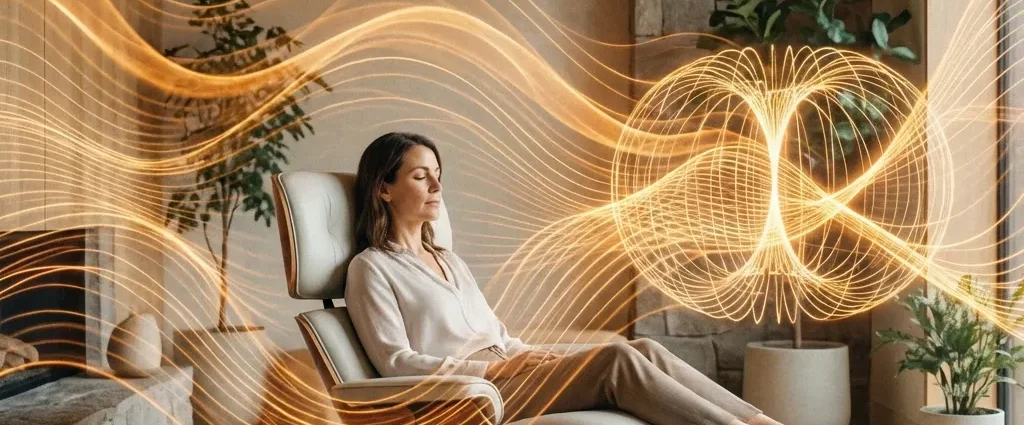
Many people come across the subject of frequency therapy sooner or later. Some out of curiosity. Others because traditional medicine no longer helps enough. Chronically ill people, people with autoimmune diseases or long-term pain in particular are looking for new approaches. This is where the question often arises: What can frequency therapy really achieve and what are the limits of frequency therapy?
Between enthusiastic testimonials and harsh criticism, it is difficult to keep track. Some speak of profound regeneration. Others warn of empty promises. As is so often the case, the truth lies somewhere in between. Frequency therapy is not a standardized procedure. It ranges from medically recognized methods to purely complementary approaches without reliable studies.
This article brings order to the topic. You will find out which forms of frequency therapy have been scientifically proven. Where real effects can be expected. And where there are clear limits. We look at studies, practical examples and typical fields of application. At the same time, we will talk openly about risks, misconceptions and unrealistic expectations. The aim is a sober, comprehensible classification, without polemics, but also without whitewashing.
If you want to learn, apply or critically evaluate frequency therapy, you will find a sound basis here. Regardless of whether you are a therapist, alternative practitioner, sufferer or already have experience. In the end, you will know better when frequency therapy can be useful and when other methods are more important.
What is really meant by frequency therapy
The term frequency therapy is often used very vaguely. This is one of the main reasons for confusion. It refers to procedures in which electrical, magnetic or acoustic vibrations are used in a targeted manner to influence biological processes.
It is important to note that frequency therapy is not a single concept, but a collective term. It encompasses methods with completely different objectives, technical implementation and evidence. While medical methods use clearly defined parameters, other approaches work more exploratively or symbolically.
There are clearly defined procedures in medicine. These include TENS, PEMF or high-frequency spinal cord stimulation. These methods work with precisely defined frequencies, intensities and indications. They have been investigated in studies and are partly in line with guidelines. The application is standardized, often under medical supervision.
There is also a wide range of complementary methods. Bioresonance, Rife systems or some plasma devices fall into this category. There is often a lack of controlled studies or reproducible measurements. Effects are usually described subjectively, for example as relaxation or a short-term change in symptoms.
This distinction is crucial for users. This is because the effect of frequency therapy depends heavily on which procedure is meant. General statements are not useful and often lead to false expectations.
An overview of the current status will help you to better understand the situation:
| Range | Examples | Evidence |
|---|---|---|
| Medical | TENS, PEMF, HF-SCS | Well documented |
| Complementary | Bioresonance, Rife | Weak or missing |
| Wellness | Sound, binaural beats | Partly moderate |
These differences are not a value judgment. They only show where there is reliable knowledge and where there is not. It is precisely this clarity that is a prerequisite for a responsible approach.
Scientific data on the effect of frequency therapy
When frequency therapy is discussed scientifically, researchers usually refer to clearly defined applications. High-frequency spinal cord stimulation for chronic pain has been particularly well studied.
In a randomized study with almost 200 patients, more than 84 % of those treated showed a significant reduction in back and leg pain after three months. Even after two years, the effect remained in over 76 % stable. These figures are remarkable for pain therapy and are significantly higher than placebo effects.
Data also exist for PEMF applications. Meta-analyses show moderate effects on bone healing, blood circulation and postoperative pain. The effect sizes are not spectacular, but consistent.
Such results show that frequencies can indeed be effective. But only under clear conditions. Frequency, dose, target tissue and indication must fit exactly. This is where medicine clearly differs from free application without a protocol.
Such data is lacking for many popular devices from the wellness or self-application sector. This does not automatically mean that they are ineffective. But it does mean that claims about healing or therapy must be viewed critically.
No evidence for the effectiveness of Healy. None of these studies have investigated whether the Healy device can alleviate the health problems mentioned.
This assessment is not directed against frequency therapy per se. It calls for differentiation. It is precisely this differentiation that is crucial for serious work and honest communication.
How frequencies can have a biological effect
To understand the possibilities, it is worth taking a look at the mechanisms. Cells communicate electrically. Nerves work with impulses. Muscle tension is created by electrical stimuli. Frequencies are therefore not a foreign body in the organism.
At the cellular level, electric fields influence ion channels, membrane potentials and signaling pathways. Studies show that certain frequency ranges can modulate cell growth, inflammatory reactions or neuronal excitability.
Medical frequency procedures make targeted use of these properties. TENS influences pain conduction via gate control mechanisms. PEMF can modulate cell metabolism and blood circulation. Neuromodulation intervenes directly in neuronal networks.
Many complementary approaches also refer to these principles. The difference lies in the precision. The more vaguely frequencies are defined, the more difficult it is to achieve a measurable effect.
This is where misunderstandings often arise. Not every vibration reaches every cell. Not every frequency is suitable for every organ. And not every subjective improvement is a direct biological effect.
If you would like to delve deeper, you will find a detailed explanation of the Frequency therapy effect in the body with concrete examples from practice.
Clearly state the limits of frequency therapy
As important as it is to see opportunities, it is just as important to be honest about the limitations of frequency therapy. There are clear areas in which there is no proven effect.
These include autoimmune diseases, cancer, genetic defects or acute infections. Here, frequency therapy can at most be used as an adjunct. It does not replace medical treatment and must not delay it.
Another problem area is exaggerated promises of healing. Statements such as „frequencies cure every illness“ are scientifically untenable and damage the credibility of the entire field.
It also becomes problematic when frequency systems are sold as a diagnostic tool. Bioresonance measurements do not provide any medically usable data. This is well documented.
The level of evidence varies depending on the procedure, but is clearly growing overall.
This sentence sums it up. Growth needs clear standards. Without these, promises remain empty.
Frequency therapy in the practice for pain
One area in which frequency therapy is used particularly frequently is chronic pain. This includes back pain, nerve pain and joint pain.
In practice, the clearer the diagnosis, the better the results. Frequency therapy often has a regulating effect here. It can dampen pain signals, reduce muscle tone and promote regeneration.
Patients with neuropathic pain in particular report noticeable relief. However, the effect varies from person to person and depends on the duration, intensity and combination with other measures.
The combination with exercise, physiotherapy and mental work is particularly useful. When used alone, the effect is often limited.
You can find a more detailed description in the article on Frequency therapy for chronic pain.
Autoimmune diseases and realistic expectations
Many sufferers hope for frequency therapy for autoimmune diseases. The reality is complex. There is no evidence of a causal cure. But there is evidence of symptomatic relief.
Stress reduction, better sleep quality and subjective stabilization are frequently reported. These effects are not trivial, as stress is a known trigger for relapses.
However, it is important to note that these improvements do not change the underlying immune dysregulation. Laboratory values or disease progression usually remain unchanged.
A responsible approach here means seeing frequency therapy as a complementary component. Not as a substitute. You can find out more about this in the article on Autoimmune diseases and frequency therapy.
Device selection and quality criteria
If you want to buy a frequency therapy device, you should check it critically. Important questions are: Is there clear technical data? Are frequencies defined? Are there studies or at least comprehensible protocols?
Safety aspects also play a role. Medical certifications, CE marking and transparent manufacturer information are minimum standards.
Devices with vague terms such as quantum field or information medicine rarely deliver verifiable results. Systems with a clear physical basis are better.
A practical guide helps to avoid typical mistakes and develop realistic expectations.
Frequently asked questions from practice
Many beginners ask how often frequency therapy should be used. The answer is: it depends. Medical procedures have fixed protocols. Complementary applications require observation and adaptation.
The question of side effects also arises. If used correctly, these are rare. However, slight tiredness, initial aggravation or vegetative reactions are possible.
The key is to listen to your own body and not to increase your applications uncritically.
Learning frequency therapy with structure
Anyone who wants to learn frequency therapy benefits from a systematic approach. The basics of neurophysiology, knowledge of equipment and critical thinking are crucial.
Unstructured self-experiments often lead to frustration or misjudgements. Clear learning paths with theory, practice and reflection make more sense.
A good place to start is with a structured Practical guide for frequency therapy beginners, which combines theory and application.
The essentials in a nutshell
Frequency therapy is neither a miracle cure nor nonsense. It is a tool. Used correctly, it can relieve pain, promote regeneration and regulate the nervous system.
Used incorrectly, it creates false hopes or distracts from necessary therapies. This is precisely where the responsibility of users and providers lies.
The effect of frequency therapy always depends on the procedure. Medically defined applications are well documented. Complementary approaches need critical support. The limits of frequency therapy lie where promises of healing are made without evidence.
If you want to use frequency therapy, do it informed. Ask questions. Check sources. And combine them with proven methods. In this way, frequency therapy does not become a belief system, but a useful building block in a holistic approach.

Comments are closed, but trackbacks and pingbacks are open.