





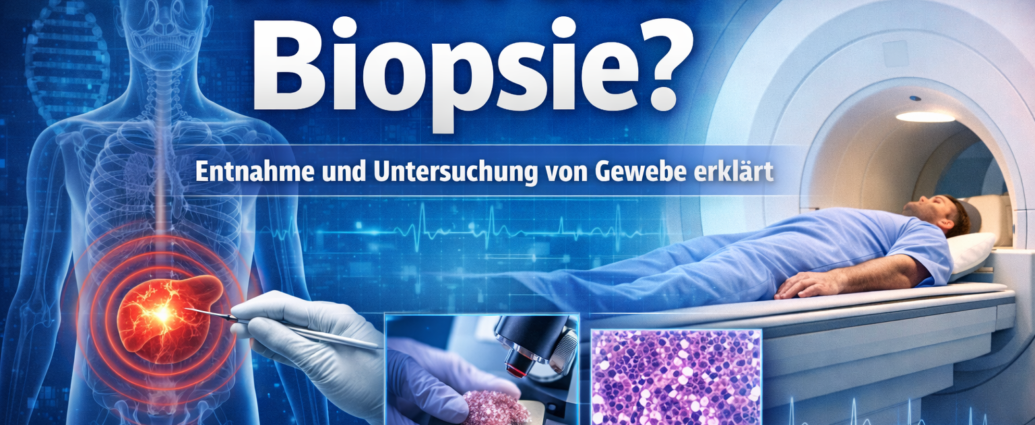
One Biopsy is a medical procedure in which a small tissue sample is taken from the body for subsequent closer examination in the laboratory. The aim is to assess conspicuous changes in the tissue as precisely as possible. A biopsy is primarily used when imaging procedures such as ultrasound are not possible, CT, MRI or X-ray may show a change, but it is not yet possible to say with certainty what type of tissue is involved.
For many people, the term sounds unsettling at first. However, a biopsy is actually an established diagnostic procedure that is used on a daily basis in many medical specialties. Especially in connection with Cancer diseases it plays a central role because it is often the only way to make an accurate diagnosis.
What does biopsy mean?
The term Biopsy comes from the Greek and means „the observation of life“. It refers to the examination of living tissue. In contrast to imaging procedures, which make structures visible, biopsies provide direct information about the composition of cells and tissue.
This is so important because many changes in the body can look similar from the outside, but are clearly different under the microscope. It is often only through histological examination that it can be determined whether it is an inflammation, a benign change or a malignant disease, for example.
Why is a biopsy taken?
A biopsy is carried out when doctors need precise clarification. It helps to better classify unclear findings and plan further treatment.
Common reasons for a biopsy are
- Unclear lumps or tissue changes
- abnormal findings in the breast, prostate, skin, liver or lymph nodes
- Suspicion of tumors or Metastases
- Chronic inflammation
- Changes to mucous membranes
- unclear organ enlargement
- Control of already known diseases
Especially with Cancer diseases biopsy is often crucial. Not only can it confirm whether cancer cells are present, but in many cases it can also provide information on the exact type of tumor, its biological behavior and possible therapeutic approaches.
How does a biopsy work?
The exact procedure depends on the area of the body from which the tissue sample is taken. In many cases, the biopsy is performed on an outpatient basis and under local anesthesia. Some biopsies are guided by ultrasound, CT or MRI so that the sample can be taken as specifically as possible from the abnormal area.
A biopsy typically involves several steps:
1. preparation
Before the examination, we will discuss what medication is being taken, whether blood thinners are being used and whether there are any particular risks.
2. taking the tissue sample
A small sample is taken from the suspicious tissue using a fine needle, a special punch or a small procedure.
3. examination in the laboratory
The removed material is examined microscopically by pathologists. The cell structure, tissue pattern and possible pathological changes are assessed.
4. discussion of findings
As soon as the results are available, we will discuss what the findings mean and what further steps are appropriate.
What types of biopsies are there?
There are various forms of biopsy. Which method is chosen depends on the body region and the question being asked.
Fine needle biopsy
Cell material or fluid is removed using a very thin needle. This method is comparatively gentle and is often used for the thyroid gland, breast or lymph nodes.
Punch biopsy
In a punch biopsy, a small cylinder of tissue is removed using a slightly stronger hollow needle. This provides more tissue structure for examination. This method is often used for the breast, prostate or liver.
Excisional biopsy
A small conspicuous area is completely removed. This method is used for skin changes, for example.
Incisional biopsy
Only part of a larger conspicuous structure is removed for histological examination.
Endoscopic biopsy
Tissue samples can also be taken as part of an endoscopy, for example from the stomach, intestines, bronchi or bladder.
Does a biopsy hurt?
Many people are afraid of a biopsy, mainly because of the possible pain. In most cases, however, the examination is well tolerated. A local anesthetic is often used so that the actual removal is only slightly painful or not painful at all. Afterwards, the area may be sensitive or slightly painful for a short time.
Depending on the type of biopsy, minor bruising, a feeling of pressure or temporary discomfort may also occur. Serious complications are rare if the procedure is carried out correctly, but as with any medical procedure, they must be taken into account.
What are the risks?
A biopsy is a routine procedure, but there are certain risks. These include, among others:
- Bleeding
- Bruising
- Infections
- Pain at the extraction site
- Rare injuries to neighboring structures
The risks involved in individual cases depend heavily on the body region being examined. Individual information is therefore always provided before the examination.
What do the biopsy findings say?
The biopsy findings are often the decisive step in making an accurate diagnosis. It can show
- whether tissue is benign or malignantly altered
- whether inflammatory processes are present
- which cell types are present
- how active or aggressive a change appears
- whether further examinations are necessary
Especially with Cancer diseases the biopsy often provides the basis for further treatment planning. Without histological confirmation, a reliable oncological classification is often not possible.
Why is biopsy so important in cancer diagnostics?
Imaging procedures such as CT, MRI or ultrasound can show that a change is present. However, they often cannot provide a definitive answer as to what type of tissue is involved. This is precisely where biopsies are particularly important.
It makes visible what is happening at a cellular level. This is particularly important in cancer diagnostics because not every mass is automatically malignant. Conversely, microscopic examination is the only way to reliably determine which type of tumor is malignant. Tumor and what the next therapeutic steps should be.
Holistic approach: diagnostics and information medicine
From the perspective of Information medicine biopsy is a classic conventional medical procedure for structural and cellular clarification. It provides specific information about the nature of the tissue and thus creates an important basis for medical decisions.
In the area of Frequency therapy and holistic support, the organism is also often analyzed from the perspective of regulation, stress, and the effects of stress, Resonance and energetic order. While the biopsy enables a direct cellular statement, complementary approaches often attempt to include functional and regulatory relationships of the entire organism.
Especially with serious diagnoses such as Cancer many people are not only looking for a precise conventional medical classification, but also for complementary ways to support the body in its overall regulation. It is important to make a clear distinction between the two levels: Biopsy is a recognized medical diagnostic procedure, while holistic methods are considered complementary.
Conclusion
A biopsy is the removal of a small tissue sample in order to examine pathological changes more closely. It is one of the most important diagnostic procedures when unclear findings need to be clarified. It is often indispensable in cancer diagnostics in particular, as it enables a reliable cellular assessment.
Anyone who understands what a biopsy is and how it works can often approach such an examination with greater peace of mind. In many cases, it is a crucial step in gaining clarity and initiating the appropriate further treatment.



Comments are closed, but trackbacks and pingbacks are open.