





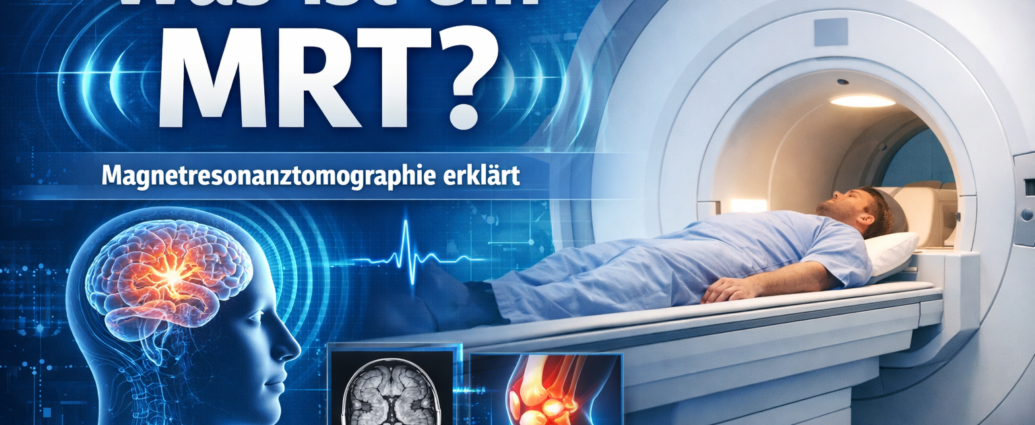
Magnetic resonance imaging, in short MRI, is one of the most important imaging techniques in modern medicine today. It makes it possible to precisely visualize the inside of the body without using X-rays. MRI plays a particularly important role in the diagnosis of disorders of the brain, spine, joints or cancer. Many people have heard the term, but do not know exactly how an MRI works, when it is used and what actually happens during the examination.
The meaning of the abbreviation MRT
MRT stands for Magnetic resonance imaging. Sometimes the term Magnetic resonance imaging is used. Both terms refer to the same procedure. It is an examination method that uses a strong magnetic field and radio waves to produce sectional images of the body. These images help doctors to assess tissue, organs and pathological changes very precisely.
In contrast to computer tomography, which uses X-rays, MRI does not require ionizing radiation. This makes the method particularly interesting for many issues where detailed tissue imaging is required.
How does an MRI work?
An MRI machine generates a strong magnetic field. The human body consists largely of water. The hydrogen atoms in the body contain tiny particles that are aligned by the magnetic field. Additional radio waves temporarily move these particles out of position. When they return to their original position, they send out signals. These signals are recorded by the device and converted into high-resolution images by a computer.
This allows even subtle differences between different types of tissue to be visualized. For example, the following can be visualized particularly well:
- Brain and nervous system
- Intervertebral discs and spine
- Muscles, tendons and ligaments
- Joints
- internal organs
- Soft tissue
- Tumor-suspicious structures and inflammatory processes
When is an MRI used?
An MRI is used when particularly precise images of the inside of the body are required. Common areas of application are
MRI of the head
In the event of headaches, dizziness, neurological abnormalities or suspected changes in the brain, an MRI can provide important information.
MRI of the spine
In cases of back pain, disc problems or suspected nerve compression, an MRI of the cervical, thoracic or lumbar spine is often performed.
MRI of the joints
Knees, shoulders, hips and ankles can be visualized in great detail. This is particularly helpful for sports injuries or chronic complaints.
MRI of the organs
The liver, abdomen, pelvic organs, heart and blood vessels can also be examined using special MRI techniques.
MRI for cancer
In connection with Cancer diseases MRI plays an important role. It can help to detect suspicious tissue changes, Tumors more precisely or to monitor the course of therapy. MRI is therefore often an indispensable part of modern oncological diagnostics.
How does an MRI examination work?
Before the examination, it is first clarified whether metallic objects or implants are present. Because strong Magnetic fields can have an effect on certain metals. Jewelry, watches, hearing aids, keys or cards must be removed before entering the examination room.
During the examination, the patient lies on a couch that is moved into the MRI machine. Depending on the question being asked, the examination usually takes between 15 and 45 minutes. During this time, it is important to lie as still as possible so that the images are not blurred.
The device makes loud knocking and humming noises during the examination. This is why you are usually given headphones or earplugs. In some cases, a contrast agent is also administered to make certain tissues or blood vessels even more visible.
Is an MRI dangerous?
For most people, MRI is considered a very safe examination procedure. As no X-rays are used, the exposure must be assessed differently than with CT or X-ray. Nevertheless, there are some points that need to be clarified in advance.
Special care should be taken with:
- Pacemakers
- certain metal implants
- Cochlear implants
- older vascular clips
- Metal splinters in the body
- some insulin pumps or neurostimulators
People with claustrophobia also sometimes find the examination unpleasant, as they are lying in a narrow tube for a certain period of time. In many cases, however, this can be helped with good preparation, reassuring support or an open MRI.
What is the difference between MRI and CT?
Many people confuse MRI and CT. Both procedures provide cross-sectional images of the body, but differ in terms of technology and area of application.
CT works with X-rays and is often available very quickly. It is particularly suitable for emergencies, bone injuries or acute bleeding.
MRI works with magnetic fields and radio waves. It provides particularly good images of soft tissue, nerves, muscles, brain and tumor tissue. However, the examination usually takes longer.
Which procedure is more suitable always depends on the medical issue.
Why is MRI so important for modern medicine?
MRI has greatly improved diagnostics in many areas. Doctors can now detect changes in the body earlier and in a more differentiated way than before. This applies to inflammatory processes, degenerative diseases, neurological abnormalities and also to the detection and monitoring of cancer.
It is precisely because the procedure does not require radiation exposure and at the same time provides very detailed information that it has become indispensable in modern medicine.
Holistic approach: diagnostics and information medicine
From the perspective of Information medicine every diagnostic imaging procedure is an instrument for visualizing structural changes in the body. An MRI primarily shows anatomical and sometimes functional changes at a very high medical level. In a holistic approach, such diagnostics can be an important basis for better understanding physical processes.
In the area of Frequency therapy and energetic support, the aim is often to look at people not only at the structural level, but also at the level of regulation, vibration and information processing. While MRI provides classic conventional medical images, frequency therapy deals with complementary thought models relating to Resonance, regulatory capacity and energetic connections. Many people are interested in an expanded view of the organism, particularly in the case of protracted stress or accompanying serious illnesses such as cancer.
It is important to make a clear distinction between conventional medical diagnostics and complementary approaches. MRI remains an established medical procedure for diagnostics. Complementary methods from information medicine are also used by many people to provide more comprehensive support for their own health journey.
Conclusion
An MRI is a modern imaging procedure that can be used to create high-resolution images of the inside of the body. It works without X-rays and is particularly suitable for imaging soft tissue, nerves, organs and suspicious tissue changes. Whether for back pain, neurological symptoms, joint problems or in connection with cancer - MRI has become an indispensable part of diagnostics.
If you have a better understanding of what an MRI is and how it works, you can often look forward to an examination in a much more relaxed way. At the same time, it becomes clear how important a precise diagnosis is as a basis for any further medical or supplementary support.


Comments are closed, but trackbacks and pingbacks are open.