





Conventional medical principles and complementary frequency information
Author: NLS Information medicine Ltd, Herbert Eder
Introduction
Lung cancer is one of the most important oncological diseases worldwide. The literature describes lung tumors as either arising directly from the lung tissue and bronchi or as Metastases of other primary tumors reach the lungs. Precisely because the lungs play a central role in the breathing, oxygen supply and resilience of the organism, malignant changes in this area often have far-reaching consequences.
In the case of lung cancer, conventional medicine focuses primarily on the exact type of tumor, its location, spread, metastasis and the patient's general condition. At the same time, many people in the field of information medicine are also interested in complementary considerations, in which resonance patterns and frequency ranges are also classified.
In the following, the focus is initially on the conventional medical basics of lung cancer. Only at the end follows the Frequency info with the complementary frequency ranges mentioned in the literature.
What is lung cancer?
Lung cancer includes various malignant tumors that arise in the lungs or bronchial system. The literature emphasizes that more than 90 percent of primary lung tumours originate in the bronchi. There are also tumors that arise from the alveoli or metastasize from other organs to the lungs.
The most important primary tumor forms of the lung include
- Squamous cell carcinoma of the lung
- Adenocarcinoma the lungs
- bronchoalveolar carcinoma
- large cell carcinoma
- small cell lung carcinoma
- bronchial adenomas
- Sarcomas of the lung
Lymphomas can also affect the lungs, although they originate in the lymphatic system.
Metastases in the lungs
Not everyone Tumor in the lung is a primary lung tumor. The literature describes that many cancers of other organs can spread to the lungs. Frequent primary sites of such metastases are:
- Chest
- Colon
- Prostate
- Kidney
- Thyroid gland
- Stomach
- Cervix
- Rectum
- Testicles
- Bones
- Skin
The distinction between primary lung cancer and lung metastases is of central importance for diagnosis, prognosis and treatment.
Important risk factors for lung cancer
Various factors associated with the occurrence of lung cancer are mentioned in the literature. These are particularly emphasized:
- Smoking
- Contact with substances containing uranium
- Silicosis
- genetic predisposition
Smoking plays a particularly important role in several types of lung tumors. The literature also describes additional biological stresses that are discussed in a complementary context. These are taken up in the later section of the frequency information.
Typical symptoms of lung cancer
The symptoms depend greatly on the type, location and extent of the tumor. The most important symptoms include
- Chronic cough
- Worsening of an existing cough
- bloody sputum
- Shortness of breath
- Whistling breathing
- Chest pain
- Weakness
- Loss of appetite
- Weight loss
With increasing tumor size or unfavorable location, further symptoms may occur. These include
- Collapse of parts of the lung due to bronchus obstruction
- Pleural pain
- Pleural effusions
- Hypoxia
- Cardiac stress up to and including heart failure
If the tumor grows into certain nerves or neighboring structures, additional signs may develop.
Neurological and local accompanying signs
Several concomitant syndromes are described in the literature, which can result from growth into neighboring structures.
Horner syndrome
If a tumor affects nerves in the neck area, the following signs may occur:
- Drooping upper eyelid
- Narrow pupil
- sunken eyeball
- Reduced sweating on one side of the face
Involvement of arm nerves
Tumors in the upper lung area can affect nerves to the arm, causing
- Pain
- Weakness
- Numbness
Involvement of the vocal apparatus
Hoarseness can occur if the supplying nerves are damaged.
Involvement of the esophagus or heart
A tumor can also cause the following problems through direct growth or pressure:
- Difficulty swallowing
- Cardiac arrhythmia
- Heart enlargement
- Pericarditis
Superior vena cava syndrome
If the tumor compresses or constricts the superior vena cava, this can result in
- Shortness of breath
- Headache
- Visual disturbances
- Dizziness
- Drowsiness
Paraneoplastic syndromes in lung cancer
Lung carcinomas in particular can cause so-called paraneoplastic syndromes. Symptoms are not caused directly by the location of the tumor, but by hormone-like or immunological effects of the tumor on the organism.
These include, among others:
- metabolic changes
- neurological syndromes
- Muscle and nerve diseases
- endocrine abnormalities
This concomitant problem is particularly important in small cell lung cancer.
Squamous cell carcinoma of the lung
According to the literature, squamous cell carcinoma accounts for around 30 to 40 percent of bronchogenic carcinomas. It is strongly associated with smoking and is usually centrally located. Among bronchogenic carcinomas, it is particularly prone to cavity formation.
Typical features are
- intraluminal growth
- Rather local spread
- Frequent spread to regional lymph nodes
- Rare early distant metastasis
The literature also describes a connection with hypertrophic osteoarthropathy and hypercalcemia.
Adenocarcinoma of the lung
Adenocarcinoma of the lung also accounts for around 30 to 40 percent of cases and has overtaken squamous cell carcinoma in terms of frequency in many statistics. It is peripheral in around half of cases and is also associated with smoking.
Important features are:
- peripheral location
- Possible development from scar tissue
- Rare cavern formation
- early metastasis
The literature describes that metastases can spread early to the following areas:
- Lymph nodes
- Pleura
- Adrenal glands
- Central nervous system
- Bones
Bronchoalveolar carcinoma
Bronchoalveolar carcinoma is described as a subtype of adenocarcinoma and accounts for around 5 percent of bronchogenic carcinomas. A clear link with smoking is less clear, but many patients have a history of smoking.
The literature mentions the following favorable backgrounds:
- interstitial lung diseases
- parenchymal scarring
- exogenous lipoid pneumonia
There are two main forms:
Mucinous form
- more often
- often multicenter
- occasionally with bronchorrhea
- Less favorable prognosis
Non-mucinous form
- rather localized
- Better prognosis
Bronchoalveolar carcinoma can occur in various forms:
- solitary pulmonary round focus
- multiple nodes
- Consolidated form
Large cell lung carcinoma
Large cell carcinoma accounts for around 5 to 10 percent of bronchogenic carcinomas and is strongly associated with cigarette smoking. It is usually peripheral, grows rapidly and metastasizes early.
A sub-form is the Giant cell carcinoma, which is particularly aggressive and has an unfavorable prognosis.
Small cell lung cancer
Small cell lung carcinoma is one of the most aggressive lung tumors. It is closely associated with smoking and is characterized by early spread, high biological activity and frequent paraneoplastic syndromes.
Typical targets of early metastases are:
- mediastinal lymph nodes
- Liver
- Bones
- Adrenal glands
- Brain
In addition, small cell lung carcinoma can release various hormone-active or hormone-like substances. These are mentioned in the literature:
- SIADH
- ectopic ACTH syndrome
- Cushing's syndrome
- Hyperparathyroidism
- Carcinoid syndrome
- Gynecomastia
- Hyperpigmentation
- Hypoglycemia
- Hypocalcemia
Neurological concomitant syndromes are also described, including
- Lambert-Eaton syndrome
- Polymyositis
- peripheral neuropathies
- cerebellar degeneration
- Encephalomyelitis
- limbic encephalitis
The prognosis is generally unfavorable, and small cell lung carcinoma usually requires systemic treatment.
Bronchial adenomas and lung sarcomas
Bronchial adenomas and sarcomas of the lung are also described in the literature. These are rarer, but are important within the differentiated view.
Bronchial adenomas
They can be benign or malignant and occur less frequently than classic bronchogenic carcinomas.
Lung sarcomas
These tumors do not arise from the typical bronchial epithelium but from mesenchymal structures and represent a rare but important differential diagnosis.
Diagnostics for lung cancer
The conventional medical diagnosis is based on symptoms, imaging and histological confirmation. The literature mentions in particular
The exact classification of the tumor is a prerequisite for therapy planning and prognosis assessment.
Conventional medical treatment of lung cancer
The therapy depends on the type of tumor, stage, location and general condition of the patient. The following are mentioned in the literature:
- Operation
- Radiotherapy
- Chemotherapy
- Combination therapies
- Symptomatic treatment
- Palliative treatment
Chemotherapy plays a particularly important role in small cell lung cancer. For other types of tumor, surgery may be more important if the tumor is resectable.
Why lung cancer is particularly interesting for frequency therapy
For the Frequency therapy lung cancer is particularly interesting because the lung is a highly dynamic organ with intensive blood circulation, mucosal contact, air exchange and close links to the immune system and metabolism. Different tumor forms also show very different biological patterns. Within information medicine, these differences are also considered from the perspective of complementary resonance areas.
The variety of tumor forms - from squamous cell carcinoma to adenocarcinoma to small cell carcinoma - makes the frequency information in the lung area particularly differentiated.
Frequency info - complementary resonance frequencies for lung cancer
The following are those mentioned in the literature complementary resonant frequencies of the various lung tumors.
Squamous cell carcinoma of the lung
321-324, 370-376, 402-410, 420-426, 428-437, 442-451, 494, 544-546 kHz
Adenocarcinoma of the lung
316-319, 321-324, 370-374, 376-387, 393-394, 408-410, 426-438, 442-451 kHz
Bronchoalveolar carcinoma
299, 316-319, 321-324, 337-344, 370-384, 408-410, 426-438, 442-451, 530-536 kHz
Large cell lung carcinoma
321-324, 370-374, 427-438, 442-451, 536 kHz
Small cell lung cancer
294-297, 321-324, 397, 402-410, 427-438, 434-436, 440-451, 470-473, 476-479, 488-496, 513-519, 533-548, 556-558, 589-591 kHz
Bronchial adenomas
321-324, 434-451, 513-534 kHz
Lung sarcomas
404-408, 440-452, 446-447, 470-473, 499-496, 513-534 kHz
Frequency info compact
Squamous cell carcinoma: 321-324, 370-376, 402-410, 420-426, 428-437, 442-451, 494, 544-546 kHz
Adenocarcinoma: 316-319, 321-324, 370-374, 376-387, 393-394, 408-410, 426-438, 442-451 kHz
Bronchoalveolar carcinoma: 299, 316-319, 321-324, 337-344, 370-384, 408-410, 426-438, 442-451, 530-536 kHz
Large cell carcinoma: 321-324, 370-374, 427-438, 442-451, 536 kHz
Small cell lung carcinoma: 294-297, 321-324, 397, 402-410, 427-438, 434-436, 440-451, 470-473, 476-479, 488-496, 513-519, 533-548, 556-558, 589-591 kHz
Bronchial adenomas: 321-324, 434-451, 513-534 kHz
Lung sarcomas: 404-408, 440-452, 446-447, 470-473, 499-496, 513-534 kHz
Complementary classification of the resonance ranges
Within frequency therapy, there are several conspicuous resonance chambers in lung cancer:
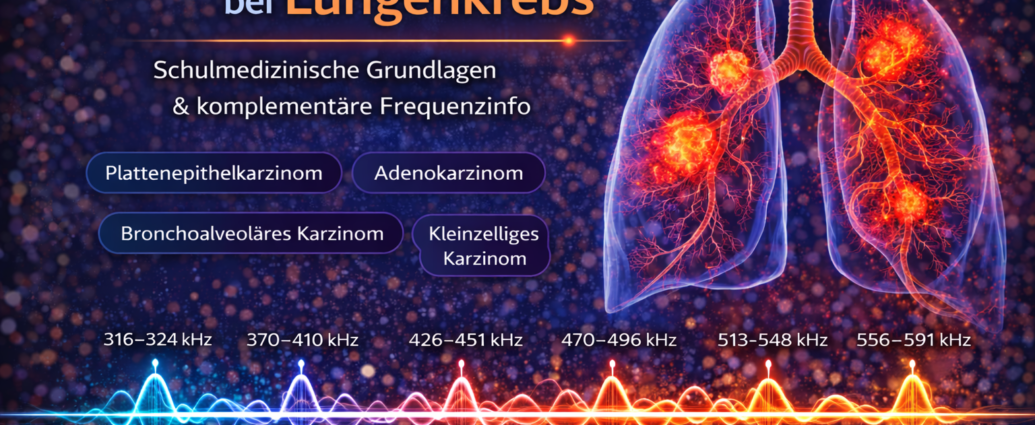
- 316 to 324 kHz
- 370 to 410 kHz
- 426 to 451 kHz
- 470 to 496 kHz
- 513 to 548 kHz
- 556 to 591 kHz
The area between 426 and 451 kHz appears as a central resonance field in several tumor forms. Equally striking are the higher areas between 513 and 548 kHz, which recur particularly in small cell lung carcinoma, bronchial adenomas and sarcomas.
It is precisely these superimpositions that make the lungs a particularly interesting resonance chamber within frequency therapy from a complementary point of view.
Conclusion
Lung cancer comprises a broad group of malignant diseases that differ significantly in their origin, growth, prognosis and treatment. Conventional medicine focuses on tumor type, spread, symptoms, diagnosis and stage-appropriate therapy.
The topic also opens up a complementary perspective for frequency therapy. The resonance frequencies of the various lung tumors described in the literature form a structured frequency information that can be viewed as complementary within information medicine. Particularly striking are the resonance clusters between 370 and 451 kHz and the higher frequency ranges 513 kHz.
The result is a detailed WordPress post that combines conventional medical basics and complementary frequency information on lung cancer in a clearly structured, SEO-friendly and directly usable way.


Comments are closed, but trackbacks and pingbacks are open.