

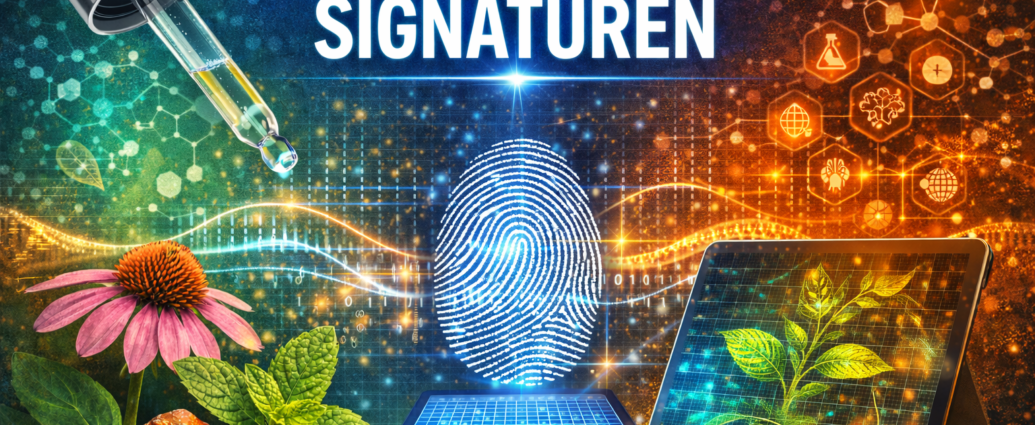
What does the digitization of signatures mean? This article explains how natural substances in the Information medicine not only materially, but also as recordable and transferable information patterns.
The combination of nature, information and technology is one of the most exciting topics in the field of Information medicine and Frequency therapy. While natural substances are described in classical science primarily in terms of their chemical properties, information medicine goes one step further: it asks whether plants, minerals, natural substances or other natural sources also have an additional effect. Characteristic signature that can be captured, described and possibly even digitize lets.
This is precisely where the issue arises Digitization of signatures. On www.herbert-eder.com this idea is placed in the wider context of frequency therapy, regulation and information-related models. The key question here is: Can a natural substance be used not only as a material, but also as a Information patterns be understood? And if so, could this pattern be stored in digital form, transferred and integrated into a complementary application concept?
This article explains what is meant by digitization of signatures, why this topic is important for Frequency droplets and other information medicine concepts is important and where the limits of a serious classification lie.
What is meant by „signature“?
The term Signature can be understood in different ways. In the context of frequency therapy and information medicine, it usually refers not simply to a symbol or a sign, but to a characteristic pattern, that is assigned to a natural substance or a biological system.
This could mean, for example
- a resonance profile
- a vibration pattern
- an energetic characteristic
- a structured order
- an information-related pattern
- a specific allocation of natural properties
When we talk about the signature of a plant or a mineral, we are not only referring to the material composition, but also to a kind of individual profile that describes this natural template in its particularity.
The difference between fabric and signature
In order to understand the digitization of signatures, the difference between Fabric and Signature be clear.
A substance is material. It consists of molecules, atoms, minerals, water, plant constituents or other chemically describable components. It can be weighed, measured and analyzed.
In contrast, a signature in the information medicine model is the Sample, that is attributed to such a substance. It is therefore not simply the substance itself, but the idea of a characteristic order or a specific information profile.
Put simply:
- The fabric is the material original.
- The signature is the pattern assigned to it.
This distinction is particularly important because digitization does not refer to the material itself, but to the assumed profile or the assigned information.
Why do we talk about digitization at all?
The term Digitization originally comes from technology. It means that something is transferred from an analog, continuous or natural form into a digital, storable, coded form. Photos are digitized, music is digitized, texts are stored digitally.
In information medicine thinking, this technical idea is transferred to natural signatures. The assumption is then:
- A natural substance has a characteristic signature.
- This signature can be written or recorded.
- It can then be converted into a digital or coded format.
- This format can be saved, transferred or integrated into an application system.
The natural template thus becomes the source of an information pattern that is to be processed separately from the material level.
Natural substances as a starting point
What is particularly important here is that the digitization of signatures usually involves natural substances is connected. These include, for example:
- Medicinal plants
- Herbs
- Blossoms
- Resins
- Minerals
- Trace elements
- Mushrooms
- Complex natural substances
In classical natural substance science, these substances are interesting because of their chemical properties. In information medicine, they are also understood as carriers of a specific order or resonance quality. It is precisely this imagined quality that should then be able to be digitally mapped.
What does „digitize“ mean in this context?
In the narrower technical sense, digitization means converting an analogue signal into numerical values. In the field of signatures, however, the term is often used more broadly. It can mean
- the detection of a pattern
- the assignment of a frequency image
- the conversion into data records
- the storage of a coded structure
- transfer to a digital information system
The term is therefore often not used in a purely technical sense, but as a model. This is important because it does not automatically mean that every such process has already been clearly validated by science. Rather, the term describes a concept within information medicine.
The basic idea behind the digitization of signatures
The basic idea can be summarized in just a few steps:
1. a natural template is selected
For example, a plant, a mineral or a natural substance.
2. a signature is assigned to this template
This signature can be understood as a resonance pattern, information profile or characteristic order.
3. the signature is described or recorded
This is done in the model via frequency images, data records, coding or other system-internal forms.
4. the captured signature is stored digitally
It is thus made available independently of the original material.
5. the digitized signature is reused
For example, in concepts such as frequency drops, digital information systems or complementary frequency applications.
This creates a transition from natural substance to digital information.
Why is this topic so relevant for frequency therapy?
The Frequency therapy deals with the idea that biological systems react not only to material influences, but also to vibrations, Resonance and patterns. This is why the question of signatures plays a central role here.
If an organism can respond to certain frequency patterns or forms of information, then it would make sense in the model to consider natural templates not only in terms of material, but also in terms of signatures. The digitization of such signatures would then be an attempt to store and apply these patterns in a way that is suitable for everyday use.
On www.herbert-eder.com this way of thinking is considered in the wider context of regulation, order and information medicine support.
Digitalization as a bridge between nature and technology
One particularly fascinating aspect is that the digitization of signatures builds a bridge between two worlds:
- the world of natural substances
- and the world of modern data technology
On the one hand, there is the plant, the mineral or the natural pattern. On the other side is digital coding, i.e. the ability to store and pass on patterns independently of the original material.
It is precisely this combination that makes the topic so interesting for many people. It combines naturopathy, frequency therapy, information medicine and a modern understanding of technology in a common model.
Examples of the basic principle
The principle can be illustrated with simple comparisons.
Music
A musical instrument produces a sound. This sound can be recorded, digitized and played back later without the original instrument being present.
Image
A landscape can be photographed and stored digitally. The stored image is not the landscape itself, but its digital representation.
Text
A book can be scanned and saved as a file. The content becomes available digitally, although the physical book is no longer necessary.
In information medicine thinking, a similar principle is applied to natural signatures. It is not the substance itself, but its characteristic pattern that should be digitally usable.
From the signature to the data record
A central element of this model is the idea that a natural template can be turned into a Data set or a coded pattern can be obtained. The plant, mineral or natural substance then serves as the source. However, the actual application no longer necessarily relates to the material, but to the information content derived from it.
This opens up new possibilities within the model:
- Storage without material instability
- Combination of several signatures
- Transfer to different application systems
- Individualization of information patterns
- Assignment to specific subject areas
It is precisely this flexibility that is one of the reasons why the topic of frequency therapy receives so much attention.
Connection with frequency drops
The Digitization of signatures is one of the most important theoretical foundations for the concept of Frequency droplets. This is because frequency drops are based on the idea that the essential quality of a natural substance does not necessarily lie in its material presence, but in the information assigned to it.
The following then happens in this model:
- A natural template is selected.
- Your signature is digitized or encoded.
- This information is transferred to a neutral carrier medium.
- The carrier medium is provided as a frequency droplet.
Without the idea of digitized signatures, this concept would be almost incomprehensible. This is why the topic occupies such a central position within information medicine.
Personalization through digital signatures
Another interesting point is the possibility of Personalization. As soon as signatures are available digitally, they can theoretically be individually combined, adapted or compiled thematically. This is often seen as an advantage in a complementary environment.
Digitized signatures could be used in the model:
- can be used individually
- be combined
- be tailored to specific topics
- be categorized in individual concepts
- Be part of frequency therapy support
Precisely because digital samples can be stored and combined more easily than material preparations, digitization appears to be a logical step here.
The role of information in biological thinking
The fascination of this topic is closely linked to an expanded understanding of biology. In information medicine, the human being is not only seen as a chemical organism, but also as a Information processing system. There are also many examples of this in classical biology:
- DNA stores coded blueprints
- Nerve cells transmit signals
- Hormones transport messages
- Receptors recognize patterns
- the brain processes information
In information medicine, these established biological facts lead to the further question of whether natural signatures could also be biologically relevant as patterns. The digitization of such signatures would then be an attempt to make this information technically available.
Opportunities from the perspective of the model
Within the information medicine model, certain opportunities are often associated with the digitization of signatures:
- Natural materials could be used without material pollution
- Information patterns could be stored and made available in a reproducible manner
- Complex natural templates could be combined digitally
- Individual adjustments could be made easier
- Frequency therapy could be made more suitable for everyday use
These opportunities are part of the concept and explain why the topic is receiving so much attention.
Scientific caution is necessary
However, it is precisely at this point that a clear classification is important. The idea that natural signatures can be digitized and subsequently used in a biologically effective way is not recognized by conventional medicine and not generally scientifically proven.
A clear distinction must therefore be made between:
- secured procedures of technical digitization
- biological information processing in the recognized sense
- complementary hypotheses for signature transfer
- theoretical models of frequency therapy
- scientifically not yet generally confirmed impact assumptions
This differentiation is crucial in order to present the topic in a serious manner.
Why the topic still fascinates
Despite all the unanswered questions, the digitization of signatures has a strong appeal. This is because it offers a modern language for an old human concern: to understand nature not only in terms of material, but also in terms of its inner order.
Many people find the idea fascinating that:
- Nature could be more than chemistry
- Patterns and order are biologically significant
- Information can be described independently of matter
- Technology could help to make natural qualities accessible again
It is precisely this mixture of nature, resonance, information and digitalization that makes the topic so special.
A sensitive field for serious illnesses
As with all topics in this area, particular caution is required in the case of serious illnesses, especially in the case of Cancer diseases. It can happen that people in difficult health situations are interested in complementary methods, including frequency therapy, frequency drops or digitized signatures.
However, it must be made quite clear: Such concepts are No scientifically recognized cancer therapy and do not replace medical diagnosis, oncological treatment or evidence-based medical measures. Especially in connection with cancer, there must be no misleading promises of a cure.
A responsible approach here always means: theory and hope must never be passed off as a proven therapy.
Reference to Herbert Eder and www.herbert-eder.com
On www.herbert-eder.com the topic is placed within a larger framework. It is not just about individual terms such as signature or digitization, but about an expanded understanding of the human being as an interplay of substance, resonance, order and information. The digitization of signatures is not an isolated technical topic, but part of an overarching model of information medicine.
This perspective plays a particularly important role in the field of frequency drops, natural substances and complementary frequency applications. The natural template is not only understood as a chemical substance, but also as a carrier of a characteristic pattern that is to be made digitally usable in the model.
Conclusion: Digitization of signatures
The Digitization of signatures in information medicine describes the attempt to understand and record natural substances not only materially, but also as characteristic information patterns and make them available in digital form. Plants, minerals and other natural substances serve as a template for a model in which the focus is not only on the material, but also on the signature attributed to it.
For the Frequency therapy this topic is particularly important because it bridges the gap between nature, information and modern technology. It also forms an essential theoretical basis for concepts such as Frequency droplets, where the focus is not on the chemical substance but on the information transmitted.
At the same time, a sober classification is essential: the underlying assumptions are not generally recognized scientifically. Anyone talking about the digitization of signatures should therefore formulate their views openly but responsibly. On www.herbert-eder.com this question is placed in the wider context of information medicine, regulation and frequency therapy.
Note
The contents described originate from the field of information medicine and complementary frequency theory. The underlying assumptions are not recognized by conventional medicine and are not generally scientifically proven. Frequency therapy does not replace a medical diagnosis or treatment, especially not for serious illnesses such as cancer.
Comments are closed, but trackbacks and pingbacks are open.