



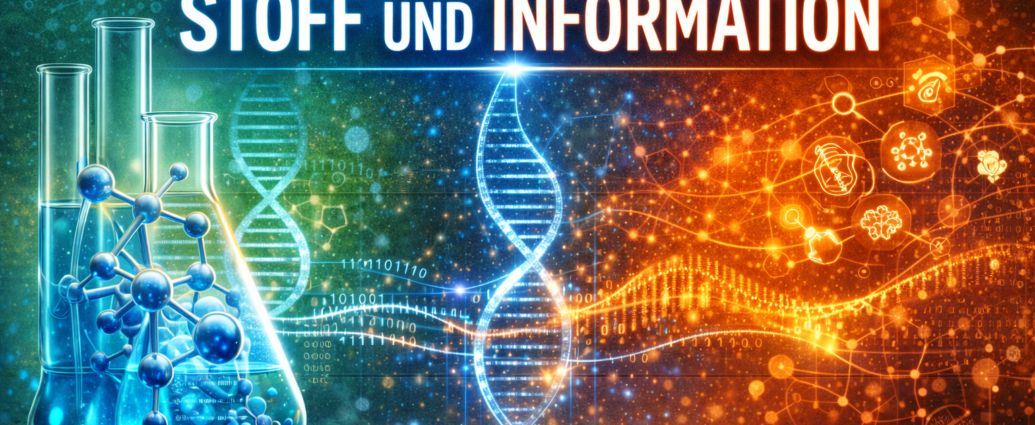
If over Frequency therapy, Information medicine or also via Frequency droplets sooner or later a fundamental question arises: What is actually the difference between substance and information? For many people, this distinction sounds abstract at first. On closer inspection, however, it is central to being able to understand modern and complementary thought models in information medicine.
On www.herbert-eder.com this difference is a recurring theme. While traditional medicine works primarily with material substances, information medicine also deals with the idea that biological systems are not only based on chemistry, but also on patterns, signals, order and Resonance could react.
This article explains the difference between substance and information in an understandable way, without blurring the boundaries between scientifically proven knowledge and complementary models.
What is a substance?
A Fabric is something material. It has mass, chemical properties, a certain structure and can be investigated using classical scientific methods. Substances consist of molecules, atoms, ions or other physically describable units. They can be weighed, analyzed, separated, measured and their composition determined.
Typical examples of substances are
- Water
- Salt
- Magnesium
- Vitamin C
- herbal extracts
- Active pharmaceutical ingredients
- Minerals
- Proteins, fats and carbohydrates
Substances play the main role in medicine and pharmacology. A drug contains an active ingredient. This active ingredient enters the body, is distributed in the tissue, binds to receptors, influences enzymes or metabolic pathways and thus triggers certain reactions.
This is the world of the material: A substance acts through its chemical or physical properties.
What is information?
Information in contrast, is not necessarily material in the classical sense, but describes a Sample, a Order, a Signal or a structured message. Information can occur on different levels:
- as language
- as numerical code
- as a signal
- as an electromagnetic pattern
- as an arrangement or structure
- as a transmitted message
- as digital coding
A simple example from everyday life makes this clear: a sheet of paper is a material. The words printed on it are information. The ink is material. The meaning of the written text is not the material itself, but the information it contains.
A USB stick is also a material object. The file stored on it is information. The electronics are material. The content of the file is a coded order.
Substance and information in everyday life
We constantly encounter this difference in everyday life without consciously thinking about it. A few examples will help to clarify the principle.
Example 1: Book and content
A book consists of paper, printing ink and a cover. That is the material. The real meaning of the book, however, lies in the information, i.e. the thoughts, sentences and meanings contained on the pages.
Example 2: Music file
A CD, a cell phone or a computer chip are material carriers. The music itself is not identical to the plastic or metal, but exists as stored information.
Example 3: DNA
This difference is also exciting in biology. DNA is physically present. At the same time, it carries information in the form of an ordered sequence. It is not just the material of the DNA that is decisive, but the arrangement of the building blocks.
Examples such as these make it clear that substance and information are connected, but not identical.
Why is this difference so important?
In classical natural science, the first question is often about the substance: What does it contain? Which molecules are present? What is the concentration? What chemical reaction is taking place?
In the Information medicine The following questions are also asked: What patterns are present? What is the underlying order? Which signals could be biologically relevant? What resonance relationships exist?
This is exactly where the bridge to frequency therapy begins. This is because frequency therapy is not only interested in matter, but also in vibration, resonance and information patterns. The difference between matter and information is therefore not a minor detail, but a central basic principle.
The classic medical view: Substance has a chemical effect
Conventional medicine works primarily with substances and their measurable effects. A medicine contains a defined substance. This binds to receptors, blocks processes, changes signaling pathways or intervenes in the metabolism.
This is a clearly describable model:
- Substance is absorbed
- Substance is distributed in the body
- Substance reacts with biological structures
- Effect is created by biochemical processes
This model is scientifically established and indispensable in many areas. It has enabled enormous progress in diagnostics, emergency medicine, surgery, pharmacology and therapy.
The information medicine view: Information as a pattern
Information medicine adds another perspective to this picture. It asks whether biological systems respond not only to substances, but also to Structured signals could react. The assumption that the organism is not only organized biochemically, but also bioenergetically and in terms of information processing, plays a role here.
In this model, for example, the following could be relevant:
- Frequency pattern
- Resonance behavior
- Ordered signals
- energetic information
- Vibration profiles of natural substances
So the key question is not just: What is chemically present?, but also: What information is contained or transmitted?
An illustrative comparison
You can put it simply like this:
- Fabric is the material.
- Information is the pattern in the material.
Or even simpler:
- The fabric is the data carrier.
- The information is the content.
A glass of water is a substance. If this water is thought of as the carrier of a transmitted pattern in an information medicine model, then a distinction is made between the material medium and the assumed information that it is supposed to carry.
Why does this topic come up with frequency drops?
Especially with Frequency droplets the distinction between substance and information is particularly important. Here, the basic model is not that a chemical agent is at the center, but that a natural substance as Information template is understood.
That means:
- The plant or natural substance is the template.
- Their chemical matter is not necessarily the main focus of the end product.
- The assigned signature or information should be decisive.
This is why frequency drops can only be understood if one accepts that we are not talking about classical pharmacology here, but about an information medicine concept.
Substance is materially limited - information is transferable
Another difference lies in the way in which material and information can be disseminated.
A substance must be physically present. If there is no magnesium in a capsule, this capsule cannot supply magnesium. Matter is bound to its real presence.
Information, on the other hand, can be copied, stored, transmitted and reproduced without the original source having to be materially transferred. A digital photo can be sent millions of times without the original photo traveling materially with it. A music file can be copied without the original instrument being sent along.
It is precisely this principle that fascinates many people in the field of information medicine: the idea that even natural substances can be thought of not only in material terms, but also in terms of information.
What does this mean for natural substances?
In classical naturopathic methods, a plant is usually used as a substance:
- as tea
- as extract
- as tincture
- as powder
- as essential oil
- as a standardized active ingredient complex
So what counts here is the material composition. In information medicine, the question is also asked as to whether a plant also has a characteristic Vibration signature or a Information profile which is relevant regardless of the amount of material.
This is a theoretical and complementary expansion of the perspective.
Substance, information and frequency therapy
In the Frequency therapy this distinction is almost unavoidable. This is because it deals with the idea that biological systems can react to signals, vibrations and resonance patterns. Frequency therapy therefore often asks more than just:
- What material is available?
- What chemical dose works?
But also:
- What is the frequency?
- What is the resonance relationship?
- What information is transmitted?
On www.herbert-eder.com this perspective is used to describe health not just as a chemical process, but as an interplay of matter, energy, order and information.
The human being as a biochemical and information-processing system
An exciting idea of information medicine is that the human being is not only made up of organs, cells and molecules, but is also a highly complex system. Information system is. This is already evident in established areas of biology:
- Nerve signals transmit information
- Hormones convey messages
- Receptors recognize patterns
- the brain processes signals
- DNA contains coded blueprints
These examples alone show that life is not just matter. Life is also always organization, control, communication and information processing.
Information medicine goes one step further and asks whether finer, non-classical information patterns could also play a role. However, this is precisely where the area of hypotheses and complementary models begins.
Where are the limits?
A clear classification is particularly important here. It is undisputed that biological systems process information. The nervous system, endocrine system and genetics provide countless examples of this. However, this means that not automatically, that any claimed energetic or digital information is also biologically effective.
A clear distinction must therefore be made between information medicine, resonance models and frequency therapy:
- sound scientific knowledge
- plausible theoretical models
- complementary hypotheses
- personal experiences
- assumptions that have not yet been scientifically confirmed
This differentiation is crucial in order to remain reputable.
Why is the topic still so interesting for many people?
Because the distinction between substance and information opens up a new perspective on health. Many people experience traditional medicine as strongly substance- and symptom-oriented. Information medicine, on the other hand, attempts to broaden the view of regulation, patterns, resonance and inner order.
This particularly appeals to people who:
- Think holistically
- are interested in frequency therapy
- want to look beyond biochemical models
- are open to complementary approaches
- Understanding the human being as a multidimensional system
This is precisely why the difference between substance and information is not a purely theoretical issue for many, but a new basis for thought.
What role does this play in cancer?
Also with Cancer diseases some people are interested in the question of whether regulation, environment, information patterns and systemic order could also play a role alongside biochemical processes. Such considerations arise again and again in the complementary environment.
However, extreme care is required. The fact that one thinks about information, resonance or frequency models means not, that this represents a scientifically recognized cancer therapy. Medical diagnostics, oncological care and evidence-based treatment methods must be at the forefront, especially in the case of cancer.
Complementary considerations should never be presented here as a substitute for necessary medical measures. At best, they can be regarded as complementary models of thought, not as a reliable alternative.
Substance and information as two levels of the same reality
A balanced view does not have to play off material against information. Rather, one can say that both levels belong together, but they are not the same thing.
- Without fabric, there is often no carrier.
- Without information, there is no order.
- No biological substrate without matter.
- No control without signals.
In many areas of life, material and informational processes interact simultaneously. This is precisely why the question is not necessarily either substance or information, but often rather: How do the two levels interact?
Why this distinction could be important for the future
Modern science is increasingly moving in directions in which patterns, networks, signal processing and complex control systems are becoming more and more important. Whether in biology, medicine, computer science or physics, simply looking at materials is often no longer enough to fully understand complex systems.
This does not mean that every claim made in information medicine is automatically correct. But it does mean that the question of information in living systems remains a serious and fascinating dimension of thought.
This is precisely why the difference between substance and information is not only interesting for frequency therapy, but also for a more modern understanding of regulation and biological complexity.
Conclusion: The difference between substance and information
A Fabric is material. It has chemical, physical and measurable properties. Information on the other hand, is a pattern, an order or a signal that can be present on a material carrier but is not identical to this carrier.
In classical medicine, the focus is usually on the substance. In the Information medicine and Frequency therapy the role that information, resonance and vibration patterns could play is also asked. This is precisely why this distinction is so fundamental.
If you want to understand topics such as frequency droplets, natural signatures or digital information transmission, you must first understand that substance and information describe two different levels. On www.herbert-eder.com this idea is part of an expanded understanding of health, regulation and frequency therapy.
The key insight is this:
Not everything that works or could work must necessarily be thought of as a substance. But not every piece of claimed information is therefore automatically scientifically proven. A serious approach to this topic lies somewhere between openness and responsibility.
Note
The contents described originate from the field of information medicine and complementary frequency theory. The underlying assumptions are not recognized by conventional medicine and are not generally scientifically proven. Frequency therapy does not replace a medical diagnosis or treatment, especially not for serious illnesses such as cancer.
Comments are closed, but trackbacks and pingbacks are open.