





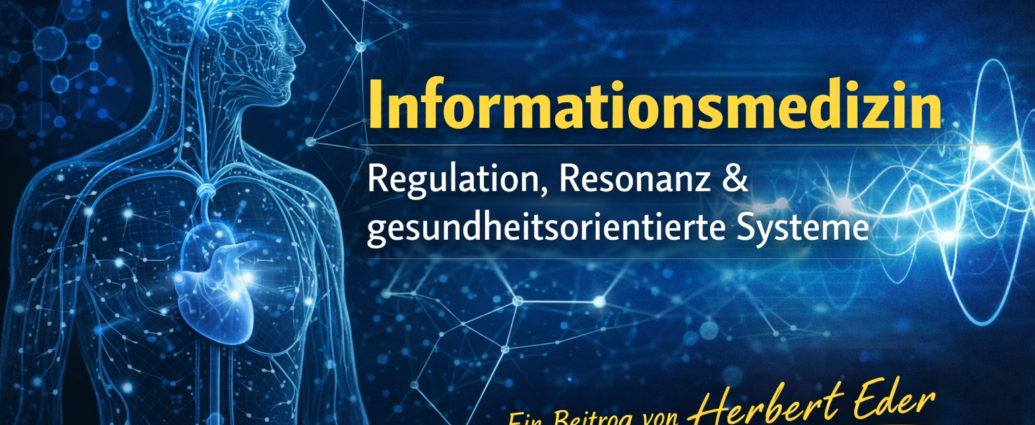
Basics, significance and classification
Information medicine describes approaches that view the human body not only in biochemical terms, but also as a regulatory and interconnected system. The focus is on signal transduction, adaptability, Resonance and self-organization. This article sheds light on the fundamentals, practical significance, opportunities and limitations of information medicine in an understandable and technically sound form,
Introduction
Information medicine is a term that has gained increasing attention in recent years. It refers to a way of looking at the human body not only through biochemical processes, but also through regulation, communication, signal processing and functional relationships. The focus is on the question of how the organism absorbs and processes information and converts it into orderly reactions.
This approach is particularly interesting at a time when many people are looking for holistic approaches to health. Information medicine opens up a view of the human being as a dynamic system in which not only substances and organs, but also feedback, adaptability and inner order play an important role.
What is information medicine?
A broader understanding of health
Information medicine assumes that health depends not only on chemical substances or structural conditions, but also on the quality of biological communication. The organism is understood as a finely tuned network in which the nervous system, hormonal system, immune system and metabolism constantly exchange information.
In this model, health primarily means orderly regulation. Complaints or illnesses, on the other hand, are understood as an indication of disturbed processes, reduced adaptability or a strain on natural self-organization. Information medicine therefore does not focus solely on an isolated symptom, but on the interaction of the entire system.
Information instead of just matter
The term information medicine makes it clear that human beings are not only made up of matter, but are also characterized by patterns, signals, rhythms and order processes. Many processes in the body follow temporal and functional sequences. Heartbeat, sleep-wake rhythm, hormone regulation, neuronal stimulus transmission and immune responses are examples of how strongly life depends on communication and coordination.
This is exactly where information medicine wants to start: with the function, order and ability of the body to react appropriately to internal and external stimuli.
Basic ideas of information medicine
The human being as a networked system
A central feature of information medicine is the view of the human being as an interconnected whole. Physical, emotional and functional levels are not strictly separated from each other, but are seen in their interplay. This creates a perspective that many people find holistic and true to life.
Instead of looking for a single defect, information medicine looks for patterns: Where are regulatory processes disturbed? Where is adaptability lacking? Where does the organism show excessive demands, imbalances or blockages? This form of thinking focuses more on interrelationships than on isolated individual findings.
Regulation and self-organization
Another basic idea is the body's ability to self-regulate. The body has numerous mechanisms to maintain balance, stability and adaptation. These processes usually take place unconsciously, but are crucial for well-being.
Information medicine therefore often sees itself as an approach that aims to support regulatory processes. It is less about linear intervention according to the pattern of cause equals remedy equals effect, and more about promoting inner order and responsiveness.
Resonance and biological communication
The term resonance also plays a role in many concepts of information medicine. This refers to the fact that biological systems can react to stimuli not only mechanically, but also in the form of patterns, rhythms and vibrational relationships. This idea is particularly important in the field of Frequency therapy has become known.
Although resonance models in the Practice are frequently used, it makes sense to understand them primarily as descriptive thought models. Their value lies in illustrating functional relationships and deepening the understanding of biological communication.
Information medicine and frequency therapy
Why the two areas are often combined
Information medicine and frequency therapy are often referred to together because both view the organism as a regulative system. Frequencies, rhythms and vibration patterns are understood as possible carriers of biologically relevant impulses.
This viewpoint gives rise to the idea that the body reacts not only to material stimuli, but also to orderly signals. This is precisely where the link to information medicine lies: it is interested in how stimulus systems, control circuits and adaptation mechanisms can be influenced.
The practical reference
In practice, information medicine is often seen as a complementary approach. Many practitioners associate it with the desire to strengthen well-being, improve body awareness and promote functional balance. The focus is on concepts such as relief, order, regulation and harmonization.
The question of how people react to stimuli and how inner stability can be promoted plays a particularly important role in information medicine. This creates an approach that does not focus solely on symptoms, but on the interaction of the entire organism.
Opportunities of information medicine
Holistic perspective
One of the greatest strengths of information medicine lies in its holistic approach. It reminds us that health is not just a question of individual findings, but the expression of a complex interplay between body, psyche, environment and lifestyle.
This perspective can help to better understand interrelationships and perceive people more comprehensively. Many people find this valuable because it creates space for individual differences and personal stress factors.
Focus on function instead of just structure
Information medicine not only asks what is present in the body, but also how well processes work. It therefore focuses on functional health. This perspective is particularly interesting in cases where people feel exhausted, stressed or out of balance, even if a clear structural cause is not always immediately apparent.
The idea of strengthening regulation and adaptability is therefore of great practical importance to many people.
Supporting health awareness
Another advantage is that information medicine can promote awareness of one's own body. Those who understand health as a dynamic process are often more aware of issues such as sleep, stress, nutrition, exercise, rhythms and recovery. This can lead to a more differentiated and responsible view of health as a whole.
Limits of information medicine
No uniformly defined technical term
As interesting as the term information medicine is, it is also open-ended. It is used differently in different contexts. Sometimes it describes a theoretical model, sometimes a diagnostic viewpoint, sometimes a collective term for regulative and complementary approaches.
This openness makes the term flexible, but can also lead to misunderstandings. It is therefore important to clearly state what is meant in each case.
Careful classification is important
Honest language is crucial, especially when it comes to holistic topics. Information medicine should be described responsibly without raising exaggerated expectations. Terms such as harmonization, regulation or balance can be useful if they are used objectively and are not understood as blanket promises of healing.
A serious approach to information medicine therefore always means clearly stating its possibilities and limitations.
Information medicine in the modern health culture
Between technology, biology and holistic medicine
Information medicine is at an exciting interface. It combines biological models of thought with questions of regulation, perception and functional order. At the same time, it opens our eyes to an understanding of health that describes the human being not just as a biochemical machine, but as a living, adaptable system.
This is precisely why the term has found a firm place in modern health culture. It appeals to people who want to understand health more comprehensively and value interrelationships.
Significance for practice
In practical application, information medicine often serves as an orientation model. It helps to better classify stresses, imbalances and functional relationships. This can be valuable in counseling, health support and complementary therapeutic thinking.
It remains crucial that information medicine is communicated responsibly and clearly describes its place as a regulatory and holistic approach.
Conclusion
Information medicine is an exciting approach to understanding health, regulation and biological communication more comprehensively. It views the human being as a networked system in which not only substances and organs, but also Information, order, adaptation and self-organization play an important role.
It is precisely its holistic perspective that makes it attractive to many people. It draws attention to interrelationships, the importance of functional balance and the body's ability to react to stress and reorganize itself.
Its particular value lies in viewing health not only materially, but also functionally and dynamically. Information medicine thus opens up an approach that understands the human being as a living whole and focuses on regulation as a central element of well-being and health.
Comments are closed, but trackbacks and pingbacks are open.