





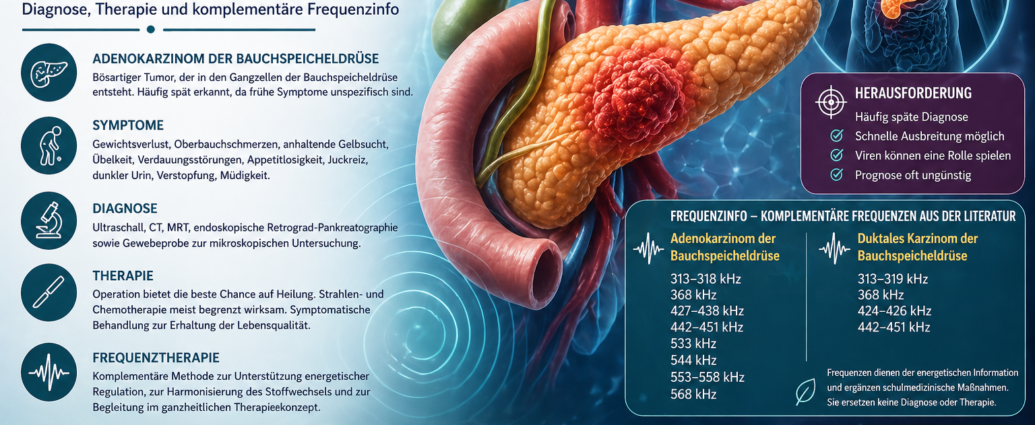
Conventional medical principles, symptoms, diagnosis, treatment and complementary therapies Frequency info at the Adenocarcinoma of the pancreas
Pancreatic cancer is one of the most serious malignant diseases of the digestive system. The pancreas is located deep in the upper abdomen and fulfills two central functions: It produces digestive enzymes and forms important hormones to regulate blood sugar. It is therefore closely linked to Digestion, metabolism, liver, gall bladder, intestines and the entire energy balance.
Adenocarcinoma of the pancreas develops from cells that line the excretory ducts of the pancreas. These ducts transport digestive juices into the duodenum. If malignant changes develop there, digestion, bile flow and metabolism can be significantly impaired.
The literature describes this form of cancer as a disease that is often recognized late because early symptoms can be unspecific. Weight loss, pain, digestive disorders and persistent jaundice are among the important indications that need to be clarified by conventional medicine.
In the Frequency therapy and Information medicine the pancreas is also regarded as part of a larger regulatory system. Frequencies are classified in a complementary manner and relate to Resonance, energetic order, Cell communication, milieu regulation and the supportive consideration of the entire organism.
Pancreatic cancer frequency therapy: conventional medical principles
Adenocarcinoma of the pancreas is a malignant tumor that arises from the pancreatic duct system. This type of tumor is particularly common in the area of the head of the pancreas. The pancreas is located there in close proximity to the duodenum, the bile duct and important blood vessels.
This anatomical position explains why complaints are often associated with digestion, bile flow and upper abdominal pain. When the Tumor constricts the bile duct, the bile can no longer flow out normally. This results in jaundice, which can manifest itself as yellowish skin, yellowish eyes, dark urine, lighter-colored stools and itching.
From a conventional medical point of view, pancreatic cancer is particularly challenging because the disease is often only discovered at an advanced stage. The pancreas lies deep in the body and smaller tumors do not always cause clear symptoms immediately.
Pancreatic cancer frequency therapy: importance of the pancreas
The pancreas is a central organ of the digestive and metabolic system. Its outer part produces digestive enzymes that break down proteins, fats and carbohydrates in the small intestine. Its inner part produces hormones such as insulin and glucagon, which regulate blood sugar levels.
If the pancreas is abnormally altered, this can have far-reaching consequences. Digestive disorders, loss of appetite, nausea, weight loss, metabolic changes and general weakness can occur. In tumor diseases in particular, it becomes clear how closely the pancreas is connected to the liver, gall bladder, intestines, lymph and energy balance.
In frequency therapy, the pancreas is therefore not considered in isolation. The complementary view includes the entire digestive field: Stomach, duodenum, liver, gall bladder, intestines, lymphatic system, nervous system and metabolism. In this context, frequencies are understood as impulses that are geared towards resonance and regulation in the sense of information medicine.
Pancreatic cancer frequency therapy: typical symptoms
The symptoms of adenocarcinoma of the pancreas can begin insidiously. There is often unwanted weight loss, loss of appetite, nausea, digestive problems and increasing weakness. Constipation can also occur, as can a general feeling of pressure or discomfort in the upper abdomen.
An important symptom is pain. This can be located in the upper abdomen and radiate into the back. Depending on the location and growth of the tumor, the pain can be permanent or intermittent. Some sufferers describe a deep-seated, drilling pain or pain that is difficult to classify.
Persistent jaundice is particularly significant. It occurs when the outflow of bile is obstructed. The course and severity of the jaundice depends on how pronounced the narrowing of the bile duct is. Itching can occur even before the yellowing of the skin and eyes becomes clearly visible.
Other possible complaints are
- Tiredness
- Poor performance
- Loss of appetite
- Nausea
- Vomiting
- Digestive disorders
- Feeling of fullness
- unwanted weight loss
- Upper abdominal pain
- Back pain
- Yellowing of the skin and eyes
- dark urine
- Itching
- Constipation
Pancreatic cancer frequency therapy: course of the disease
Pancreatic cancer can affect the body on several levels. On the one hand, the tumor impairs the function of the pancreas itself. On the other hand, its location can disrupt the flow of bile, involve neighboring organs and severely weaken the metabolism.
The literature describes that an advanced tumor can become life-threatening due to emaciation, bile stasis, local growth or distant metastases. In particular, the loss of weight, energy and digestive power plays a major role.
Direct growth can cause the tumor to invade surrounding structures. These include the liver, spleen, stomach, duodenum, colon, portal vein system and peritoneum. This proximity to important organs and vessels makes the disease complex.
Metastases can also develop. Regional lymph nodes, liver, lungs, lymph nodes in the chest and neck area and bones are frequently affected. It is therefore very important to assess the exact spread of the disease when making a diagnosis.
Frequency therapy pancreatic cancer: spread in the body
Adenocarcinoma of the pancreas can spread in different ways. It can grow directly into neighboring organs, spread via lymphatic channels or reach more distant organs via blood vessels.
The liver is particularly important because blood from the digestive tract reaches the liver via the portal vein system. As a result, tumor cells can form metastases there. The peritoneum can also be affected if tumor cells spread in the abdominal cavity.
The conventional medical assessment therefore not only examines the tumor itself, but also the lymph nodes, liver, lungs, peritoneum and other possible target regions. The exact staging determines which form of therapy is suitable.
In frequency therapy, this propagation pattern is seen as a complementary indication of higher-level regulatory fields. The pancreas, liver, lymph, blood flow, digestion and peritoneum are closely related to each other.
Pancreatic cancer frequency therapy: causes and stress factors
The development of pancreatic cancer is complex. The literature also mentions viral stress patterns as a cause in connection with adenocarcinoma of the pancreas. From a frequency therapy perspective, such indications can be included as part of a complementary resonance approach.
In conventional medicine, various risk factors are considered in pancreatic cancer. These include chronic inflammation of the pancreas, smoking, metabolic stress, certain familial predispositions, lifestyle factors, age and general tissue stress.
In a complementary way, the focus is also on the internal environment: digestive power, acid-base balance, liver-bile system, sugar metabolism, tendency to inflammation, lymph flow, emotional stress and energy regulation. The pancreas in particular reacts sensitively to long-term metabolic and digestive stress.
Frequency therapy pancreatic cancer: Diagnosis
Early diagnosis of adenocarcinoma of the pancreas is difficult. Small tumors often do not cause any clear symptoms. When symptoms do occur, they may initially appear to be ordinary digestive problems.
Imaging procedures are often used if pancreatic cancer is suspected. These include ultrasound, Computer tomography and special endoscopic examinations. Endoscopic imaging of the pancreas and bile duct system can help to visualize constrictions, obstructions or pathological changes.
A tissue sample can be taken to confirm the diagnosis. This is examined microscopically to determine the type and characteristics of the tumor cells. Only then can the diagnosis be clearly confirmed.
The diagnosis usually comprises several levels:
- Physical examination
- Blood values
- Liver and bile values
- Ultrasound
- Computer tomography
- Magnetic resonance imaging
- Endoscopic procedures
- Visualization of bile ducts and pancreatic ducts
- Tissue sample
- Microscopic examination
- Staging
Pancreatic cancer frequency therapy: differentiation from other diseases
Pancreatic complaints can also be caused by other diseases. It is therefore particularly important to differentiate between them. Upper abdominal pain, weight loss, jaundice or indigestion can occur with various diseases.
Among other things, a distinction must be made between Liver cancer, bile duct diseases, gallstones, chronic pancreatitis, gastrointestinal diseases and metastases of other tumors. Also Metastases from other cancers can cause similar symptoms in the region of the pancreas or liver.
From a conventional medical point of view, the exact differentiation is crucial because the therapy differs greatly depending on the cause. Imaging, laboratory values and tissue examinations help to determine the origin of the disease.
Frequency therapy also looks at this demarcation using resonance patterns. This involves checking which organ systems are energetically involved and which stresses may play a role in the overall picture.
Frequency therapy pancreatic cancer: conventional medical therapy
The most important option for curative treatment is the complete surgical removal of the tumor if the disease is not yet very advanced. Surgery is particularly suitable if the tumor is limited and no distant metastases are detectable.
Depending on the location of the tumor, major surgery may be necessary. This involves removing affected areas of the pancreas and, if necessary, adjacent structures. The exact procedure depends on the location, size and spread of the tumor.
Radiotherapy and chemotherapy are described in the literature as procedures whose effect may be limited in this disease. In modern treatment, however, they can be used depending on the stage, general condition and individual factors. The aim can be to control tumor growth, alleviate symptoms or prepare for or supplement surgery.
With advanced disease, the focus is often on quality of life. This includes pain therapy, digestive support, treatment of jaundice, nutritional therapy, metabolic support and stabilization of the general condition.
Pancreatic cancer frequency therapy: Nutrition and digestion
The pancreas is closely linked to digestion. If its function is impaired, nutrients are less easily absorbed. This can lead to weight loss, bloating, diarrhea, fatty stools, weakness and deficiencies.
An adapted diet can therefore play an important role. Easily digestible meals, an adequate supply of protein, high-quality fats in tolerable quantities, small portions and individual tolerance are key.
If digestive enzymes are lacking, enzyme preparations can be used in conventional medicine. This can support the breakdown of food. Controlling blood sugar is also important, as the pancreas plays a central role in sugar metabolism.
Frequency therapy provides complementary support for this area. Frequencies can be directed towards energetic digestive regulation, liver-bile flow, lymphatic system, pancreatic field, metabolic harmonization and general strength.
Pancreatic cancer frequency therapy: a holistic approach
A serious disease of the pancreas does not just affect a single organ. The whole person is affected. Physical discomfort, weight loss, pain, digestive problems, anxiety, exhaustion and insecurity can have a major impact on life.
From a holistic perspective, it is about taking all levels into account: Body, metabolism, digestion, nervous system, mental stability, sleep, breathing, movement, nutrition and energetic order.
Frequency therapy can be complementary to the following areas:
- Energetic pancreas regulation
- Support of the digestive field
- Harmonization of the liver-bile system
- Accompaniment of the lymph flow
- Strengthening general vitality
- Energetic support for weight loss
- Accompaniment for tiredness and weakness
- Regulation of the autonomic nervous system
- Energetic consideration of viral resonance patterns
- Complementary support of the metabolism
Frequency therapy for pancreatic cancer: resonance and information medicine
In information medicine, the body is understood as a living communication system. Organs, cells, tissues and fluids are in constant interaction. Frequencies are regarded as ordered information impulses that are associated with certain resonance fields.
In the case of pancreatic cancer, the complementary frequency approach focuses in particular on the pancreatic duct system, the glandular tissue, the digestive juices, the hepatobiliary system, the sugar metabolism and possible viral stress patterns.
The frequency lists in the literature serve as orientation within a larger therapeutic framework. They are not considered in isolation, but in connection with the diagnosis, symptoms, course of the disease, energetic resilience and the overall regulatory state of the person.
Frequency therapy pancreatic cancer: ductal carcinoma
Ductal carcinoma of the pancreas develops in the area of the excretory ducts. These duct structures are crucial for the transportation of digestive juices. If a tumor grows there, drainage disorders, pressure changes and inflammatory reactions can occur.
In frequency therapy, the ductal carcinoma is also examined via its resonance patterns. The focus here is on the duct structures, the surrounding tissue tension, the digestive field and the energetic connection to the liver, gall bladder and duodenum.
The following also applies here: the frequency approach is always complementary. Conventional medical diagnosis and therapy planning remain the basis, while frequencies can provide additional information for energetic support.
Pancreatic cancer frequency therapy: complementary support during the course of the disease
Needs can change over the course of an illness. At the beginning, the focus is often on diagnosis, clarification and treatment decisions. Later on, digestion, nutrition, strength, pain, sleep, mental stability and quality of life can become more important.
Frequency therapy can be used to accompany various phases. It is always checked which level is in the foreground at the moment. Sometimes it is the energetic relief, sometimes the stabilization, sometimes the digestive regulation or the support of the lymphatic system.
Individual adaptation is particularly important. Every person reacts differently. This is why frequency work should not be carried out rigidly, but rather sensitively, observationally and in line with the overall picture.
Frequency information: complementary frequencies for adenocarcinoma of the pancreas
The literature mentions the following frequently found resonant frequencies in adenocarcinoma of the pancreas:
313-318 kHz
368 kHz
427-438 kHz
442-451 kHz
533 kHz
544 kHz
553-558 kHz
568 kHz
These frequencies are considered in the complementary context of frequency therapy. They can serve as resonance clues for adenocarcinoma of the pancreas and are classified in connection with glandular tissue, the ductal system, digestive power, bile flow, metabolism and general regulatory ability.
Frequency information: complementary frequencies in ductal carcinoma of the pancreas
The literature mentions the following frequently found resonant frequencies in pancreatic ductal carcinoma:
313-319 kHz
368 kHz
424-426 kHz
442-451 kHz
In frequency therapy, these frequency ranges are understood as a complementary energetic orientation. They can be considered particularly in connection with the pancreatic ducts, the outflow of digestive juices, the liver-bile system and the local tissue environment.
Conclusion: Frequency therapy for pancreatic cancer
Adenocarcinoma of the pancreas is a serious disease that is often detected late and requires precise conventional medical diagnosis. Typical symptoms may include weight loss, upper abdominal pain, indigestion, loss of appetite and persistent jaundice.
The pancreas is closely linked to digestion, bile, liver, intestines, metabolism and energy balance. This is why a disease of this organ often affects the whole person.
Frequency therapy complements this approach by looking at resonance, regulation and energetic order. The focus is not only on the tumor tissue, but also on the pancreatic duct system, the digestive field, the metabolism, the liver-bile system and the general regulatory power.
The frequency lists from the literature offer additional complementary orientation. They can be used in the context of information medicine to integrate resonance patterns in adenocarcinoma and ductal carcinoma of the pancreas into a holistic support concept.

Comments are closed, but trackbacks and pingbacks are open.