





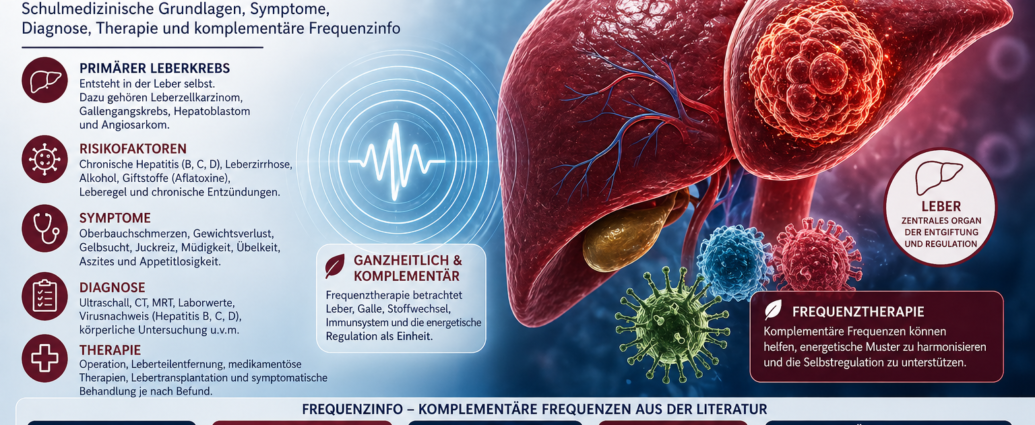
Conventional medical principles, symptoms, diagnosis, treatment and complementary therapies Frequency info for primary liver cancer
Primary liver cancer is a serious disease of the internal organs and affects one of the central metabolic organs of the human body. The liver performs vital tasks: It processes nutrients, breaks down toxins, produces bile, stores energy, regulates metabolic processes and is in close contact with the blood, immune system and the liver. Digestion.
When tumors develop in the liver, a distinction must be made as to whether they arise directly from the liver tissue or whether they are metastases of other cancers. Primary liver cancer develops in the liver itself. Metastatic liver cancer, on the other hand, originates from another organ and has spread to the liver.
The literature describes various forms of primary liver tumors. These include hepatocellular carcinoma, bile duct cancer, hepatoblastoma and hepatocellular carcinoma. Angiosarcoma of the liver. Each of these forms has its own characteristics, causes, risk factors and clinical course.
In the Frequency therapy and Information medicine the liver is also regarded as a highly active regulatory organ. Frequencies are classified as complementary in this context and refer to energetic Resonance, Cell communication, milieu regulation, stress patterns and the supportive consideration of the entire organism.
Frequency therapy for liver cancer: conventional medical principles
Liver tumors can be benign or malignant. Benign changes are not necessarily dangerous, but should be monitored depending on their size, location and growth. Malignant liver tumors can either develop directly in the liver or be spread to the liver by other cancers.
Primary liver cancer develops from cells in the liver or from structures within the liver, such as the bile ducts or blood vessels. The term „primary“ means that the origin of the disease lies in the liver itself.
The liver is particularly sensitive to chronic stress. Long-term inflammation, viral infections, liver cirrhosis, alcohol exposure, certain toxins and metabolic disorders can change the tissue in the long term. This can disrupt the natural cellular order. From a conventional medical perspective, chronic liver diseases and inflammatory processes are at the center of the risk assessment.
Frequency therapy liver cancer: hepatocellular carcinoma
Hepatocellular carcinoma is the most common form of primary liver cancer. It develops from the liver cells themselves. It is also referred to as hepatoma in the literature. This form of cancer develops particularly frequently on the basis of an already damaged liver.
An important risk factor is a chronic infection with hepatitis B or hepatitis C viruses. These Viruses can maintain inflammatory processes in the liver over a long period of time. If the liver is permanently irritated, inflamed or scarred, the risk of malignant changes increases.
Hepatitis D viruses are also discussed in the literature in connection with liver cancer. With Hepatitis E such a connection is viewed much more cautiously. In addition to viral contamination, alcohol, liver cirrhosis, mold toxins such as aflatoxins and certain chronic liver diseases also play a role.
A special type is fibrolamellar carcinoma. This rare form can also affect younger adults and differs in some characteristics from classic hepatocellular carcinoma.
Liver cancer frequency therapy: liver cirrhosis as a risk factor
Liver cirrhosis is an advanced scarring of the liver tissue. It occurs when the liver is damaged over a long period of time. Healthy liver tissue is increasingly replaced by connective tissue structures. The result is impaired liver function and altered tissue architecture.
Liver cirrhosis can be caused by alcohol, chronic viral infections, metabolic diseases, autoimmune processes or disorders of the bile flow. Certain forms of chronic bile duct disease can also increase the risk of liver cancer.
From a conventional medical point of view, a cirrhotic liver is an important warning sign. People with liver cirrhosis need regular check-ups, as hepatocellular carcinoma can initially develop unnoticed. Changes in liver function, new symptoms, weight loss or deterioration in general health must therefore be carefully investigated.
In frequency therapy, liver cirrhosis is also seen as a complementary sign of a long-standing regulatory disorder. This involves stress patterns, metabolic stress, inflammatory tendencies, tissue hardening, energetic congestion and limited regenerative capacity.
Frequency therapy liver cancer: bile duct cancer
Bile duct cancer develops from the mucous membrane of the bile ducts. These fine ducts transport bile from the liver to the gallbladder or into the intestine. Bile duct cancer can occur inside or outside the liver.
The literature describes connections with chronic irritation of the bile ducts. In certain regions of the world, liver flukes can also play a role. These parasites can promote long-term inflammation and mucosal changes in the bile ducts.
Long-standing inflammatory bowel diseases, in particular ulcerative colitis, and sclerosing cholangitis can also be associated with an increased risk of bile duct cancer. These are complex chronic diseases in which inflammation, scarring and bile stasis are intertwined.
From a complementary point of view, the focus in bile duct cancer is not only on the tumor tissue, but also on the flow of bile, the liver-bile system, digestion, detoxification performance and the energetic permeability of the upper abdomen.
Frequency therapy for liver cancer: Hepatoblastoma in children
Hepatoblastoma is a cancer of the liver that can occur primarily in infants and young children. It is one of the more common malignant liver tumors in children. This disease also occurs less frequently in older children.
The literature describes that some hepatoblastomas can produce hormone-like substances. This can cause signs of premature physical development in affected children in individual cases.
Conventional medical diagnostics and therapy are particularly important for children. Imaging, laboratory values, tumor markers, surgery and additional treatment procedures are planned individually. Treatment requires specialized paediatric oncology experience.
In a complementary context, frequency therapy can be understood here exclusively as an accompanying approach. The focus here is on stabilization, energetic support, emotional support, environmental considerations and the family environment.
Frequency therapy liver cancer: angiosarcoma of the liver
Angiosarcoma of the liver is a rare malignant disease that arises from the blood vessels of the liver. As the liver is heavily supplied with blood, this type of tumor can be particularly serious.
The literature mentions chemical exposure as possible risk factors, including vinyl chloride and similar solvents. Other carcinogenic substances are also described in connection with this rare form of tumor.
From a conventional medical point of view, angiosarcoma is a serious disease that requires precise diagnosis and specialized treatment. Symptoms can be non-specific and overlap with other liver diseases.
Frequency therapy for such stresses also focuses on the vascular system, blood flow, tissue environment, detoxification, liver stress and the overriding regulatory power of the organism.
Frequency therapy for liver cancer: typical symptoms
Primary liver cancer can remain undetected for a long time. The liver itself often only causes clear symptoms at a late stage. Early signs of the disease are therefore easily overlooked or attributed to other causes.
Frequently described symptoms are upper abdominal pain, especially in the right upper abdominal area, unintentional weight loss, loss of appetite, nausea, vomiting, tiredness, weakness and fever. Some sufferers notice an increasing reduction in performance or a general feeling of illness.
If liver function is more severely impaired, yellowing of the skin and eyes, dark urine, itching and fluid accumulation in the abdomen may occur. Such an accumulation of fluid is called ascites.
In people with long-standing liver cirrhosis, the condition can suddenly worsen. In some cases, severe abdominal pain and circulatory problems occur when a Tumor bleeds or tears. Such acute situations require immediate medical attention.
Frequency therapy for liver cancer: diagnosis from a conventional medical perspective
Primary liver tumors are diagnosed using a combination of different examinations. The initial focus is on a physical examination, medical history, blood values and liver values. This looks for indications of inflammation, liver dysfunction, bile congestion or tumor activity.
Imaging procedures are particularly important. These include ultrasound, Computer tomography and Magnetic resonance imaging. These examinations can make the location, size, blood flow and spread of a tumor visible.
X-ray examinations can also be used as a supplement. If viral liver diseases are suspected, antibodies and viral markers are determined. Especially hepatitis B, Hepatitis C and Hepatitis D can be examined in connection with chronic liver processes.
Depending on the situation, further laboratory values, tumor markers or tissue examinations may be necessary. The aim is to differentiate between benign tumors, primary liver cancer, bile duct cancer and liver metastases from other cancers.
Frequency therapy liver cancer: conventional medical treatment
The treatment depends on the type, size, location and spread of the tumor. The condition of the liver also plays a decisive role. A small, localized tumour can be surgically removed in certain cases.
For some patients, partial liver removal is an option. In other cases, local procedures, drug therapies, targeted treatments or a liver transplant can be considered. The decision depends on the individual findings.
In advanced disease, the focus is often on symptom control, quality of life, control of tumor growth and support of liver function. Various conventional medical procedures can be combined for this purpose.
Follow-up care is also essential. Regular imaging, blood tests and monitoring of liver function help to detect changes at an early stage. In the case of chronic hepatitis or liver cirrhosis, long-term care remains particularly important.
Liver cancer frequency therapy: the importance of the liver in the body
The liver is one of the body's most important regulatory organs. It processes carbohydrates, fats and proteins, stores vitamins and minerals, forms coagulation factors and is centrally involved in detoxification.
It also produces bile, which is necessary for the digestion of fat. The liver receives blood from the intestine via the portal vein and processes numerous substances that come from digestion. As a result, it is closely connected to the intestines, immune system, metabolism and internal environment.
In frequency therapy, the liver is therefore not considered in isolation. The liver, intestines, bile, blood, lymph, nervous system and metabolism form an interconnected regulatory field. Stress in one area can affect other levels.
The liver is often seen as a central organ of order, clarification and processing, particularly in the case of chronic illnesses. In a complementary understanding, frequencies can help to make energetic patterns visible and set regulatory impulses.
Frequency therapy for liver cancer: viruses and chronic stress
Various viral strains are mentioned in the literature for primary liver cancer. Hepatitis B, hepatitis C and hepatitis D are the main focus. Other viruses such as Epstein-Barr virus, cytomegalovirus, human papillomaviruses and unspecified wart-like virus groups are also mentioned.
From a conventional medical point of view, chronic liver inflammation is particularly crucial. If a viral infection persists for many years, it can lead to repeated cell damage, repair processes, scarring and impaired cell regulation.
In the complementary understanding of frequency therapy, such stresses are also viewed as resonance patterns. Frequencies can serve as reference fields that are considered in connection with viruses, liver tissue, the immune system and inflammatory tendencies.
A holistic classification is important here: not every resonance area found automatically has the same meaning. The interpretation is always made in the context of findings, condition, medical history and individual resilience.
Frequency therapy liver cancer: liver, bile and parasite load
The literature describes liver flukes particularly in connection with certain forms of bile duct cancer. Such parasites can play a role in special cases, especially where such infections occur more frequently.
Liver flukes can irritate the bile duct system and promote long-term inflammatory processes. If chronic irritation, congestion and changes to the mucous membrane occur over years, the tissue can change.
In terms of frequency therapy, parasite contamination is viewed as a complementary possible interference field. The focus is not only on the pathogen itself, but also on the environment in which such burdens can persist. Bile flow, digestive power, liver relief, intestinal environment and immune competence are important accompanying topics.
Frequency therapy for liver cancer: holistic support
Holistic support for primary liver cancer encompasses physical, emotional and energetic levels. The disease affects not just one organ, but often the entire attitude to life. Fatigue, loss of appetite, weight loss, nausea, anxiety, sleep problems and insecurity can have a major impact on everyday life.
In frequency therapy, attention is therefore not only paid to individual frequency ranges. The overall picture is decisive. This includes liver function, digestion, bile flow, lymphatic system, immune system, metabolism, toxin exposure, emotional processing and general life energy.
Complementary frequency applications can be aimed at the following areas:
energetic liver regulation
Support of the bile flow
Accompanying the metabolism
Regulation of the intestinal-liver system
Energetic relief for chronic stress
Support for the lymphatic system
Strengthening general vitality
Accompaniment of tiredness and exhaustion
Harmonization of the vegetative nervous system
Complementary consideration of viral resonance patterns
Frequency therapy for liver cancer: complementary frequency therapy
In information medicine, frequencies are understood as ordered vibrational impulses. Every cell, every tissue and every organ is in a dynamic exchange. If this exchange is disturbed, this can manifest itself in function, environment, energy flow and regulatory capacity.
In the case of liver cancer, the complementary frequency approach focuses on several levels: Liver tissue, bile ducts, blood vessels, viral loads, parasite patterns, inflammatory tendencies, liver cirrhosis, metabolism and general energetic stability.
The frequency lists in the literature serve as orientation within a larger concept. They are not considered in isolation, but in conjunction with the conventional medical diagnosis, course, laboratory values, imaging and individual situation.
The liver in particular, as a central detoxification and metabolic organ, shows how important a comprehensive approach is. Frequency therapy can be seen here as a complementary method that focuses on order, resonance and the ability to regulate.
Frequency info: Hepatitis B frequencies
The literature mentions the following resonant frequencies for hepatitis B viruses:
293 kHz
340 kHz
384 kHz
392-398 kHz
414-420 kHz
444-448 kHz
454 kHz
488 kHz
These frequencies are considered in the complementary context of frequency therapy. They can serve as resonance clues for chronic liver stress caused by hepatitis B patterns and are always classified in the overall context of liver function, immune system, inflammatory tendency and conventional medical control.
Frequency info: Hepatitis C frequencies
The literature mentions the following resonant frequencies for hepatitis C viruses:
324-339 kHz
350-352 kHz
370-374 kHz
396 kHz
400-402 kHz
450-456 kHz
475-482 kHz
540-541 kHz
559-563 kHz
In frequency therapy, these frequency ranges are understood as a complementary energetic orientation. They can be considered in connection with the environment, liver metabolism, immune response and long-term regulatory capacity, particularly in the case of chronic liver stress.
Frequency info: Hepatitis D frequencies
The literature mentions the following resonant frequencies for hepatitis D viruses:
348 kHz
375 kHz
386 kHz
410 kHz
432 kHz
450 kHz
468 kHz
471 kHz
490 kHz
532 kHz
535-548 kHz
550-563 kHz
580 kHz
These frequencies are considered complementary in the context of frequency therapy. They can be used for the energetic classification of viral stress patterns, especially if the liver is burdened by chronic inflammatory processes and limited regulatory power.
Frequency info: Liver fluke frequencies
The literature mentions the following resonant frequencies for liver flukes:
280 kHz
292 kHz
346 kHz
390 kHz
420-430 kHz
484 kHz
These frequencies are considered complementary especially in connection with special forms of bile duct cancer and chronic stress of the bile-liver system. They can serve as orientation in frequency therapy for parasitic resonance patterns.
Frequency info: Frequencies for primary liver cancer
The literature mentions the following frequently found resonant frequencies in primary liver cancer:
343-347 kHz
375-377 kHz
390 kHz
400-403 kHz
408-409 kHz
420-438 kHz
442-451 kHz
490-493 kHz
513 kHz
530-535 kHz
548 kHz
550-558 kHz
These frequency ranges are considered in the complementary context of frequency therapy. They can serve as resonance indicators for primary liver tumors and are classified in connection with liver tissue, bile ducts, viral loads, inflammatory tendencies, metabolism and general regulatory capacity.
Conclusion: Frequency therapy for liver cancer
Primary liver cancer is a complex disease in which the focus is on conventional medical diagnostics, imaging, laboratory values, tumor determination and individual therapy planning. It is particularly important to differentiate between tumors that develop directly in the liver and those that develop as Metastases from other organs into the liver.
Hepatocellular carcinoma, bile duct cancer, hepatoblastoma and angiosarcoma show how diverse liver tumors can be. Chronic hepatitis, liver cirrhosis, alcohol exposure, toxins, bile duct inflammation and specific parasite loads can all play a role.
Frequency therapy complements this approach by looking at resonance, regulation, energetic order and information fields. The focus is not only on the tumor, but on the entire human liver-bile-metabolism system.
The frequency lists from the literature offer additional complementary orientation. They connect liver tissue, hepatitis viruses, liver flukes, bile ducts and primary liver tumors with specific resonance areas and can be taken into account within a holistic concept of information medicine.
Comments are closed, but trackbacks and pingbacks are open.