




Causes, symptoms, diagnosis, therapy - plus frequency lists (EDTFL/CAFL)
What is a high-grade astrocytoma?
Astrocytomas belong to the Gliomas (brain tumors from glial cells). In practice, „high-grade“ usually means WHO grade 3 (formerly „anaplastic astrocytoma“) or WHO grade 4 (in the current WHO classification this often corresponds to what used to be described as secondary glioblastoma or higher-grade astrocytoma). Today, the modern classification strongly considers molecular markers (e.g. IDH status).
Common symptoms
The symptoms depend heavily on the tumor location. Typical symptoms include
- Headache, often with nausea/vomiting (indication of increased intracranial pressure)
- Epileptic seizures (always clarify newly occurring seizures in adulthood)
- Focal failuresParalysis, speech disorders, visual disorders, sensory disorders
- Cognitive/psychological changes (concentration, personality, memory)
Causes and risk factors
In most cases No single cause can be determined. Genetic factors are discussed (depending on the context) and rarely pre-treatment/exposure - in everyday clinical practice, however, the cause often remains unclear.
Diagnosis: how it is clarified
- Imaging (MRI with contrast medium)Standard for displaying position, extent and typical signal changes.
- Tissue sample (biopsy/surgery): histological confirmation.
- Molecular diagnosticse.g. IDH mutation, other markers (important for prognosis and treatment planning).
Standard therapy (conventional medicine)
Treatment is planned in an interdisciplinary tumor board and typically includes
- Operation (maximum safe resection, if possible)
- Radiotherapy
- Chemotherapy (often temozolomide; depending on grade/markers/protocol)
- With RecurrenceRe-operation, re-radiation in selected cases, systemic therapies/studies, supportive measures
Forecast
The prognosis depends, among other things, on Tumor grade, IDH status, Extent of resection, Age/general condition and other markers. Modern WHO classification and markers help to better differentiate progressions.
Frequency lists (EDTFL / CAFL) - if available
Note on the unit: ETDFL/EDTFL is often used in kHz indicated; the conversion to Hz takes place with × 1000.
EDTFL (ETDFL 2023) - matching entries for Astrocytoma/Glioma
The following programs from the ETDFL PDF (2023) are directly relevant:
1) Cancer: Brain Tumor, Cerebellar Astrocytoma (Program #459)
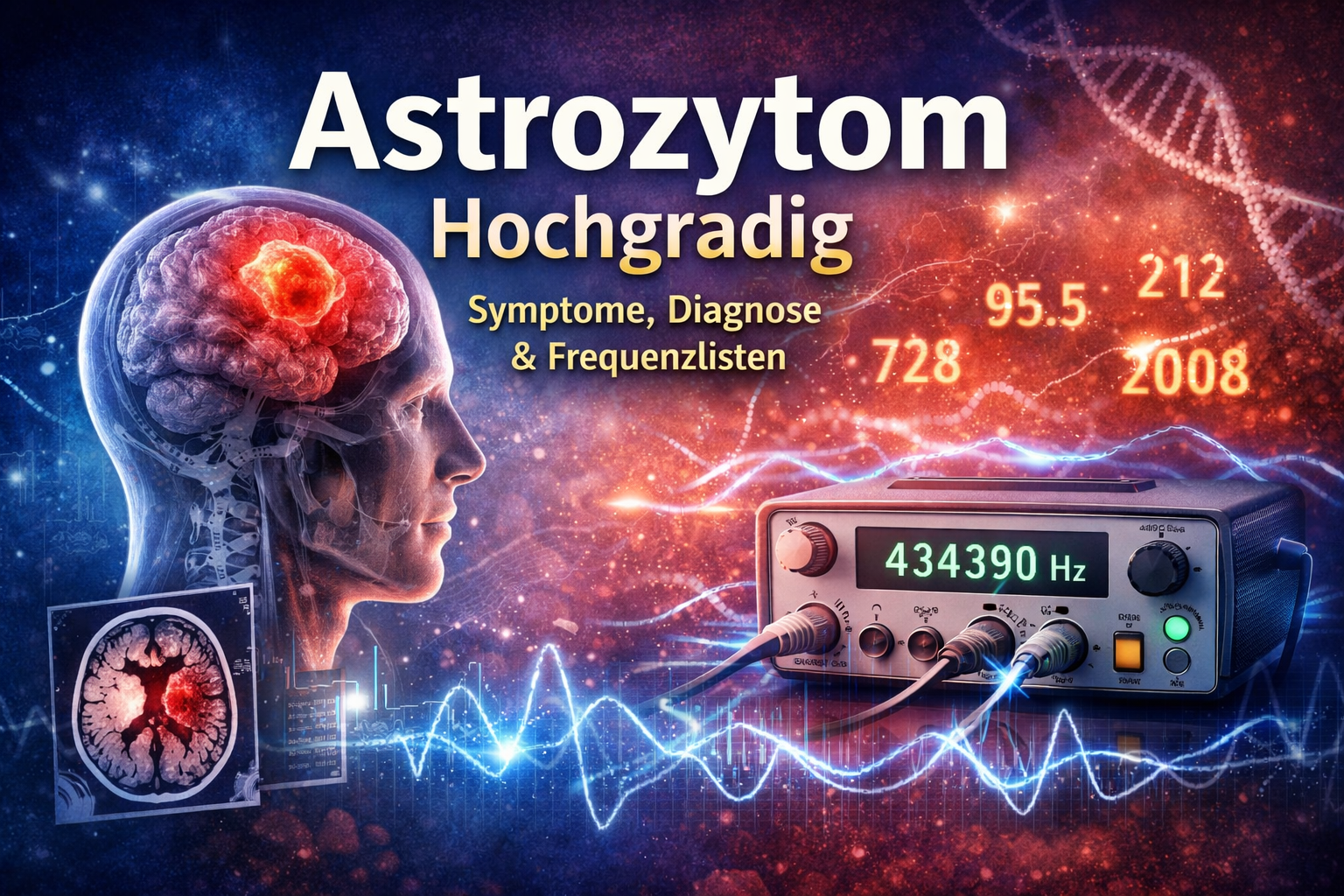
Frequencies: 2.75, 5.03, 15.61, 17.5, 37, 95.5, 350, 434.39, 739.1, 905.31
2) Cancer: Brain Tumor, Cerebral Astrocytoma (Program #460)
Frequencies: 2.75, 5.03, 15.61, 17.5, 37, 95.5, 350, 434.39, 739.1, 905.31
3) Glial Cell Tumors [Astrocytoma] (Program #1409)
Frequencies: 2.75, 5.03, 15.61, 17.5, 37, 95.5, 350, 434.39, 739.1, 905.31
4) Glioblastoma (Program #1410) (as a high-level reference, grade 4 context)
Frequencies: 0.08, 0.35, 0.6, 0.8, 212.03, 305.21, 434.24, 565.61, 690, 826.32
5) Glioblastoma Multiforme (Program #1411)
Frequencies: 0.08, 0.35, 0.6, 0.8, 212.03, 305.21, 434.24, 475.16, 527, 541.22
Conversion to Hz (if your system expects Hz):
Example: 434.39 kHz → 434 390 Hz (× 1000).
CAFL (Consolidated Annotated Frequency List) - „Astrocytoma“ not as a separate entry
In the CAFL PDF version I checked (v2007-05-16) Astrocytoma only mentioned as a reference in the context of „Brain tumor / Tumor brain“, but not as an independent frequency set listed.
CAFL-related alternatives (high-level context):
- Cancer_glioblastoma: 720, 2008, 2128, 2180, 2182, 728, 832, 800, 664, 20, 855, 543, 641, 857
- Cancer_gliomas: 543, 641, 857
- Cancer_droglioma: 853
- Cancer_general_1: 10000, 5000, 3176, 2720, 2489, 2189, 2184, 2128, 2084, 2050, 2008, 880, 854, 800, 784, 728, 666, 524, 464, 333, 304, 120
- Cancer_general_2: 10000, 3176, 3040, 2720, 2489, 2182, 2127, 2048, 2008, 1862, 1552, 880, 802, 786, 727, 665, 664, 465, 304, 125, 96, 72, 64, 20
Practical note on classification (important)
If you mean „high-grade astrocytoma“, the EDTFL splint (Astrocytoma/Glioma/Glioblastoma) mostly the More direct allocation (Program #459/460/1409 plus possibly 1410/1411). In CAFL it is rather about Glioma/Glioblastoma/Cancer sets because „Astrocytoma“ does not appear there as a separate data set.
Disclaimer
Frequency therapy is not recognized by conventional medicine and replaces none diagnosis or treatment by doctors or therapists. It can - if at all - only accompanying and on your own responsibility. In the event of symptoms or suspected brain tumors, a Immediate medical clarification required.