





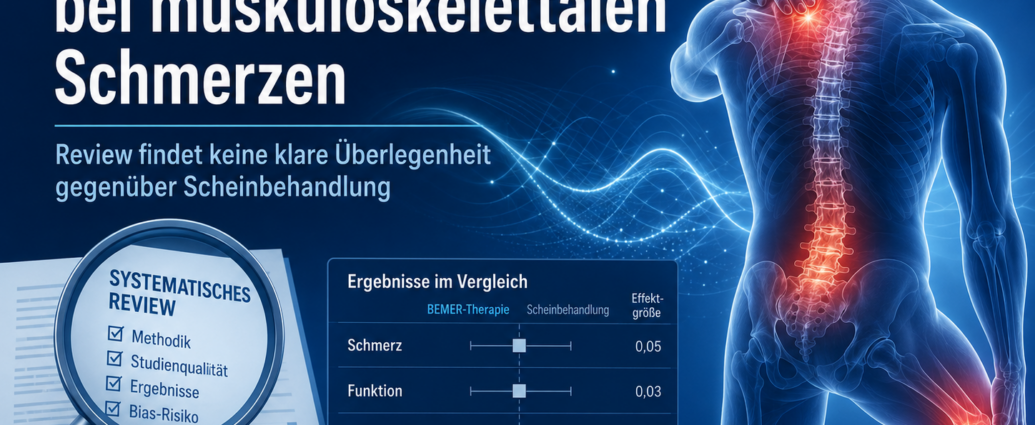
New review finds no clear superiority over sham treatment
A new review takes a scientifically cautious stance on BEMER
BEMER therapy is frequently discussed in the context of magnetic field therapy, PEMF applications, and bioelectromagnetic regulation as a complementary method for treating pain, circulatory disorders, and regeneration processes. This is precisely why a sober scientific assessment is important: Which effects are plausible? Which effects are subjectively experienced? And above all: What are the results when BEMER is compared not only to no treatment at all, but to a sham treatment?
A newly discoverable systematic review in the journal Bioelectromagnetics addresses precisely this question. The article is titled „Efficacy of Bio-Electro-Magnetic-Energy-Regulation Therapy in the Management of Musculoskeletal Pain: A Systematic Review of Randomized Controlled Trials“. Bibliographic information includes, among other things, the DOI 10.1002/bem.70057 and PMID 42227300 called. The publication is accompanied by July 1, 2026 is dated, but it was already available in abstract databases as early as June 2026.
The authors are Makbule Karci, Neslisah Gün, Rüstem Mustafaoglu, Abdurrahim Yildiz, and Rengin Demir. The participating institutions include Istanbul Aydin University, Kirklareli University, Istanbul University-Cerrahpasa, and Sakarya University of Applied Sciences, among others.
Source of the abstract summary:
https://qigonginstitute.org/abstract/20527/efficacy-of-bio-electro-magnetic-energy-regulation-therapy-in-musculoskeletal-pain-management-a-systematic-review-of-randomized-controlled-trials
DOI link:
https://doi.org/10.1002/bem.70057
Why This Review Is Important for Frequency Therapy Research
BEMER stands for Bio-Electro-Magnetic Energy Regulation and is usually described as a low-frequency, magnetic-field-based intervention. In public discourse, the method is often associated with microcirculation, regeneration, pain reduction, and general regulation.
This review is relevant to the debate on frequency therapy because BEMER should not be considered in isolation. The method is part of a broader field of applications in which terms such as PEMF, pulsed electromagnetic fields, Magnetic field therapy, bioelectromagnetic regulation and Frequency therapy are often used together.
However, caution is warranted, especially when it comes to pain-related applications. Pain is a complex biological, psychological, and social phenomenon. Expectations, attention, treatment rituals, the effect of the device, its technical appearance, and subjective hope can significantly influence the experience of pain. For this reason, it is particularly important to compare device-based procedures with a credible sham treatment.
What was studied?
The review evaluated randomized controlled trials that examined BEMER or related magnetic-field-based interventions for musculoskeletal pain. According to the abstract, the literature search was conducted in several scientific databases, including PubMed, EMBASE, Scopus, and Web of Science. The search was based on PRISMA 2020, a recognized standard for systematic reviews.
We included English-language randomized controlled trials that assessed pain in musculoskeletal conditions. We excluded cell studies, animal studies, in vitro studies, reviews, and conference abstracts. Methodological quality was assessed using the PEDro Scale assessed using an established tool for evaluating physical therapy and rehabilitation-related studies.
Thus, the review does not merely ask whether pain improves after a treatment session. More specifically, it asks: Is there evidence that BEMER has a specific effect beyond placebo, context, or expectation effects?
The main takeaway: No clear advantage over Sham
The review’s main conclusion is cautious but scientifically significant: While individual studies report pain reduction following BEMER treatment, overall the authors found that No robust evidence that BEMER is clearly more effective than sham or placebo treatments for musculoskeletal pain.
This is a crucial point. When it comes to pain, it is not enough for symptoms to improve after a single treatment. Pain can also be influenced by natural fluctuations, regression to the mean, expectation effects, concomitant therapies, rest, attention, or general contextual factors. Only a convincing comparison with a sham treatment can help to better pinpoint a specific effect of the device.
Seven randomized trials: A still limited evidence base
The review identified seven randomized controlled trials. For a clinical question, this is a limited body of data. This figure alone shows that research on BEMER for musculoskeletal pain is not yet extensive enough to support strong general recommendations.
Randomized controlled trials are indeed considered a key component of clinical evidence. However, their validity depends heavily on the quality of the study: How large was the sample size? Was the study properly blinded? Was the placebo credible? Were the endpoints defined in advance? Were the groups treated in a comparable manner? And were the treatment parameters standardized?
When there are only a few studies available and they differ in their methodology, it is not possible to form a consistent overall picture. That seems to be exactly the case here.
Individual improvements do not automatically prove efficacy
Some of the included studies reported reductions in pain. This is interesting, but it does not automatically prove that BEMER has a specific effect. The key question is whether BEMER performs better in a direct comparison with a credible sham treatment.
According to the abstract, only one of four sham-controlled studies BEMER’s superiority over sham treatment. This does not mean that BEMER „does not work.“ To be more scientifically precise: The current body of research does not show any convincing, consistent superiority over sham treatment.
This distinction is important. A negative or cautious review is not a definitive judgment on all possible uses. However, it is a clear signal that bold claims of healing are not currently justified.
Heterogeneous protocols make it difficult to draw clear conclusions
Another issue concerns the variability of study protocols. Magnetic field-based methods can differ in many parameters: frequency, field strength, pulse shape, treatment duration, number of sessions, target region, distance from the body, combination with other therapies, and the type of condition being studied.
When studies with different parameters, patient groups, and endpoints are pooled, it becomes difficult to draw a clear conclusion about the method itself. It is often unclear: Was the procedure ineffective? Was the protocol unsuitable? Was the study duration too short? Or was the patient group under study too heterogeneous?
That is precisely why many reviews in the field of PEMF and magnetic field therapy call for standardized protocols and better study designs.
Significance for PEMF, Magnetic Field Therapy, and Frequency Therapy
BEMER is not the same as all forms of PEMF or magnetic field therapy. Nevertheless, the review is of interest to the entire field of frequency therapy. It serves as a reminder that physiological plausibility, technical sophistication, and positive user reports do not automatically prove specific clinical efficacy.
In the field of frequency therapy, this distinction is particularly important. Many methods are based on plausible concepts such as resonance, electromagnetic regulation, Cell communication or microcirculation. However, there is a long way to go from a plausible mechanism of action to a clinically proven therapeutic effect.
The review therefore highlights not only a limitation of BEMER but also a challenge for frequency therapy research as a whole: the methods must be studied in such a way that placebo effects, expectations, subjective perceptions, and natural disease progression can be separated as clearly as possible.
What does this mean for patients?
For people with musculoskeletal pain, the message is mixed. On the one hand, there are isolated reports of improvements. On the other hand, the current evidence is insufficient to establish BEMER as a proven effective pain treatment.
Anyone using BEMER should therefore view the method realistically: as a potential complementary treatment, not as a substitute for medical diagnostics, physical therapy, exercise therapy, pain management, or other established forms of treatment.
A professional evaluation is especially important in cases of persistent, worsening, or unexplained pain. Musculoskeletal complaints can have many causes, including overuse, inflammation, joint changes, disc problems, neurological causes, rheumatic diseases, or other conditions requiring treatment.
Why Sham Controls Are So Important in Pain Studies
Pain is subjective. That does not make it any less real, but it does make it more difficult to measure scientifically. Two people may experience the same physical change differently. At the same time, expectations, anxiety, attention, the therapeutic relationship, and the treatment environment can all influence the perception of pain.
In technical applications, there is another factor to consider: devices often appear convincing. Lights, programs, coils, mats, acoustic signals, or specific treatment rituals can reinforce the impression that something effective is happening. A good sham treatment must therefore be credible without incorporating the active mechanism of action.
If a method does not clearly outperform the sham treatment in sham-controlled studies, this is an important warning sign. It means that the observed improvements may not have been specifically caused by the device.
What future studies should do better
The review highlights not only limitations but also avenues for improving research. Future studies on BEMER and related magnetic-field-based frequency applications should meet several requirements:
- samples that are large enough to ensure that genuine effects are statistically detectable
- clear target indications, such as back pain, knee osteoarthritis, or myofascial pain, considered separately
- standardized treatment parameters to ensure that studies are comparable
- credible sham controls
- Effective blinding of participants and analysts
- Transparent registration of study protocols
- Long-term follow-up to distinguish short-term effects from those with lasting impact
- Clear documentation of side effects, discontinuations, and concomitant therapies
Only when such studies show consistent results can their effectiveness be assessed with greater certainty.
Relevance to Cancer and Other Serious Diseases
Although the review examines musculoskeletal pain, its message is also relevant to discussions about frequency therapy in the context of serious illnesses such as cancer. Pain, fatigue, quality of life, and associated symptoms play a major role in cancer. At the same time, particular caution is required in this context.
No conclusions regarding the effectiveness of BEMER in treating cancer should be drawn from a review of its use for musculoskeletal pain. Frequency therapy or magnetic field-based treatments may, at most, be considered as complementary or supportive therapies, provided they do not replace or delay standard oncological treatment.
When it comes to cancer in particular, it is important to note that no method involving frequency therapy, magnetic field therapy, or BEMER should be presented as a substitute for medical diagnosis, surgery, radiation therapy, chemotherapy, immunotherapy, targeted therapy, or palliative care.
Scientific Evaluation
The reliability of the review is fundamentally important because it is a systematic review of randomized controlled trials. In the hierarchy of evidence, this ranks higher than individual reports, anecdotal accounts, or purely theoretical considerations.
At the same time, the evidence remains limited. Only seven studies were included, the protocols were heterogeneous, and the number of sham-controlled studies was small. Therefore, the scientifically sound conclusion is not: „BEMER does not work.“ A more precise statement would be:
The randomized evidence available to date does not show any convincing and consistent superiority of BEMER over sham or placebo in the treatment of musculoskeletal pain.
This phrasing is understated, but that is precisely where its strength lies.
Conclusion: An important reality check for BEMER and frequency therapy
The new review provides an important reality check for BEMER and magnetic-field-based frequency therapies. Individual positive findings and subjective improvements are interesting, but they are not sufficient to convincingly demonstrate a specific pain-relieving effect.
In terms of responsible communication, this means that BEMER should not be advertised with strong claims of healing for musculoskeletal pain. Anyone using the method should clearly state that the evidence is currently limited and does not show clear superiority over sham treatments.
Nevertheless, the review is valuable for research on frequency therapy. It highlights the next steps: better studies, clear protocols, robust sham treatments, and open, scientifically honest communication.
Disclaimer: Frequency therapy, BEMER, PEMF, and magnetic field treatments are not recognized by conventional medicine in many areas or lack sufficient scientific evidence. This article is for informational purposes only and is not a substitute for medical diagnosis, consultation, or treatment by qualified physicians or alternative practitioners. In cases of pain, chronic conditions, neurological symptoms, or suspected inflammation or cancer, a specialist evaluation should always be sought.


Comments are closed, but trackbacks and pingbacks are open.