




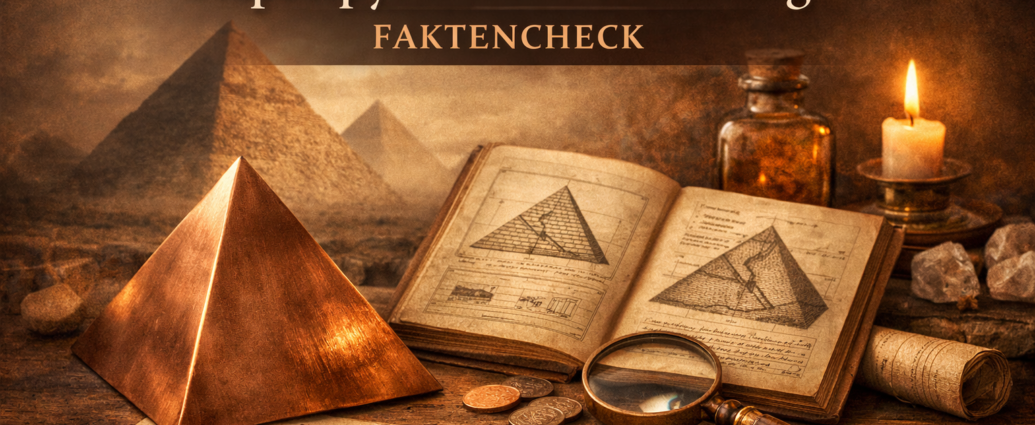
The claim that sick people were placed in copper pyramids as early as the 19th century and felt better within a few hours keeps cropping up. This sounds like spectacular „forgotten knowledge“. However, the historical sources paint a different picture: There is evidence of metallotherapeutic experiments with metal disks and metal plates on the skin in the 19th century on the one hand, and pyramidological interpretations of the pyramid of Cheops as a building of measurement, knowledge or symbolism on the other. The concrete connection to a healing method with pyramids can only be clearly traced in the 20th century.
So anyone looking for a reliable historical basis for „copper pyramid healing“ must clearly distinguish between two things: old reports about metals in medicine and later esoteric tales about pyramid energy. It is precisely at this point that many modern accounts have apparently conflated different lines of tradition into a single, dramatic story.
What sources from the 19th century actually show
In the 19th century, there was actually a movement that went by the name of metallotherapy. In 1853, Victor Burq published a work on „Métallothérapie“, i.e. treatment using metallic applications. Later medical overviews from the 1870s describe this method as the external application of certain metals to the skin or anaesthetic areas of the body. It did not involve rooms, chambers or geometric structures, but direct contact with metal disks, coins or plates.
It is interesting to note that these old reports actually speak of rapid but temporary effects. The overview of metalloscopy and metallotherapy published in 1878 states that, under certain circumstances, visual function can gradually improve after the application of an „active“ metal disk and that this improvement lasts for several hours if the metal is removed in time. In terms of language, this is similar to modern statements such as „within a few hours“, but refers to metal discs on the body and not to pyramids.
Equally important: copper was not the only „miracle metal“. A BMJ review from 1879 mentions discs made of copper, iron, zinc and tin, which were placed one after the other on affected areas of the body for several hours. Other passages also mention gold and other metals. This argues against the idea that there was already a clearly defined doctrine of special healing copper pyramids in the 19th century.
What is even more remarkable is that even the medical community of the time did not unanimously accept these phenomena as proof of a special metallic power. The BMJ review of 1879 refers to an interpretation according to which the observed changes were rather due to strong skin irritation; in the cases described, even a mustard plaster had produced the same or stronger effects than metal disks. In other words, even at the time, there was skepticism about the idea that metals would develop a mysterious special energy.
The crucial point for today's debate is therefore: Yes, there were reports of metal applications and temporary improvements in the 19th century. No, the sources examined here do not include copper pyramids into which patients were placed. The documented procedures deal with externally applied metals, not with pyramidal constructions as healing facilities.
The second strand: pyramidology instead of a healing method
At the same time, a completely different line of interpretation developed around the Great Pyramid in the 19th century: pyramidology. John Taylor's book The Great Pyramid appeared in 1859 and associated the pyramid with a „pyramid inch“ and a „sacred cubit“. Charles Piazzi Smyth took up such ideas in the 1860s and traveled to Giza in 1864 to measure the Great Pyramid as a monument of astronomy and metrology. This was not medicine, but a mixture of measurement, interpretation of symbols and religiously charged historical interpretation.
From an archaeological point of view, the matter is much more sober. Britannica describes the pyramids of ancient Egypt as funerary structures; during the Old Kingdom they were the usual form of royal tomb. The Smithsonian Institution also explains that pyramids were part of larger mortuary and funerary complexes, along with temples, chapels, other tombs and enclosure walls. These standard sources provide no basis for a historical use as healing facilities.
This is precisely the flaw in many modern narratives: From the fact that pyramids were symbolically exaggerated in the 19th century, it does not follow that they were used medically at that time or in antiquity. Surveying myths, religious interpretations and healing claims are three different things. Only later were they combined into a single story.
When the pyramid becomes an „energy source“
The first clearly documentable source in which special effects are attributed to small pyramids is not from the 19th century, but from the 20th century: the 1935 booklet by Antoine Bovis. In it, Bovis explicitly writes that he was unable to experiment on site at the pyramid of Cheops and therefore built pyramids out of cardboard. He then describes measurements taken at about a third of the height and reports on the successful „mummification“ of a small fish and a piece of meat. This is a key point: Bovis talks about cardboard pyramids and preservation effects, not about copper pyramids and the treatment of sick people.
Bovis does formulate the question of whether the „King's Chamber“ could possibly have been a magnetic chamber for various experiments. But here, too, the findings remain clear: this is speculative radiesthesia and not historical documentation of a medical procedure. In any case, no 1800s tale about patients in copper pyramids can be derived from his booklet.
The next frequently cited milestone is Karel Drbal's patent. The patent document mentions a filing date of November 4, 1949, a validity from April 1, 1952 and publication in August 1959. It describes a hollow pyramid body made of dielectric material such as hard paper, paraffinized paper, hard cardboard or plastic, under which razor blades are to be stored in relation to the earth's magnetic field. This is also not copper, not medicine and not the healing of people, but a technical or pseudo-technical claim about razor blades.
By the 1970s at the latest, such motifs had become a popular esoteric myth. Max Toth and Greg Nielsen published in 1976 Pyramid Power; the bibliographical details and the description of the book already show that there was talk here of a „secret energy“ of the pyramids that preserved food, strengthened thought forms and triggered other astonishing effects. This is the phase in which older metal and pyramid motifs finally merged to form an overall narrative that had an impact on the public.
Why „copper“ sounds serious - but the conclusion is wrong
The fact that the modern narrative seems so plausible is also due to the fact that copper actually has a real biological significance. The NIH Office of Dietary Supplements describes copper as an essential mineral and cofactor of various enzymes, including energy production, iron metabolism, connective tissue and neurotransmitter synthesis. This genuine physiological background is often used in alternative narratives to infer far-reaching effects of external copper objects. However, precisely this conclusion is not supported. An essential nutrient is not automatically an effective healing method in the form of a carried or spatially arranged metal object.
When external copper applications are tested today under controlled conditions, the results are sober. A randomized, double-blind, placebo-controlled crossover study on rheumatoid arthritis found no statistically significant differences between the devices tested and concluded that copper bracelets showed no clinically significant therapeutic effect over and above placebo. This does not automatically prove that every pyramid effect ever claimed has been disproved; however, it clearly weakens the basic assumption that external copper objects have a reliable healing effect of their own.
Historical conclusion
The historically best-supported reconstruction looks like this: In the 19th century, there were reports of metallotherapy with disks, coins and plates; at the same time, a pyramidological interpretation of Khufu's pyramid as a building of measurement and knowledge emerged. In the 20th century, Antoine Bovis introduced the cardboard pyramid and the idea of special pyramid effects, followed by Drbal's patent for razor blades under a dielectric pyramid. In the 1970s, this became a popular narrative under the slogan „Pyramid Power“. A reliable primary source from the 19th century, which documents sick people in copper pyramids with rapid healing effects, has not become visible in this source base.
The myth of „forgotten knowledge“ is therefore probably not a historically buried truth, but rather a later narrative pattern composed of older, separate ideas: Metallotherapy, pyramidology, radiesthesia and the modern esoteric market. Anyone who wants to write seriously about copper pyramids and healing should make precisely this distinction visible.
FAQ for the WordPress article
Were there any healing applications with copper in the 19th century?
Yes, but in a different form than the modern copper pyramid narrative claims. The sources speak of metal disks, coins or plates on the skin; not only copper is mentioned, but also other metals such as iron, zinc, tin or gold.
Are there historical primary sources for patients in copper pyramids?
In the source base examined here, no. There are verifiable 19th-century reports on metallotherapy and 20th-century sources on cardboard or dielectric pyramids, but no reliable primary source for an 1800s healing method with copper pyramids in which patients were placed.
Were the Egyptian pyramids originally intended as healing rooms?
The established standard depictions describe them as funerary buildings and royal tombs within larger mortuary cult complexes. A main historical function as a healing facility is not supported there.
Does this make copper completely meaningless in medical terms?
No. Copper is an essential mineral for the human body. However, it does not follow from this that external copper objects or copper pyramids have a proven healing effect; modern clinical data on copper bracelets rather speak against a specific therapeutic effect beyond placebo.
Note: This article is intended for historical and scientific classification and is not a substitute for medical advice.



Comments are closed, but trackbacks and pingbacks are open.