



Polioviruses belong to the group of Enteroviruses and are the triggers of poliomyelitis, also known as polio. It is an acute viral infection that naturally affects humans and can cause a wide range of clinical symptoms. In severe cases, parts of the central nervous system are affected, which gives the disease a special medical significance. The literature describes poliomyelitis as an infection whose course can range from mild general symptoms to neurological deficits.
What are polioviruses?
Polioviruses are enteroviruses that can be transmitted primarily through the ingestion of contaminated food or water. Fecal-oral transmission plays an important role in this. After ingestion, the Virus initially in the body and can spread further from there. The literature describes that the virus can be detectable in the throat for a short time, while it remains present in the stool for much longer.
The spread in the organism is systemic from there. It is particularly significant that in certain cases the brain and spinal cord can be affected. The different virus variants differ in their ability to infect nerve tissue and damage nerve cells. This is one of the key reasons why poliomyelitis has historically been one of the most feared viral infections.
How does a poliovirus infection progress?
Not every poliovirus infection leads to severe neurological consequences. Rather, the literature describes a wide range of possible courses. Some infections are comparatively mild, others show signs of involvement of the meninges or the nervous system. Particularly severe courses are those in which motor nerve cells in the spinal cord, brain or cranial nerve nuclei are affected.
Before the introduction of nationwide vaccination programs, outbreaks mainly occurred in the summer and autumn months of temperate climate zones. This shows the great epidemiological significance poliomyelitis used to have. Preventive measures have fundamentally changed this picture in many regions.
Typical symptoms of poliomyelitis
Early symptoms include a general feeling of illness, mild fever, headache, sore throat and vomiting. According to the literature, these symptoms often begin a few days after infection and can initially appear unspecific. As a result, it is not always possible to immediately assess in the early stages whether an uncomplicated course or a more serious development is imminent.
In the non-paralytic form, there are also signs of meningeal irritation. This means that structures around the central nervous system can be affected. The literature also describes changes in the spinal fluid that are of diagnostic significance.
The paralytic form is characterized by more extensive involvement of the nervous system. If motor nerve cells are damaged, this can lead to muscle weakness, paresis or paralysis. Depending on which areas are affected, different muscle groups may be restricted in their function. This form in particular highlights the severity of the disease.
Why poliomyelitis is taken so seriously medically
Poliomyelitis is considered a serious disease because it not only affects the intestines or general bodily functions, but in severe cases can directly affect the nervous system. The involvement of the spinal cord, brain or cranial nerve nuclei leads to a fundamentally different dimension of the disease. A viral infection that initially has a general effect can develop into a highly relevant neurological situation.
This possibility of severe courses of disease has been History of poliomyelitis. It was precisely the risk of permanent deficits or paralysis that made poliomyelitis a disease that had a deep impact on public health awareness for decades. The conventional medical approach to polio is therefore closely linked to prevention, diagnosis and observation of neurological signs.
Diagnosis and conventional medical classification
Diagnosis is based on the detection of the virus and immunological reactions of the body. The literature describes that polioviruses can be identified in stool or throat secretions. In addition, the detection of high neutralizing antibody levels in the blood can be used for confirmation.
Conventional medicine focuses on the course, neurological involvement and differentiation from other diseases of the nervous system. Of particular importance is the question of whether an infection only causes general symptoms or whether there are signs of meningeal irritation or paralysis.
Treatment and prevention
The literature describes that poliomyelitis cannot be cured causally and that antiviral drugs do not fundamentally change the course of the disease. This makes prevention all the more important. The polio vaccination has long been a routine childhood immunization and has played a decisive role in containing the disease worldwide.
The importance of prevention is particularly clear in the case of poliomyelitis. As severe neurological courses cannot be predicted with certainty, preventive protection is a central component of the medical strategy. This makes it clear why the disease plays such an important role historically and in terms of health policy.
Holistic view of stress and the nervous system
From a broader view of the organism, poliomyelitis is an impressive example of how viral infections can go far beyond local symptoms. If the nervous system is affected, this not only affects individual symptoms, but also central control mechanisms of the body. Movement, muscle control, general condition and the ability to regenerate can be massively affected.
This is precisely why complementary thinking models often look not only at the pathogen itself, but also at the state of the organism as a whole. The focus here is on concepts such as regulation, stress processing, inner stability and individual reactions. This complementary perspective attempts to place biological stress in a broader context.
Complementary perspective on frequency therapy and frequencies
Around the Frequency therapy is often associated with concepts such as Resonance, vibration and regulatory dynamics. In a complementary understanding, the aim is to consider stresses on the organism not only on a material level, but also in connection with functional and systemic patterns. Frequencies are not understood in isolation, but as part of a complementary perspective within the literature.
In the complementary field, attention is often paid to the overall order of the organism, reaction patterns and the sensitivity of regulatory systems, particularly in the case of issues with neurological relevance. In this context, certain frequency data are used as supplementary orientation values within a larger framework of frequency therapy and frequencies.
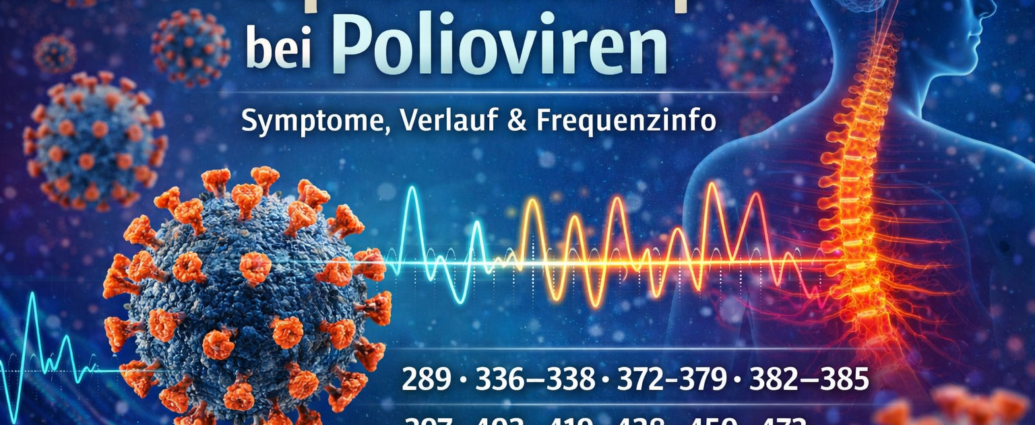
Frequency info
The following frequency ranges are mentioned in the literature for polioviruses:
289, 336-338, 372-379, 382-385, 397, 403, 419, 438, 450, 473, 488, 493, 552, 576-579 kHz
The literature also points out that this list is not yet complete, as further subgroups with different frequency ranges are described.
In the complementary context of frequency therapy and frequencies, this information is understood as supplementary literature references.
Conclusion
Polioviruses are enteroviruses that can trigger an acute infection in humans with very different courses. While some courses appear rather mild, severe cases can lead to involvement of the central nervous system with muscle weakness or paralysis. The conventional medical view includes the transmission route, symptoms, diagnosis, course and, above all, the great importance of prevention through vaccination. In the complementary environment, the view of frequency therapy and frequencies can be understood as a thematic extension. The frequency ranges mentioned in the literature are used as short Frequency info in a larger context.



Comments are closed, but trackbacks and pingbacks are open.