





Conventional medical principles and complementary frequency information
Author: NLS Information medicine Ltd, Herbert Eder
Introduction
Breast cancer is one of the most common tumor diseases in women. The literature describes that breast carcinomas are classified according to the tissue of their origin and the extent of their spread. A Tumor can occur in the milk ducts, in the glandular lobules or in structures close to the connective tissue. Very rarely, other parts of the breast tissue are also affected.
Not every breast cancer progresses in the same way. Some tumors grow slowly over a long period of time and initially remain localized, while others develop much more aggressively and spread to other parts of the body earlier. Even tumors of the same histological group can behave very differently in different patients. This is precisely why diagnostics, tissue analysis and individual treatment planning play such an important role in conventional medicine.
In the following WordPress article, the focus is initially on the basics of conventional medicine. Only at the end follows the Frequency info with the complementary resonance frequencies described in the literature.
What is breast cancer?
Breast cancer is a malignant tumor disease of the breast that is classified differently depending on its origin and biological behavior. The literature describes that a breast carcinoma can develop in the milk ducts, in the mammary gland lobules or in other tissue structures of the breast. This distinction in particular is important for conventional medical classification because it results in different forms of growth and therapeutic approaches.
In principle, a distinction is made between non-invasive and invasive tumor forms are distinguished. Non-invasive carcinomas initially remain confined to their place of origin, while invasive forms can grow into the surrounding tissue and spread further via the lymphatic or bloodstream.
In-situ carcinomas and invasive tumors
A Carcinoma in situ describes an early tumor stage in which the malignant cells remain confined to their site of origin and have not yet invaded neighboring tissue.
Ductal carcinoma in situ
The literature describes that ductal carcinoma in situ often begins in the epithelial cells of the milk ducts. It is not always perceived as a palpable lump and may show up on mammography as fine microcalcifications.
Lobular carcinoma in situ
This form develops in the epithelia of the glandular lobules and often occurs before the menopause.
Invasive breast cancer
Invasive tumor forms can grow into surrounding breast tissue and also affect other organs over the course of time. In the literature, the bones in particular are mentioned as a frequent target region of Metastases mentioned.
Different forms of breast cancer
Breast cancer is not a uniform disease. The literature describes that some tumors grow very slowly and spread late. Other tumors develop much faster and show aggressive biological behavior earlier.
The influencing factors include, among others:
- Original fabric
- Tumor grade
- Hormone dependence
- Invasiveness
- Lymph node status
- Individual biological tumor characteristics
This is precisely why conventional medical assessment is not only based on palpation or imaging, but also essentially on histological and molecular biological classification.
Risk factors for breast cancer
The literature describes several factors that may be associated with an increased risk of breast cancer. These include, among others:
- atypical hyperplasia
- Chronic inflammatory changes in the breast tissue
- Prolonged use of oral contraceptives
- Estrogen replacement therapy
- Family burden
- Known breast cancer genetics
- already undergone breast cancer
- Overweight after the menopause
- older age
Breast cancer in first-degree relatives, such as a mother, sister or daughter, increases the personal risk. The literature also describes that certain familial patterns can be associated with both breast cancer and an increased incidence of ovarian cancer.
Genetic factors and familial clustering
The literature emphasizes that genetic factors play an important role in certain forms of breast cancer. Some women carry genetic changes that are associated with a significantly increased risk of developing the disease. At the same time, an increased genetic risk does not automatically mean that the course of the disease is necessarily more severe than in other patients.
Men can also develop breast cancer, albeit much more rarely. Conventional medical diagnostics must therefore also remain vigilant in men if palpable changes in the breast occur.
Precursors and benign changes with increased attention
An important topic in the literature is benign or functional breast changes, which require special attention in certain constellations.
Mastopathia cystica
Mastopathic or cystic remodeling processes of the breast are described as frequent changes. The literature indicates that certain forms can be regarded as precursors or risk constellations.
Fibrocystic changes
Diffuse nodular, cystic or fibroglandular changes are common and must be assessed in the overall context.
Atypical mastoplasia
Atypical tissue changes are of particular importance in conventional medicine, as they can be interpreted as an indication of an increased risk.
Typical symptoms of breast cancer
It is often not easy to assess the symptoms. The literature describes that breast pain alone is not a typical main sign of breast cancer. Nevertheless, some patients may experience pain even if a lump is not initially palpable.
Typical indications can be
- palpable lump
- Hardening in the breast tissue
- Difference to the surrounding tissue
- later reduced displacement
- Skin changes
- Swelling
- weeping or inflammatory skin areas
- Changes in the shape of the breast
In the early stages, a lump can often still move relatively freely. In advanced stages, it often becomes coarser and less mobile. An inflammatory form of breast cancer can be accompanied by warmth, redness and swelling of the breast and thus initially resemble inflammation.
Inflammatory and advanced forms
The literature describes that advanced breast cancer can lead not only to deep tissue changes, but also to significant skin symptoms. These include
- reddened skin
- Swelling
- Inflammatory imposing changes
- Ulcerating areas
- chronically irritated or hardened tissue
Inflammatory changes in the breast in particular therefore always require careful clarification.
Conventional medical diagnostics for breast cancer
The diagnosis of breast cancer is based on several examination steps.
Physical examination
Palpation of the breast and regional lymph nodes is an essential first step.
Medical history and family history
Family history, previous breast findings and hormonal factors are important for risk assessment.
Mammography
Mammography is a key procedure for visualizing structural changes and microcalcifications.
Ultrasound
Ultrasound complements mammography and helps to distinguish solid from fluid-filled changes.
Biopsy
The tissue sample is crucial for the final diagnosis. Only a histological examination can clarify with certainty which type of tumor is involved.
Advanced imaging
To search for metastases, additional methods can be used depending on the problem:
Conventional medical treatment of breast cancer
Treatment depends on the type of tumor, stage, hormone dependency and general condition of the patient. The most important treatment methods mentioned in the literature are
- Operation
- Radiotherapy
- Chemotherapy
- hormone-blocking medication
- Combination therapies
In addition Biological response modifier mentioned, for example:
- Interferons
- IL-2
- LAK
- TNF
The specific therapy is always individually tailored to the type of tumor and its spread.
Why breast cancer is particularly interesting for frequency therapy
For the Frequency therapy Breast cancer is particularly interesting because very different processes can occur in breast tissue: early localized forms, invasive developments, hormonal influences, precursors and functional tissue changes such as mastopathic remodelling. Information medicine looks at these processes not only structurally, but also from the perspective of complementary resonance patterns.
Precisely because the literature provides different frequency lists for ductal processes, adenocarcinomatous patterns, mastopathic changes and atypical tissue changes, the frequency information in the breast area is particularly complex.
Frequency info - complementary resonance frequencies for breast cancer
The following are those mentioned in the literature complementary resonant frequencies different breast changes and tumor forms.
Milky duct wall carcinoma
315-321 kHz
This area is mentioned in the literature for breast cancer in connection with mammary duct wall processes.
Adenocarcinomatous patterns
426-438 kHz
This frequency range is described in the literature for adenocarcinomatous patterns in the breast area.
Mastopathia cystica
314-321, 340, 353-354, 372, 396-402, 410-413, 442-451, 476, 513, 525-527, 538, 543-545 kHz
This list shows a broad spectrum with several distinctive clusters.
Atypical mastoplasia
314-321, 340, 353-354, 373, 400, 410-413, 442-451, 476, 513-515, 550-551, 565, 579 kHz
Here, too, there are clear overlaps with other breast patterns.
Ductal cancer
314-319 kHz
Acinar cancer
426-438 kHz
Further resonances of breast cancer
314-321, 324, 335-336, 346, 353, 370-374, 394, 432, 440-451, 454, 482, 488, 502, 504-507, 578 kHz
These additional resonances expand the overall complementary picture of breast cancer.
Frequency info compact
Milk duct wall carcinoma: 315-321 kHz
Adenocarcinomatous patterns: 426-438 kHz
Mastopathia cystica: 314-321, 340, 353-354, 372, 396-402, 410-413, 442-451, 476, 513, 525-527, 538, 543-545 kHz
Atypical mastoplasia: 314-321, 340, 353-354, 373, 400, 410-413, 442-451, 476, 513-515, 550-551, 565, 579 kHz
Ductal cancer: 314-319 kHz
Acinar cancer: 426-438 kHz
Further resonances in breast cancer: 314-321, 324, 335-336, 346, 353, 370-374, 394, 432, 440-451, 454, 482, 488, 502, 504-507, 578 kHz
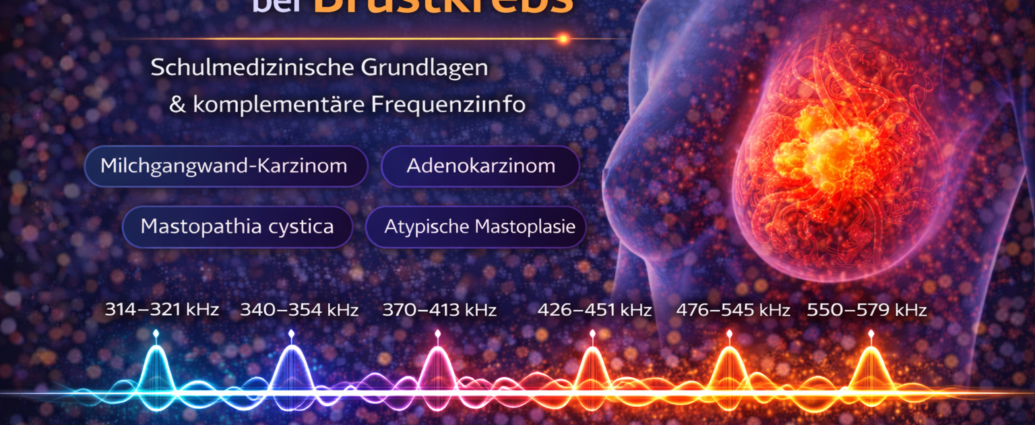
Complementary classification of the resonance ranges
Within frequency therapy, breast cancer and precancerous breast changes show several conspicuous resonance areas:
- 314 to 321 kHz
- 340 to 354 kHz
- 370 to 413 kHz
- 426 to 451 kHz
- 476 to 545 kHz
- 550 to 579 kHz
The area between 426 and 451 kHz appears to be particularly central, as it recurs both in connection with adenocarcinomatous patterns and in other breast constellations. Equally striking are the resonance clusters in the area of mastopathic and atypical changes, which partially overlap with the frequency patterns of more invasive processes.
In information medicine, this staggering is seen as an indication of the progression and gradation of different complementary tissue patterns.
Importance of frequency therapy in a complementary context
Within frequency therapy, breast cancer is not only understood as a local tumor, but also as an expression of complex regulatory and tissue changes. The complementary frequency information expands the conventional medical view to include resonance areas, which are assigned to different breast patterns in the literature.
Breast tissue, where hormonal influences, glandular tissue, milk ducts, connective tissue and functional remodeling are closely interlinked, creates a particularly complex resonance pattern. Frequency therapy therefore not only looks at the manifest tumor, but also at precursors, atypical patterns and mastopathic changes in a complementary context.
Conclusion
Breast cancer is a common and biologically very different tumor disease. Conventional medicine focuses on the tissue of origin, tumor spread, risk factors, diagnostics and an individually tailored therapy consisting of surgery, radiotherapy, chemotherapy and hormonal treatment.
The topic also opens up a complementary perspective for frequency therapy. The resonance frequencies described in the literature for mammary duct wall carcinomas, adenocarcinomatous patterns, mastopathia cystica, atypical mastoplasia and other forms of breast cancer form a structured frequency information that can be considered as a complement within information medicine.
Particularly striking are the resonance clusters between 314 and 321 kHz, 426 and 451 kHz and the higher ranges between 476 and 579 kHz. The result is a detailed WordPress post that combines conventional medical basics and complementary frequency information on breast cancer in a clearly structured, SEO-compatible and directly usable way.


Comments are closed, but trackbacks and pingbacks are open.