





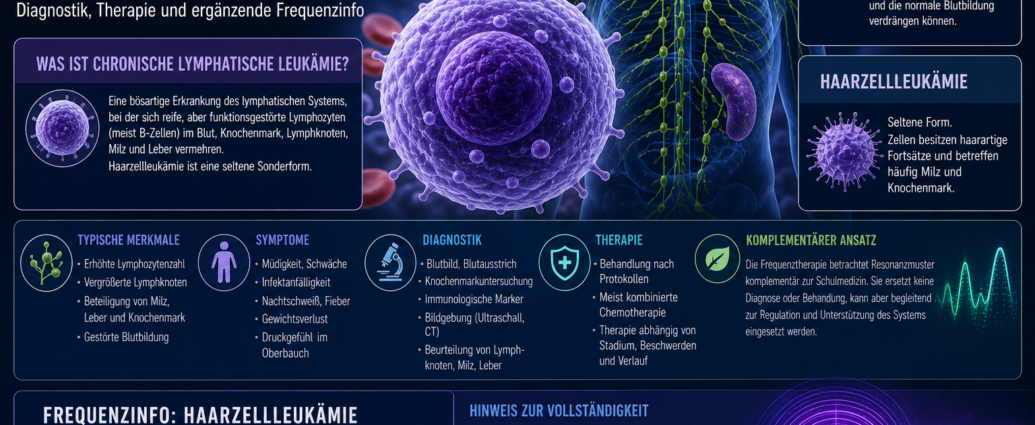
The Frequency therapy in chronic lymphocytic leukemia is described in the complementary context as a supplementary perspective on conventional medical principles, lymphocyte proliferation, lymph node enlargement, diagnosis, therapy, and possible resonance patterns. Chronic lymphocytic leukemia is a disease of the lymphatic system in which mature-appearing but pathologically altered lymphocytes proliferate in the blood, bone marrow, and lymphatic organs.
From a conventional medical perspective, chronic lymphocytic leukemia is one of the most common forms of leukemia in adults. It is particularly common for this to be B-cell leukemia. A rarer, related form is hairy cell leukemia. The literature also describes certain resonance frequencies that are used as complementary therapies within the context of frequency therapy. Frequency info can be documented and examined.
Frequency Therapy for Chronic Lymphocytic Leukemia: An Overview of Conventional Medicine
Chronic lymphocytic leukemia is a malignant disease of the lymphocytes. Lymphocytes are white blood cells and an important part of the immune system. They play a role in defending against pathogens, producing antibodies, and regulating immune responses.
In chronic lymphocytic leukemia, lymphocytes that appear mature but are pathologically altered proliferate. These cells can accumulate in the blood, bone marrow, lymph nodes, spleen, and liver. This leads to characteristic changes in the blood count as well as enlargement of the lymphatic organs.
The term „chronic“ refers to the typically slower progression of the disease compared to acute leukemias. Many patients have no symptoms or only mild symptoms at the onset. The disease is often discovered by chance during a blood test.
Frequency therapy for chronic lymphocytic leukemia and lymphocytes
Lymphocytes are among the most important immune cells. They are broadly classified into B lymphocytes, T lymphocytes, and natural killer cells. In chronic lymphocytic leukemia, the B-cell lineage is usually the primary focus.
B lymphocytes normally mature into plasma cells and produce antibodies. In B-cell leukemia, however, abnormal B lymphocytes multiply and fail to perform their normal function adequately. They accumulate and displace healthy cells in the hematopoietic system.
This can result in a weakened immune system. Although there are many lymphocytes present, they do not function normally. This can lead to increased susceptibility to infections, fatigue, and other symptoms.
B-cell leukemia as the most common form
B-cell leukemia is the most common form of chronic lymphocytic leukemia. In this condition, the abnormal cells originate from the B-cell lineage. Under a microscope, these cells often appear mature, but they do not behave normally from a biological standpoint.
They can accumulate in the blood and cause the lymph nodes to swell. The bone marrow, spleen, and liver may also be affected. Over time, normal blood production may be impaired.
As leukemic lymphocytes increasingly take over the bone marrow, the production of normal red blood cells, white blood cells, and platelets may decline. This leads to anemia, an increased susceptibility to infection, and signs of bleeding.
Hair cell leukemia as a rare form
Hair cell leukemia is a rare form of leukemia. It is also classified as a disease of the B-cell lineage. The name derives from the microscopic appearance of the tumor cells, which may have fine, hair-like projections.
Hair cell leukemia is often a chronic condition that affects the blood, bone marrow, and spleen. Typical symptoms may include an enlarged spleen, low blood cell counts, and susceptibility to infections.
The literature cites specific resonance frequencies for hairy cell leukemia. These are listed in the "Frequency Information" section of this article as supplementary frequency data.
Frequency therapy for chronic lymphocytic leukemia and lymph nodes
A characteristic feature of chronic lymphocytic leukemia is swollen lymph nodes. These can occur in the neck, armpits, groin, or deeper areas of the body.
Lymph nodes are usually painless and may gradually enlarge. In some cases, they are discovered by chance during an examination. If deeper lymph nodes are enlarged, they may cause discomfort due to pressure.
Enlarged lymph nodes indicate that the disease affects more than just the blood. It is part of a broader lymphatic process in which the blood, bone marrow, lymph nodes, spleen, and immune system are all interconnected.
Bone Marrow and Hematopoiesis in Chronic Lymphocytic Leukemia
The bone marrow is the primary site of blood formation. It is where red blood cells, white blood cells, and platelets are produced. In chronic lymphocytic leukemia, leukemic lymphocytes can accumulate in the bone marrow.
If these cells take up too much space, normal blood production is impaired. This can lead to anemia. Those affected feel tired, weak, and less able to cope with stress. If platelet levels are low, bruising or bleeding can occur more easily.
Normal immune function may also be impaired. Despite an elevated lymphocyte count, infections may occur more frequently or be more severe because the abnormally altered cells are unable to perform their defensive functions adequately.
Common symptoms of chronic lymphocytic leukemia
Chronic lymphocytic leukemia can go unnoticed for a long time without causing any noticeable symptoms. Many cases are detected during routine blood tests. When symptoms do appear, they usually develop gradually.
Possible complaints are
- Tiredness
- Power reduction
- feeling of weakness
- swollen lymph nodes
- Susceptibility to infection
- Night sweats
- Fever
- unwanted weight loss
- A feeling of pressure in the upper abdomen
- Enlarged spleen
- Enlarged liver
- Anemia
- Paleness
- Shortness of breath during physical activity
- bruises
- Tendency to bleed
These symptoms can vary in severity. In some people, the condition remains stable for a long time, while others experience a more active course of the disease.
Frequency therapy for chronic lymphocytic leukemia and the immune system
The immune system plays a central role in chronic lymphocytic leukemia. The disease affects lymphocytes, which are cells normally responsible for defense and immune regulation.
The proliferation of altered lymphocytes can weaken normal immune function. Less effective antibodies may be produced, and infections may occur more frequently. At the same time, the immune system may be dysregulated.
In the complementary context of frequency therapy, this relationship is given special attention. Lymphocytes, lymph nodes, bone marrow, the spleen, antibody production, and the body’s ability to regulate itself are considered as a whole.
Possible complications of chronic lymphocytic leukemia
Various complications can arise during the course of the disease. One major group involves blood formation. If the bone marrow is severely affected, this can lead to anemia, a low platelet count, and an increased susceptibility to infections.
Autoimmune phenomena may also occur. In such cases, the immune system attacks the body’s own blood cells. This can, for example, contribute to increased destruction of red blood cells or platelets.
Another challenge is the increased susceptibility to infections. This can be exacerbated both by the disease itself and by certain treatments. Therefore, monitoring the immune system is an important part of patient care.
Conventional medical diagnosis of chronic lymphocytic leukemia
Diagnosis usually begins with a blood test. An elevated lymphocyte count in the blood is typical. Red blood cells, platelets, and other white blood cells are also evaluated.
A blood smear can show what the cells look like. Further tests determine whether the condition is a B-cell disorder. This may involve testing for immunological cell markers.
Depending on the situation, bone marrow tests, ultrasound, CT scans, or other imaging techniques may also be used. These help to better assess involvement of the lymph nodes, spleen, liver, and bone marrow.
Diagnosis of hairy cell leukemia
In hairy cell leukemia, the focus is on blood counts, blood smears, and bone marrow examinations. Under the microscope, the characteristic cells may exhibit hair-like projections.
Reduced blood cell counts, an enlarged spleen, and characteristic bone marrow findings are commonly observed. The exact diagnosis is determined through microscopic, immunological, and, if necessary, molecular testing.
It is important to distinguish this condition from classic chronic lymphocytic leukemia, as hairy-cell leukemia is a distinct form of the disease that requires a specific treatment plan.
Conventional medical treatment of chronic lymphocytic leukemia
Treatment depends on the stage of the disease, symptoms, blood test results, lymph node enlargement, overall health, and disease progression. Not all cases of chronic lymphocytic leukemia require immediate treatment. In cases where the disease is stable and asymptomatic, regular monitoring may be sufficient at first.
If the disease becomes active, causes symptoms, or blood test results show significant changes, conventional medical treatments are used. The literature describes treatment based on established protocols, often involving combination chemotherapy.
Today, various modern treatment strategies are used depending on the situation. The specific treatment plan is determined on an individual basis based on the patient’s findings, risk profile, and tolerance.
Treatment of hairy cell leukemia
Hair cell leukemia is also treated according to specific protocols. Because it is rare, treatment is tailored to the patient’s blood count, spleen size, susceptibility to infection, and symptoms.
The goal of treatment is to suppress abnormal cells, improve normal blood production, and reduce susceptibility to infection.
In a complementary context, the resonance frequencies cited in the literature can be further documented and considered within the framework of frequency therapy.
Frequency Therapy for Chronic Lymphocytic Leukemia in a Complementary Care Setting
Frequency therapy looks at biological processes from the point of view of vibration, Resonance and regulation. In chronic lymphocytic leukemia, the complementary approach focuses on lymphocytes, the B-cell lineage, lymph nodes, bone marrow, the spleen, hematopoiesis, the immune system, and potential resonance patterns.
The literature cites specific resonance frequencies for hairy cell leukemia. These frequencies can be documented as supplementary frequency information in the context of frequency therapy.
The frequencies are not considered in isolation. They are evaluated in conjunction with the conventional medical diagnosis, blood count, lymph node status, spleen size, susceptibility to infection, and the individual’s regulatory status.
A Broader Look at Frequency Therapy and Leukemia
Leukemias are diseases of the hematopoietic and lymphatic systems. They affect not only individual organs but the entire body. The blood, bone marrow, lymph nodes, spleen, liver, and immune system are closely interconnected.
Frequency therapy views leukemias, in a broader sense, as a manifestation of impaired Cell communication and altered biological order. In chronic lymphocytic leukemia, this particularly affects mature but pathologically altered lymphocytes.
The focus is on regulation, resonance patterns, immune balance, lymph flow, and the question of how the system can be viewed as a whole.
Frequency Info: Hair Cell Leukemia
The following frequencies are cited in the literature in connection with hairy cell leukemia. In the complementary context of frequency therapy, they are regarded as supplementary resonance ranges.
Frequency therapy for hairy cell leukemia
318 kHz,
399 kHz,
440-452 kHz,
477 kHz,
496–498 kHz.
These frequencies are described in the literature as common resonance frequencies associated with hairy cell leukemia. In the context of frequency therapy, they can be used as a supplementary guide for documentation, resonance analysis, and individualized treatment.
Frequency information: mid-range frequencies
Some of these frequencies fall within the mid-range and, in a complementary context, can be viewed as particularly associated with lymphocytes, bone marrow, and the lymphatic system.
Frequency therapy for moderate resonances
318 kHz,
399 kHz,
440–452 kHz.
These frequencies can be identified as key resonance ranges in hair cell leukemia. The 440–452 kHz range, in particular, constitutes a broad frequency band.
Frequency information: higher resonance ranges
In addition to the mid-range frequencies, the literature also mentions higher resonance points.
Frequency therapy for higher resonances
477 kHz,
496–498 kHz.
These frequencies complement the resonance pattern observed in hairy cell leukemia and can be considered additional frequency fields in a complementary context.
Frequency Information: Note on Completeness
The literature indicates that the list of frequencies for hairy cell leukemia is not yet complete. In frequency therapy, this means that the frequencies listed should be viewed as a documented guide, and that individual resonance patterns may also be taken into account.
Frequency therapy tailored to individual resonance frequencies
Lymphocytes,
B-cell series,
Bone marrow,
Lymph nodes,
Spleen,
Blood formation,
Immune system,
individual resonance patterns.
This additional perspective can help put the frequency list into context in relation to the individual situation.
Frequency therapy for chronic lymphocytic leukemia: A comparison of frequency patterns
When comparing the frequencies listed, it is noticeable that the 440–452 kHz range is particularly broad. It constitutes the central resonance field of the frequency list for hair cell leukemia cited in the literature.
The individual frequencies 318 kHz, 399 kHz, and 477 kHz complete this pattern. The 496–498 kHz range forms a higher resonance field, which can be documented separately.
The frequencies are always considered in conjunction with the conventional medical diagnosis, the distinction between chronic lymphocytic leukemia and hairy cell leukemia, the blood count, the bone marrow findings, the size of the spleen, and the patient’s individual regulatory status.
Frequency Therapy for Chronic Lymphocytic Leukemia: Summary
Chronic lymphocytic leukemia is a disease of the lymphatic system in which mature-appearing but pathologically altered lymphocytes proliferate. The most common form is B-cell leukemia. Typical features include an elevated lymphocyte count, enlarged lymph nodes, and possible involvement of the bone marrow, spleen, and liver.
Hair cell leukemia is a rare form of leukemia characterized by cells that may exhibit hair-like projections. In conventional medicine, diagnosis and monitoring of the disease’s progression are performed through blood tests, blood smears, bone marrow examinations, immunological markers, and imaging techniques. Treatment depends on the type of disease, symptoms, and course of the illness and is carried out according to specific protocols.
Frequency therapy offers a complementary perspective. The literature cites resonance frequencies such as 318 kHz, 399 kHz, 440–452 kHz, 477 kHz, and 496–498 kHz in connection with hairy cell leukemia. This list is described as not yet complete. The frequencies can be used in a complementary context for documentation, resonance analysis, and individualized frequency therapy work.

Comments are closed, but trackbacks and pingbacks are open.