





Conventional medical principles and complementary frequency information
Author: NLS Information medicine Ltd, Herbert Eder
Introduction
Fibrocystic breast changes are among the most common benign changes in the breast. In the literature, they are also described as fibroglandular changes, fibrocystic changes, chronic cystic mastitis, mammary dysplasia or benign breast disease. Many women experience palpable changes, feelings of tension or pressure-sensitive areas in the breast in the course of their lives, without any malignant disease being present.
It is precisely because palpable lumps in the breast immediately cause great concern for many patients that a clear medical classification is particularly important. The literature describes that the majority of palpable breast changes are benign. At the same time, every new or changing structure must be carefully clarified in order to reliably distinguish benign changes from other diseases.
The following WordPress article first focuses on the conventional medical basics of fibrocystic breast changes. Only at the end follows the Frequency info with the complementary resonance frequencies mentioned in the literature.
What are fibrocystic breast changes?
Fibrocystic breast changes refer to benign changes in the breast tissue that may be associated with nodular, cystic or fibroglandular remodeling processes. They are described in the literature as a common phenomenon that particularly affects women in younger and middle adulthood. Adolescents can also develop such changes, while men are affected much less frequently.
A general nodular structure of the breast is typical, often in the upper outer area. These tissue changes can be more or less pronounced depending on the menstrual cycle. Such complaints are particularly common between the ages of 35 and 50. They often recede after the menopause, but can persist with hormonal substitution.
An important point is that a general lumpy breast structure does not automatically mean cancer. This is precisely why differentiated clarification is so crucial.
Which changes belong to this group of forms?
Several benign changes in the breast are described in the literature in this context.
Cysts
Cysts are fluid-filled cavities in the breast tissue. Some are very small, others can become significantly larger. Larger cysts can become slightly deformed under pressure and can often be displaced against the surrounding tissue.
Fibroadenomas
Fibroadenomas are small, benign, firm lumps consisting of fibrous and glandular tissue. They are particularly common in younger women. In the literature, they are described as smooth, firm, elastic and well-defined.
Lipomas
Lipomas are benign tumors of the fatty tissue and can also present as palpable lumps.
Intraductal papillomas
These are benign changes in the milk ducts, which can also be palpable or cause secretions from the nipple.
Consequences of inflammation or injuries
Infections or severe tissue damage can also cause lumps or hardening in the breast.
Why do fibrocystic breast changes occur?
The development of benign breast changes is complex. In conventional medicine, the focus is primarily on hormonal influences, tissue reactions and cycle-dependent fluid shifts. At the end of the menstrual cycle in particular, the body can store more fluid, which can cause existing cysts to become larger or symptoms to become more pronounced.
The literature describes that many women are more prone to such changes in certain phases of their lives. These include hormonally active years with cycle-related fluctuations. The individual tissue structure also plays a role. Fibrocystic changes are therefore not to be understood as a uniform disease, but rather as a collective term for various benign remodeling processes of the breast tissue.
Typical symptoms
The symptoms can vary greatly. The following symptoms in particular are mentioned in the literature:
- One or more palpable nodes
- Pressure sensitivity
- Chest pain
- Feeling of tension
- Touch sensitivity
- Secretion from the nipple
Not every lump causes pain. Some changes go unnoticed for a long time and are only discovered during self-examination or as part of a medical examination. Larger cysts can be more conspicuous, especially if they swell depending on the cycle.
Fibroadenomas often feel:
- firm
- smooth
- elastic
- well delimitable
on. This tactile characteristic is clinically helpful, but does not replace further clarification.
Cycle-dependent changes in the breast
A central feature of fibrocystic changes is their cycle dependency. The literature describes that many lumps or indurations become more noticeable before menstruation when the body retains more fluid. This can make the breast feel fuller, more sensitive to pressure and more lumpy.
It is precisely this hormonal reaction that explains why some women only experience symptoms during certain phases of the month. After menstruation, the same findings can recede significantly.
A closer look at fibroadenomas
Fibroadenomas occupy a special place in the literature. They are benign, non-cancerous lumps of fibrous and glandular tissue. They are particularly typical of younger women and are often discovered by chance.
Characteristic features are
- Clear limitation
- Smooth surface
- elastic-firm consistency
- Good displaceability
Many fibroadenomas remain stable over a long period of time. Some change depending on hormones, others remain virtually unchanged. Differentiating them from other palpable breast changes is an important part of conventional medical diagnostics.
Conventional medical diagnostics
Conventional medical clarification always begins with a careful examination. The following diagnostic procedures are mentioned in the literature:
Physical examination
Palpation provides an initial indication of the size, mobility, consistency and painfulness of a change.
Mammography
Mammography is used for structural imaging of the breast tissue and can visualize suspicious areas.
Ultrasound
Ultrasound is particularly important to distinguish fluid-filled cysts from solid lumps.
CT and MRI
In special cases, further imaging procedures such as CT or MRI can be used.
Biopsy
If a finding is unclear or needs to be clarified more precisely, a tissue sample is taken. Only a histological examination can determine with certainty what type of change is involved.
Precise diagnosis is particularly important in the case of breast changes, because benign findings and findings requiring clarification can overlap clinically.
Conventional medical treatment
Treatment depends on the type and extent of the symptoms. The literature mainly describes symptomatic treatment for fibrocystic breast changes. This includes the administration of high doses of vitamin E. In addition, conventional medicine Practice The focus is on individual symptom relief.
Depending on the findings, the procedure may include
- Observation and progress monitoring
- Symptomatic measures
- Imaging follow-up checks
- Further diagnostics if necessary
Since in many cases the changes are benign, the focus is not necessarily on invasive therapy, but on safe classification and adaptation to the symptoms.
Why fibrocystic breast changes are interesting for frequency therapy
Within the Frequency therapy fibrocystic breast changes are particularly interesting because they represent a functional and structural remodeling of the breast tissue. Information medicine views such changes not only in terms of palpable lumps or cystic processes, but also as an expression of altered regulatory patterns in the tissue.
It is precisely because cysts, fibroadenomas, states of tension and cycle-dependent changes reflect a complex interplay of tissue, fluid, hormonal dynamics and local sensitivity that interesting resonance areas arise from a complementary perspective. This is precisely where the Frequency info to.
Frequency information - complementary resonance frequencies for fibrocystic breast changes
In the literature fibrocystic breast changes following Complementary resonant frequencies called:
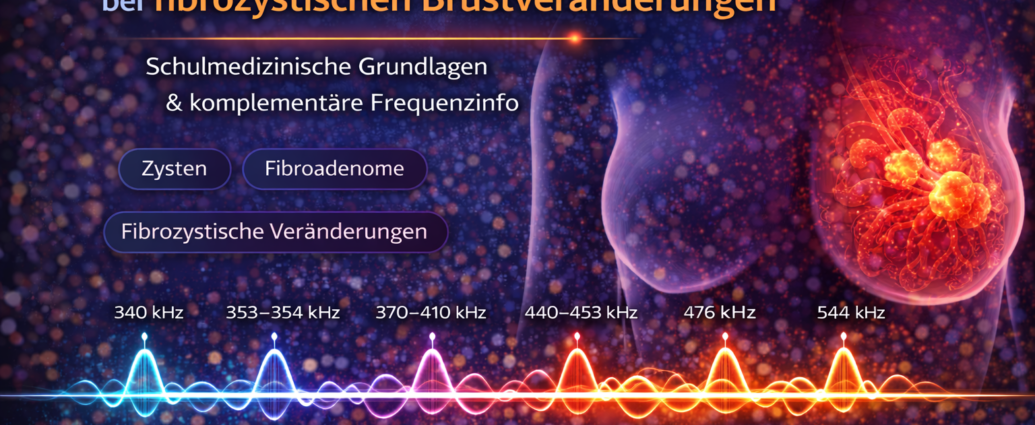
340, 353-354, 370-373, 396, 402-410, 440-453, 476, 513, 544 kHz
These frequency ranges can be divided into several characteristic resonance fields.
Lower resonance range
- 340 kHz
- 353-354 kHz
Medium resonance field
- 370-373 kHz
- 396 kHz
- 402-410 kHz
Upper central resonance field
- 440-453 kHz
Higher individual areas
- 476 kHz
- 513 kHz
- 544 kHz
Particularly striking is the concentration between 402 and 453 kHz, which appears as a prominent resonance chamber within the complementary frequency view.
Frequency info - complementary resonance frequencies for breast fibroadenomas
In the literature, the pathogen context of Breast fibroadenomas following Complementary resonant frequencies called:
354, 442-451 kHz
Here, too, there is a clear focus on the upper mid-kilohertz range. Especially the range 442 to 451 kHz is conspicuous because it overlaps with the central resonance field of the general fibrocystic breast changes.
Frequency info compact
Fibrocystic breast changes - complementary resonance frequencies:
340, 353-354, 370-373, 396, 402-410, 440-453, 476, 513, 544 kHz
Fibroadenomas of the breast - complementary resonance frequencies:
354, 442-451 kHz
Complementary classification of the resonance ranges
The following resonance chambers are particularly striking for frequency therapy:
- 340 to 354 kHz
- 370 to 410 kHz
- 440 to 453 kHz
- 476 to 544 kHz
The area between 440 and 453 kHz appears to be a particularly striking focus. The return of 354 kHz in the context of fibroadenomas is interesting. Within information medicine, such clusters are regarded as indications of related complementary resonance patterns.
The overlap between the general frequency information of fibrocystic changes and the specific frequency information of fibroadenomas makes this area particularly relevant for frequency therapy.
Importance of frequency therapy in a complementary context
Within frequency therapy, fibrocystic breast changes are not only seen as palpable tissue findings, but also as an expression of altered local information and regulation patterns. The complementary frequency information supplements the structural conventional medical view with resonance spaces, which are assigned to certain tissue changes in the literature.
Breast tissue in particular, which is hormonally, cycle-dependent and functionally very dynamic, is a particularly sensitive field for complementary observations from an information medicine perspective. Frequency therapy focuses on the resonance patterns of cysts, nodular changes and fibroadenomas.
Conclusion
Fibrocystic breast changes are among the most common benign changes in breast tissue. Conventional medicine focuses on palpation, imaging, reliable differentiation from other breast changes and treatment based on the symptoms. Cysts, fibroadenomas and other benign lumps are particularly common.
The topic also opens up a complementary perspective for frequency therapy. The resonance frequencies described in the literature for fibrocystic breast changes and fibroadenomas form a structured frequency information that can be considered as a complementary aspect within information medicine. Particularly striking are the resonance fields between 402 and 453 kHz and the recurring areas around 354 kHz.


Comments are closed, but trackbacks and pingbacks are open.