





Symptoms, forms and complementary frequency information
Author: NLS Information medicine Ltd, Herbert Eder
Introduction
Head and neck tumors comprise a diverse group of malignant diseases in the upper respiratory and alimentary tract. In the literature, this includes tumors that arise in the lips, oral cavity, nasal cavity, paranasal sinuses, pharynx and larynx. Although these tumors occur in different regions, many of them have common biological and clinical features.
For conventional medicine, the main focus of head and neck tumors is on the exact location, histological classification, the extent of the tumor and the question of lymph node involvement or metastasis. In addition, there are numerous risk factors that are associated with the development of such tumors in the literature. At the same time, the topic is also important for the Frequency therapy and information medicine, because complementary resonance patterns and accompanying biological stresses are also considered in addition to the classical aspects of conventional medicine.
In the following WordPress article, the conventional medical basics of head and neck tumors are first presented in detail. Only at the end follows the Frequency info with the complementary resonance frequencies described in the literature.
What are head and neck tumors?
The term head and neck tumors refers to a group of biologically similar cancers that originate in the upper aerodigestive tract. These include in particular
- Lips
- Oral cavity
- Nasal cavity
- Paranasal sinuses
- Pharynx
- Larynx
These regions are functionally closely connected. They play a central role in breathing, swallowing, speaking, smelling and taste. Tumors in this area can therefore lead to considerable functional impairment at an early stage.
The literature emphasizes that head and neck tumors are similar in many respects despite their different sites of origin. At the same time, however, it is the specific location that determines the clinical behavior, the type of symptoms, the therapeutic options and the prognosis.
Risk factors and possible causes
In the literature, head and neck tumors are closely linked to certain environmental and lifestyle factors. These are mentioned particularly frequently:
- Tobacco smoking
- Alcohol consumption
- Wood dust
- Paint and gasoline vapors
- Plastic by-products
- Asbestos
- Chronic irritation
One particular risk factor is the gastroesophageal reflux disease, which is mentioned in the literature in particular as a possible connection with tumors of the larynx. Chronic irritation of sensitive mucous membranes can stress the tissue over a long period of time and promote pathological changes.
In addition, the literature also Viral and microbial factors described as contributory stresses. These are mentioned in particular:
- HPV
- EBV
- CMV
- HTLV
- Mycoplasma fermentans or penetrans
The combination of classic risk factors with additional biological stresses makes head and neck tumors a particularly complex topic.
The role of viruses and microbial contamination
The literature describes that certain head and neck tumors can be associated with viral exposure. Particular emphasis is placed on the presence of HPV DNA in the tissue of oral and tonsil carcinomas. This is seen as an indication that HPV can play a predisposing role in the development of oral tumors, even in people who neither smoke nor consume alcohol excessively.
In addition to HPV EBV, CMV, HTLV and Mycoplasma species are described as predisposing factors. This point is particularly interesting for frequency therapy because not only the tumor structure itself, but also accompanying biological stresses are included in an extended resonance model.
Squamous cell carcinoma - the most common form of head and neck tumor
The literature emphasizes that the Squamous cell carcinoma, also Squamous cell carcinoma or short SCC, which accounts for more than 90 percent of all head and neck tumors. It is a malignant Tumor, which originates from keratinizing or malpighian epithelial cells.
Histologically, squamous cell carcinoma is characterized by
- Keratin formation
- so-called keratin pearls
- clear desmosome compounds
- intracytoplasmic keratin tonofilaments
Its biological behavior strongly depends on the site of origin. Although squamous cell carcinoma belongs to a common tumor group, the respective region is decisive for growth, invasion, lymph node involvement and therapeutic approach.
Early forms and precursors of squamous cell carcinoma
The literature describes that squamous cell carcinoma frequently begins as a superficial, circumscribed, slightly raised and often initially symptom-free change. Such early changes can manifest themselves as Erythroplakia and either show a Carcinoma in situ or already correspond to an invasive carcinoma.
Another important preliminary stage is the Leukoplakia. These purely white mucosal changes are considered precancerous lesions. Some of them can develop into carcinoma in situ or invasive squamous cell carcinoma.
Clinical manifestations such as:
- Plaques
- Node
- verrucous papules
- scaly changes
- Ulcerations
- Red, white or brownish lesions
are described in the literature in connection with squamous cell carcinomas.
A special form is the verrucous carcinoma, which can be prognostically more favorable because it is less likely to spread early lymphogenously or distant metastatically.
Tumors of the oral cavity
Oral squamous cell carcinomas often occur in the oral cavity. Particularly mentioned localizations are
- inner lip
- Tongue
- Mouth bottom
- Gingiva
- hard palate
According to the literature, these tumors are closely associated with tobacco consumption, especially chewing tobacco, as well as heavy alcohol consumption. Surgery often plays a particularly important role in the oral cavity, as many of these tumors can be treated surgically at an early stage.
Typical complaints can be
- palpable or visible changes to the mucous membrane
- Pain
- Burning
- Bleeding
- Difficulty swallowing
- Language changes
Nasopharyngeal carcinomas
Nasopharyngeal carcinomas arise in the area of the nasopharynx, i.e. where the nasal cavity, ear trumpets and upper pharynx are connected. The literature indicates that some of these tumors are biologically similar to typical head and neck squamous cell carcinoma, while poorly differentiated nasopharyngeal carcinomas are much more distinct in epidemiology, biology and clinical behavior.
This group of tumors in particular is often regarded as a separate disease. Depending on the location, symptoms such as
- impaired nasal breathing
- Ear symptoms
- Feeling of pressure
- Enlarged cervical lymph nodes
- Difficulty swallowing
Oropharyngeal tumors
Oropharyngeal tumors begin in the middle section of the throat. These include in particular
- Soft palate
- Base of tongue
- Tonsil region
The literature emphasizes that squamous cell carcinomas of the tonsils are more frequently associated with HPV infections than tumours of other head and neck regions. This biological peculiarity is just as important for conventional medical classification as it is for the complementary view within frequency therapy.
Tumors of the hypopharynx
The hypopharynx includes:
- Piriform sinus
- posterior pharyngeal wall
- postcricoid area
In the literature, tumors in this area are often diagnosed at an advanced stage and are considered to have a particularly unfavourable prognosis. One reason for this is the pronounced lymphatic network around the larynx, which can promote early metastasis.
This is precisely why early detection in this area is particularly important.
Laryngeal carcinomas
Laryngeal carcinomas develop in the area of the larynx. A distinction is made depending on the exact location:
- glottic carcinomas
- supraglottic carcinomas
- subglottic carcinomas
The strong link between laryngeal carcinomas and tobacco consumption is emphasized in the literature. Laryngeal tumors can cause hoarseness, voice changes, difficulty swallowing or breathing problems.
Depending on the extent, the operation can range from a partial laryngectomy up to the total laryngectomy. If the larynx is completely removed, a permanent tracheostoma remains and speech function must be relearned or technically supported.
Rare tumors in the head and neck area
In addition to the classic squamous cell carcinoma, the literature also describes other, rarer tumor forms in the head and neck area. These include
- Adenocarcinomas
- adenoid cystic carcinomas
- mucoepidermoid carcinomas
- Teratomas
- Melanomas
- Lymphomas
Tracheal carcinomas are also mentioned as rare but biologically related tumors. Tumors of the salivary glands, on the other hand, sometimes differ significantly from typical head and neck carcinomas in terms of etiology, histopathology, clinical course and therapy.
Lymph node infestation and spread
In advanced stages, it can spread to regional lymph nodes. Particularly mentioned are
- ipsilateral submandibular lymph nodes
- jugulodigastric lymph nodes
A palpable tumor in the neck area can be an indication of lymph node involvement. Distant metastases in bones or organs are rather atypical in early primary oral squamous cell carcinomas. If they occur early, a second, more advanced primary tumor must also be considered, for example in the area of the upper airways and gastrointestinal tract or in the lungs.
Symptoms of head and neck tumors
The symptoms depend heavily on the region affected. The literature mentions, among other things
- painless mucosal changes
- red or white spots
- Knot formation
- Hoarseness
- Difficulty swallowing
- Pain
- palpable cervical lymph nodes
- Language changes
- Cough
- Feeling of pressure
- Weight loss
- Tiredness
Painful or pressure-sensitive lesions may indicate perineural invasion. Precise clinical assessment of such changes is therefore of great importance.
Diagnostics for head and neck tumors
Conventional medical diagnostics are carried out on several levels.
Clinical examination
A careful examination of the oral cavity, pharynx, larynx, nose and throat region provides the first decisive indications.
Imaging procedures
The literature mentions in particular
These methods help to assess the location, size, infiltration and possible lymph node involvement.
Biopsy and histology
The histological examination is essential for a reliable diagnosis. Only then can it be determined exactly what type of tumor it is and how further action should be planned.
Conventional medical treatment of head and neck tumors
If head and neck tumors are detected early, they are considered treatable in the literature. The therapy often consists of a combination of different procedures.
Operation
Surgical removal of the tumor and any affected lymph nodes is a central component of treatment in many cases.
Radiotherapy
Radiation is one of the most common forms of treatment. Particularly mentioned is intensity-modulated radiotherapy. In the case of advanced or metastatic tumours, an older form of radiation can also be used to slow down or stabilize the course of the disease.
Chemotherapy
Cytostatic drugs play a particularly important role in more advanced diseases or as part of combined therapy concepts.
Antibiotic concomitant therapy
If necessary, antibiotics can also be administered.
In the case of head and neck tumors in particular, close coordination between tumor control and functional preservation for swallowing, breathing and speaking is of great importance.
Why head and neck tumors are particularly interesting for frequency therapy
Head and neck tumors are particularly interesting for frequency therapy because several levels come together here: highly sensitive anatomical regions, different types of tumors, strong environmental factors and additional biological stresses described in the literature. Information medicine expands the purely structural view to include the question of whether tumor processes, viral stress and tissue-related disorders can also be represented as resonance patterns.
Precisely because different types of tumors occur in the head and neck area, the frequency information is also broadly diversified. It refers not only to a single type of carcinoma, but to several tumor groups as well as to the accompanying biological stresses mentioned in the literature.
Frequency information - complementary resonance frequencies for head and neck tumors
The following are those mentioned in the literature complementary resonant frequencies various head and neck tumors and accompanying stresses.
Squamous cell carcinoma
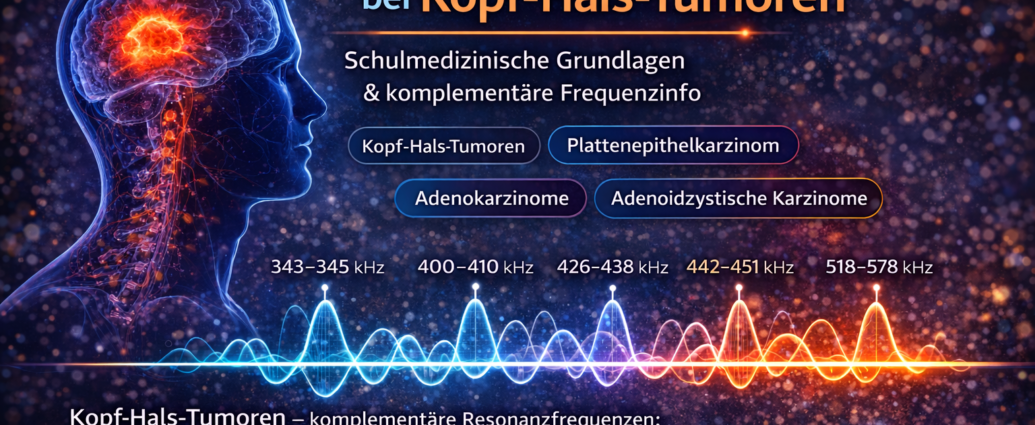
343-345, 400-410, 426-438 kHz
In squamous cell carcinoma, particularly clear resonance fields can be seen in the middle and upper kilohertz range. Especially the zone between 400 and 438 kHz acts as a central frequency pattern.
Adenocarcinomas
427-438 kHz
Also with Adenocarcinomas of the head and neck area, the main focus is on the area of 427 to 438 kHz.
Adenoid cystic carcinomas
343-345, 400-410, 426-438, 440-444, 458-469 kHz
This shows a broad and staggered resonance spectrum that encompasses several frequency clusters.
Mucoepidermoid carcinomas
370-378, 408-411, 427-437, 518 kHz
This frequency list shows a combination of medium and higher resonance fields.
Melanomas
279-300, 322-328, 442-456, 465-470, 480-489, 490-496, 501, 533-543, 544, 554-563 kHz
At the Melanoma This results in a particularly broad resonance spectrum with several distinct upper frequency bands.
Teratomas
329-332, 442-451, 543-545, 568-572 kHz
Here, too, there are staggered resonance chambers from the lower to the upper range.
Frequency information - complementary resonance frequencies of accompanying stresses
EBV
372-383, 518-519 kHz
CMV
406-410, 530-536 kHz
HTLV
297-299, 307, 311-315, 320-340, 354, 359, 365-367, 370, 376, 382-383, 397-400, 406, 416, 428-439, 453-455, 474-476, 480-482, 484, 487-490, 493-504, 523-530, 540-545, 570-578 kHz
Mycoplasma species
307-308, 321-324, 442-451, 491-495 kHz
These accompanying resonance ranges are of particular interest for frequency therapy because they can overlap with the frequency patterns of individual tumor forms.
Frequency info compact
Squamous cell carcinoma: 343-345, 400-410, 426-438 kHz
Adenocarcinomas: 427-438 kHz
Adenoid cystic carcinomas: 343-345, 400-410, 426-438, 440-444, 458-469 kHz
Mucoepidermoid carcinomas: 370-378, 408-411, 427-437, 518 kHz
Melanoma: 279-300, 322-328, 442-456, 465-470, 480-489, 490-496, 501, 533-543, 544, 554-563 kHz
Teratomas: 329-332, 442-451, 543-545, 568-572 kHz
EBV: 372-383, 518-519 kHz
CMV: 406-410, 530-536 kHz
HTLV: 297-299, 307, 311-315, 320-340, 354, 359, 365-367, 370, 376, 382-383, 397-400, 406, 416, 428-439, 453-455, 474-476, 480-482, 484, 487-490, 493-504, 523-530, 540-545, 570-578 kHz
Mycoplasma species: 307-308, 321-324, 442-451, 491-495 kHz
Complementary classification of the resonance ranges
Several condensations are particularly noticeable for frequency therapy:
- 343 to 345 kHz
- 400 to 410 kHz
- 426 to 451 kHz
- 518 to 545 kHz
- 554 to 578 kHz
The area between 426 and 451 kHz appears as a central resonance field in several tumor forms and accompanying biological patterns. Similarly, in the area above 518 kHz several distinctive clusters that play a special role within the complementary frequency analysis.
It is precisely these overlaps that make head and neck tumors particularly interesting for frequency therapy, because they can indicate common or interconnected resonance areas.
Importance of frequency therapy in a complementary context
Within frequency therapy, head and neck tumors are not only viewed as local spatial demands, but also as an expression of altered regulation and information patterns in the tissue. The complementary frequency information expands the conventional medical view by considering characteristic resonance fields, which are assigned to the individual tumor forms and accompanying stresses.
Since different types of tumors and additional stresses come together in the head and neck area, frequency therapy is particularly complex here. It not only looks at the individual lesion, but also at the overall resonance pattern of the mucous membrane, epithelium, lymphatic drainage, biological stress and functional disorder.
Conclusion
Head and neck tumors comprise a broad group of malignant diseases that arise in the upper respiratory and alimentary tracts. The conventional medical approach focuses on localization, histology, risk factors, lymph node status and an individually adapted combination of surgery, radiotherapy and chemotherapy.
This topic also opens up a complementary perspective for frequency therapy. The resonance frequencies described in the literature for squamous cell carcinomas, adenocarcinomas, adenoid cystic carcinomas, mucoepidermoid carcinomas, melanomas and teratomas as well as the accompanying biological stresses form a structured frequency information that can be considered as a supplement within information medicine.
Particularly striking are the resonance clusters between 400 and 451 kHz and in the upper areas 518 kHz. The result is a comprehensive WordPress post that combines conventional medical basics and complementary frequency information on head and neck tumors in a clearly structured, SEO-compatible and directly usable way.


Comments are closed, but trackbacks and pingbacks are open.