





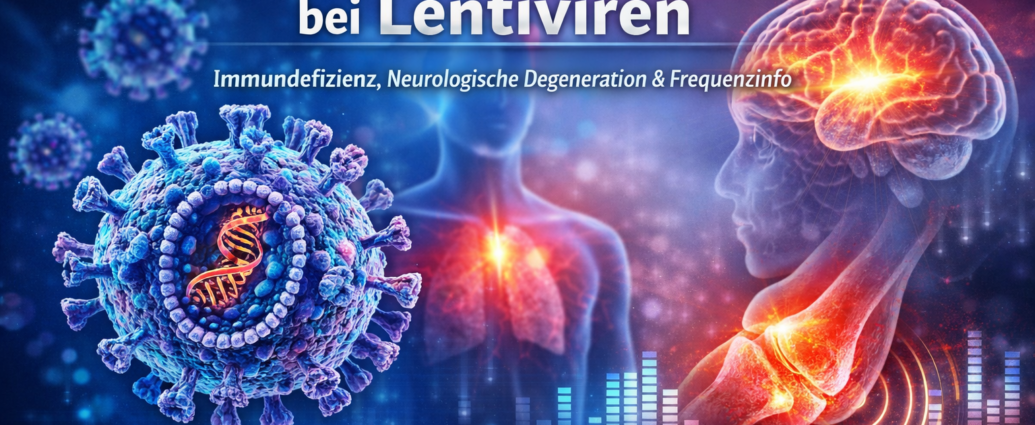
Basics, progression and complementary view
Lentiviruses belong to the family of Retroviruses and are characterized by a special biological mechanism. They are described in the literature as a virus group that differs from human T-cell lymphotropic viruses and can trigger profound chronic processes in humans. The main focus is on effects on the immune system, neurological changes and inflammatory side effects. Within this group of viruses, two human representatives are known in particular, which are referred to as human immunodeficiency virus type 1 and type 2.
What are lentiviruses?
Lentiviruses are retroviruses with a slow, often insidious biological progression. This is precisely where their particular medical relevance lies. They do not primarily cause short-term acute infections, but affect the body's central regulatory systems over a longer period of time. Their relationship to the immune system is particularly significant, as they can influence fundamental functions there.
The literature describes lentiviruses as a separate genus within the retroviruses. Although this puts them in a broader context with other retroviral pathogens, they also have clear characteristics. Their biological significance is primarily due to the fact that they can trigger chronic, systemic and often progressive processes.
The difference to other retroviruses
Lentiviruses are explicitly distinguished from HTLV viruses in the literature. This distinction is medically important because not only the structure and viral behavior differ, but also the clinical focus. While other retroviruses are more strongly associated with certain lymphoproliferative or cell regulatory processes, lentiviruses are primarily associated with immunodeficiency, neurological degeneration and inflammatory sequelae.
It is precisely these differences that make it clear that retroviruses should not be understood as a uniform group. Rather, individual genera each have their own pathogenetic and clinical profiles.
Which human lentiviruses are known?
Two known human representatives of this virus group are mentioned in the literature: Human immunodeficiency virus type 1 and type 2. Both can trigger significant disease processes, but differ in their epidemiological and biological classification. What they have in common is their membership of the lentivirus group and their systemic significance for the human organism.
HIV-3 and HIV-4 are also mentioned in the literature. These are mentioned in connection with frequency lists within a complementary view. This expands the picture of this virus group beyond the most frequently discussed representatives.
Why lentiviruses are so medically important
The particular significance of lentiviruses results from their connection to immunodeficiency syndromes, neurological degeneration and inflammatory disease processes such as arthritis. They therefore not only affect a single organ, but the interaction of several central systems. The immune system, the nervous system and inflammatory regulatory mechanisms can be affected simultaneously or sequentially.
It is precisely this systemic scope that makes lentiviruses particularly relevant to conventional medicine. These are not localized infections, but pathogens that can have long-term biological and clinical effects.
Lentiviruses and the immune system
A central characteristic of lentiviruses is their close connection to the immune system. The literature describes them as pathogens that can cause immunodeficiencies. This makes it clear that it is not just an infection in the classic sense, but an impairment of one of the body's most important protective and regulatory systems.
If the immune system is permanently affected, the impact goes far beyond the immediate infection. The defense against other stresses can be altered, regeneration processes can be impaired and the entire system stability of the organism can come under pressure.
Neurological degeneration and systemic effects
In addition to immunodeficiency, the literature also describes neurological degeneration in connection with lentiviruses. This connection is particularly significant because it shows that the effects are not limited to blood or immune cells. Rather, the nervous system, which is central to control, perception and regulation of the body, can also be affected.
This neurological dimension in particular makes it clear how far-reaching lentiviral processes can be. A chronic viral load can therefore go far beyond what you would expect from a normal infection.
Inflammatory processes and arthritis
The literature also mentions arthritis as a possible disease association with lentiviruses. This makes it clear that inflammatory processes in the musculoskeletal and general system can also play a role. Inflammation is not only to be understood as a local joint problem, but as an expression of a more comprehensive immunological and biological dysregulation.
The combination of immunodeficiency, neurological involvement and inflammatory symptoms in particular shows that lentiviruses have an extremely broad systemic reach.
HIV-1 and HIV-2 in a conventional medical context
The human representatives HIV-1 and HIV-2 mentioned in the literature are described as medically significant lentiviruses. In conventional medicine, the focus here is primarily on the long-term systemic effect. It is not about a short-term disease process, but about a chronic viral load with potentially far-reaching consequences for the regulation of the organism.
This classification makes it clear that lentiviruses require special long-term attention and differentiated medical consideration. It is not the individual symptom alone that is decisive, but the larger pattern of chronicity, systemic stress and possible progression.
Holistic view of the organism
From a holistic perspective, lentiviruses show particularly clearly how closely the immune system, nervous system and inflammatory regulation are linked. When a Virus is simultaneously associated with immunodeficiency, neurological changes and inflammatory processes, this affects the organism on several levels at the same time.
This is precisely why a complementary approach focuses not only on the pathogen itself, but also on the body's regenerative capacity, resilience, system stability and individual response. The organism is understood as an interconnected network whose internal order can be challenged by chronic stress.
Complementary perspective on frequency therapy and frequencies
Around the Frequency therapy is often associated with terms such as oscillation, Resonance and regulation. In a complementary understanding, the aim is to consider biological stress not only in terms of substances, but also functionally and systemically. The focus here is not on the idea of treating pathogens directly, but on classifying the body as a dynamic system with its own reaction and regulatory capacity.
Particularly in the case of complex and chronic stress patterns, such models attempt to consider not only the diagnosis but also the overall condition of the organism. In this context, frequency therapy and frequencies are understood as part of a complementary way of thinking that places regulation, system dynamics and individual stress patterns in a larger context.
Frequency info
The following frequency ranges are mentioned in the literature for lentiviruses:
The frequencies of HIV-1 are: 317-319, 365, 371-372, 383, 396, 402, 450, 474-478 kHz
The frequencies of HIV-2 are: 318, 365, 372, 383, 396, 402, 426-430, 450, 508-516 kHz
The frequencies of HIV-3 and HIV-4 are: 349, 365, 424, 460, 544-556, 569 kHz
In the complementary context of frequency therapy and frequencies, these frequency data are understood as supplementary literature references. Within complementary approaches, they are not isolated, but are placed in a larger context of resonance, system dynamics and individual reactions.
Conclusion
Lentiviruses are a medically highly relevant group of retroviruses that differ from HTLV viruses and can trigger profound chronic processes in humans. Immunodeficiency, neurological degeneration and inflammatory side effects such as arthritis are particularly prominent. The conventional medical perspective is central because it highlights the biological depth, systemic scope and significance of this group of viruses.
In the complementary environment, the view of frequency therapy and frequencies can also be understood as a thematic extension. The frequency ranges mentioned in the literature are referred to as Frequency info into a larger context.

Comments are closed, but trackbacks and pingbacks are open.