





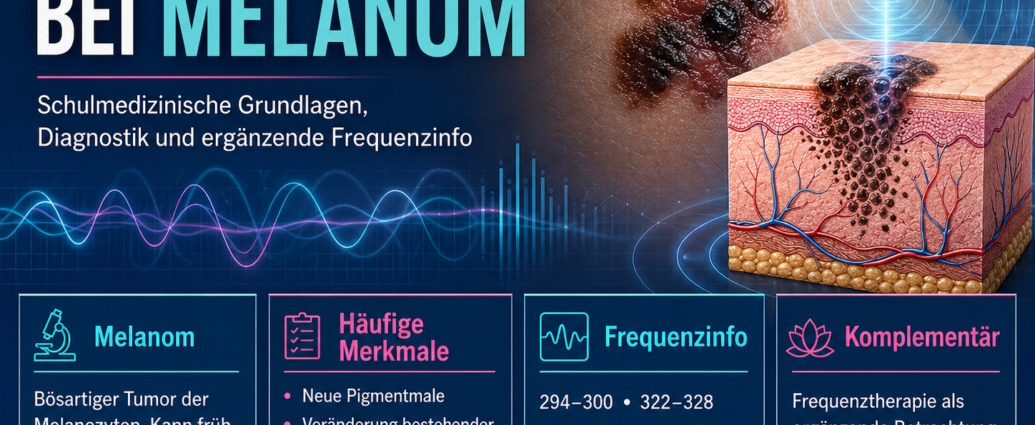
The Frequency therapy in the case of melanoma is described in the complementary context as a supplementary consideration to conventional medical principles, risk factors, spread, diagnosis, and treatment. Malignant melanoma, colloquially known as black skin cancer, is a malignant Tumor, which originates from the skin's pigment-producing cells. These cells are called melanocytes and are responsible for producing the skin pigment melanin.
From a conventional medical perspective, malignant melanoma is considered one of the most serious forms of skin cancer. It can spread relatively early through the lymphatic and blood vessels and Metastases form in various organs. The literature also describes certain resonance frequencies that are used as complementary therapies in the context of frequency therapy Frequency info can be documented and examined.
Frequency Therapy for Melanoma: An Overview from Conventional Medicine
Malignant melanoma develops from melanocytes. These pigment-producing cells are found primarily in the skin, but are also present in other parts of the body. When melanocytes become malignant, they can multiply uncontrollably, invade surrounding tissue, and eventually spread to other parts of the body.
Melanoma differs from many other forms of skin cancer in that it is more likely to metastasize. While some skin tumors grow primarily locally, melanoma can exhibit biological aggressiveness even when the lesions are relatively small. That is why early detection is particularly important.
The thinner a melanoma is at the time of diagnosis, the better the treatment options. The deeper the tumor has grown into the skin, the greater the risk that tumor cells will spread to other organs via the lymphatic or blood vessels.
Frequency therapy for melanoma and melanoma arising from pigment cells
Melanocytes produce melanin. This pigment provides some protection against UV radiation and helps determine an individual’s skin color. If these cells are damaged by external or internal factors, their normal growth regulation may be disrupted.
A melanoma can develop as a new pigmented skin lesion. However, it can also develop from an existing Birthmark or develop from a pigmented mole. The literature indicates that a significant proportion of melanomas arise on pre-existing pigmented skin, while others develop de novo on previously unremarkable skin.
Melanomas most commonly occur on areas of the skin exposed to the sun. However, they can also develop on less visible parts of the body, such as the soles of the feet, under the nails, on mucous membranes, or on areas of the body that are rarely exposed to the sun.
Malignant Melanoma and Sun Exposure
In the literature, sunburn is considered a particularly significant risk factor, especially for people with a predisposition to it. Intense UV exposure, particularly during childhood and adolescence, can cause long-term damage to the skin. Repeated sunburns increase the stress on DNA in skin cells and can contribute to subsequent cellular changes.
People with fair skin, numerous moles, a family history of skin cancer, a history of skin cancer, or high sensitivity to the sun should monitor their skin very closely. People who have had melanoma in the past are also at increased risk of developing another melanoma later on.
Protecting the skin from excessive UV radiation is therefore a key part of prevention. This includes being mindful of sun exposure, wearing protective clothing, using sunscreen, seeking shade, and having regular skin checkups.
Frequency Therapy for Melanoma and Depth of Invasion
A key factor in malignant melanoma is the depth of the tumor. The more superficial the melanoma, the better the chances of removing it completely. However, if the tumor grows deeper into the skin layers, the likelihood of it spreading increases.
Tumor cells can initially reach regional lymph nodes via the lymphatic vessels. They can spread to distant organs through the bloodstream. Once there, they can continue to grow and destroy tissue.
The depth of invasion is therefore an important factor in conventional medical diagnosis and treatment planning. It influences the assessment of risk, the extent of surgery required, lymph node evaluation, and potential further treatment options.
Spread and Metastasis in Melanoma
Malignant melanoma can metastasize to many organs. The literature specifically mentions the heart, lungs, liver, and central nervous system. Lymph nodes, skin, subcutaneous tissue, bones, and the brain may also be affected.
The course of the disease can vary greatly. Some melanomas grow rapidly and spread aggressively. Others progress more slowly at first. The body’s immune system is a key factor. The literature describes cases in which some patients remain in relatively good overall health for an extended period despite the spread of the disease.
Nevertheless, metastatic melanoma is a serious disease. Once distant metastases are present, treatment becomes more complex and the chances of recovery are reduced. Modern treatment approaches have expanded the options available, but early diagnosis remains crucial.
Possible signs of malignant melanoma
A melanoma can look different from one case to another. It often appears as a dark, irregular skin lesion. Some melanomas are black, brown, reddish, bluish, or multicolored. There are also light-colored or less pigmented forms that are harder to spot.
Possible warning signs are
- a new, rapidly growing pigmented lesion
- Changes in an existing mole
- irregular boundary
- different colors within a skin lesion
- Increase in size
- Itching
- Bleeding
- Crust formation
- Wetness
- Inflammation
- asymmetrical shape
- a noticeable lump or swelling
Any noticeable changes in the skin should always be evaluated by a dermatologist. It is especially important to have a mole examined if it looks different from all the others or has changed significantly.
Frequency Therapy for Melanoma and Diagnosis
If melanoma is suspected, it is particularly important to completely remove the suspicious skin lesion for microscopic examination. The histological examination determines whether it is indeed melanoma, how deep it has penetrated, and what other risk factors are present.
During a dermatological examination, abnormal skin changes are examined and often evaluated using a reflected-light microscope. This can reveal structures that are not visible to the naked eye.
Following removal and histological examination, further steps may be necessary depending on the findings. These include evaluation of the lymph nodes, imaging tests, and staging. The precise diagnosis forms the basis for further treatment.
Conventional medical treatment options for melanoma
The primary treatment for melanoma detected at an early stage is surgical removal. During this procedure, the tumor is completely removed, and depending on its thickness, the surrounding tissue is also excised to ensure a safety margin. The goal is to completely remove all tumor cells from the affected area.
If a melanoma has already grown deeper into the skin or if there is an increased risk of it spreading, a sentinel lymph node biopsy may be performed. This lymph node is the first stop in the lymphatic drainage from the tumor site.
In cases of advanced or metastatic melanoma, additional treatments may be used. The literature mentions chemotherapy, immunotherapy with interleukin-2, interferon, tumor necrosis factor, natural or synthetic immunostimulants, and antibody therapy.
Modern immunotherapies and targeted therapies play an important role in the treatment of advanced melanoma today. The choice of treatment depends on the tumor stage, molecular characteristics, the patient’s overall health, and individual circumstances.
Frequency Therapy for Melanoma and the Immune System
The immune system plays a particularly important role in malignant melanoma. While the immune system can recognize melanoma, the tumor also employs strategies to evade immune surveillance. This is why immunotherapy is particularly important for this type of cancer.
In the complementary approach to frequency therapy, the immune system is viewed as part of a comprehensive regulatory network. This approach considers not only tumor cells, but also the tissue microenvironment, chronic stressors, potential viral or bacterial resonance patterns, and the individual’s regulatory capacity.
The literature describes malignant melanoma in connection with a primitive retrovirus as well as associated viral and bacterial infections. In frequency therapy, such findings are documented as complementary resonance information and integrated into a holistic picture.
Frequency Therapy for Melanoma in a Complementary Care Setting
Frequency therapy looks at biological processes from the point of view of vibration, Resonance and regulation. In malignant melanoma, the complementary approach focuses on the skin, pigment cells, the immune system, potential microbial contamination, and the pattern of systemic spread.
The literature cites specific resonance frequencies that have frequently been observed in connection with melanoma. These frequencies are not considered in isolation, but rather as supplementary frequency information within the framework of a holistic approach.
This involves documentation, assessment of the body’s response, and personalized frequency therapy guidance. A structured assessment is particularly important in cases of cancer such as malignant melanoma, as local skin changes, the immune system’s status, and potential systemic spread can all interact.
Frequency therapy and cancer in an expanded view
Cancer is a complex biological process. Malignant melanoma involves a combination of changes in pigment cells, UV exposure, genetic susceptibility, immune regulation, and potential microbial interactions.
Frequency therapy views cancer, in a broader sense, as an expression of disrupted biological order and altered Cell communication. The skin is not merely an outer protective layer, but an active immune and regulatory organ.
This perspective is particularly important in the case of melanoma because the disease can quickly become systemic. The interplay between the skin environment, lymphatic pathways, blood vessels, the immune response, and potential resonance patterns creates a complex overall picture.
Frequency information: malignant melanoma
The following frequencies are cited in the literature in connection with malignant melanoma. In the complementary context of frequency therapy, they are regarded as supplementary resonance ranges.
Frequency therapy for melanoma
294–300 kHz,
322–328 kHz,
342–356 kHz,
440–456 kHz,
465–473 kHz,
480–489 kHz,
490–495 kHz,
500–507 kHz,
533–543 kHz,
554–563 kHz.
These frequencies are described in the literature as resonances frequently found in malignant melanoma. In the context of frequency therapy, they can be used as a supplementary guide for documentation, resonance analysis, and individualized treatment.
Frequency information: viral and bacterial co-occurrence patterns
In the literature, malignant melanoma is associated with a primitive retrovirus as well as other accompanying viral and bacterial infections. The frequency ranges mentioned can therefore also be interpreted, in a complementary context, as an indication of complex microbial resonance fields.
Frequency therapy for accompanying resonance fields
294–300 kHz,
342–356 kHz,
440–456 kHz,
480–489 kHz,
490–495 kHz.
These areas can be specifically addressed in frequency therapy, particularly when viral, bacterial, or immunological stress patterns are present in addition to the tumor process complementary be considered.
Frequency information: higher resonance ranges in melanoma
In addition to the mid-frequency ranges, the literature also mentions higher resonance ranges that have frequently been observed in malignant melanoma.
Frequency therapy for higher resonances
500–507 kHz,
533–543 kHz,
554–563 kHz.
These frequencies can be documented as additional resonance fields in the complementary frequency analysis. They complement the other frequency ranges and can be incorporated into an individualized frequency plan.
Frequency Therapy for Melanoma: A Comparison of Frequency Patterns
When comparing the frequency bands, it is noticeable that several groups occur in close proximity to one another. Particularly noticeable are the bands 342–356 kHz, 440–456 kHz, 480–495 kHz, and 533–563 kHz.
The frequency ranges 440–456 kHz and 480–495 kHz appear as broad resonance bands, which are described in the literature as having complex response patterns. The range 342–356 kHz can be regarded as another central resonance band.
For frequency therapy, this results in a multifaceted picture: malignant melanoma is viewed not only as a localized skin lesion, but also in relation to the immune system, associated viral and bacterial patterns, cell communication, and potential systemic spread.
Frequency Therapy for Melanoma: Summary
Malignant melanoma is a cancerous tumor of the pigment-producing melanocytes. It can appear as a new skin lesion or develop from an existing mole. Key risk factors include sunburn, UV exposure, genetic predisposition, a large number of moles, and a history of melanoma.
In conventional medicine, early detection, complete removal of suspicious skin lesions, and microscopic examination are crucial. The shallower the tumor’s depth of invasion, the better the treatment options. For advanced melanoma, surgery, chemotherapy, immunotherapy, antibody therapy, and other systemic treatments may be considered.
Frequency therapy offers a complementary perspective. The literature cites resonance frequencies for malignant melanoma such as 294–300 kHz, 322–328 kHz, 342–356 kHz, 440–456 kHz, 465–473 kHz, 480–489 kHz, 490–495 kHz, 500–507 kHz, 533–543 kHz, and 554–563 kHz. These frequency lists can be used in a complementary context for documentation, resonance analysis, and individual frequency therapy work.


Comments are closed, but trackbacks and pingbacks are open.