





Forms, symptoms and complementary frequency information
Author: NLS Information medicine Ltd, Herbert Eder
Introduction
Salivary gland tumors belong to a diverse group of changes that can be benign, tumor-like or malignant. They are described in the literature as diseases that can affect both the major and minor salivary glands. Precisely because these glands play a central role in moistening the oral cavity, the first phase of digestion and protecting the mucous membranes, pathological changes in this area often have a significant impact not only locally but also functionally.
For conventional medicine, the most important factors in salivary gland tumors are whether the process is benign or malignant, which gland is affected, how quickly the tumor grows and whether there are accompanying signs such as lymph node involvement, pain, nerve involvement or tissue invasion. At the same time, the topic is also important for the Frequency therapy and information medicine, because in addition to histological and genetic aspects, the literature also describes viral and microbial stresses as well as complementary resonance patterns.
In the following WordPress post, the focus is first on the conventional medical basics of salivary gland tumors. Only at the end follows the Frequency info with the complementary resonance frequencies mentioned in the literature.
What are salivary gland tumors?
Salivary gland tumors include neoplasms of the large and small salivary glands. The large salivary glands include:
- Parotid gland
- Mandibular salivary gland
- Sublingual salivary gland
The small salivary glands are much more numerous, often only clearly recognizable microscopically and are found almost everywhere in the submucosa of the upper airway and alimentary canal.
The literature describes that salivary gland tumors occur more frequently in people around the age of 50. Around 80 percent of all salivary gland tumors affect the Parotid gland, i.e. the parotid gland. Tumors of the submandibular salivary gland occur much less frequently. Among the benign forms, the pleomorphic adenoma also known as a benign mixed tumor.
Large and small salivary glands - why localization is so important
The location of a tumor within the salivary gland system influences the overall clinical picture. Tumors of the Parotid gland often appear in the area in front of or under the ear. Changes to the Mandibular salivary gland are more noticeable in the angle of the jaw or on the side of the neck. Processes on the Sublingual salivary gland can manifest as swelling in the floor of the mouth. Tumors of the small salivary glands occur preferentially in the area of the palate, lips or other mucous membrane sections of the upper aerodigestive tract.
It is precisely this anatomical diversity that explains why salivary gland tumors must be examined particularly carefully in conventional medical diagnostics. Location, palpation, mobility, pain and the involvement of neighboring structures often provide important clues as to the nature of the process.
Benign salivary gland tumors
Benign salivary gland tumors usually grow slowly, are often displaceable and show no severe functional deficits in the early stages. In the literature, the classic appearance of a benign salivary gland tumor is often a painless, slowly enlarging mass described.
Typical localizations are
- Facial area with parotid infestation
- Jaw angle for parotid tail or mandibular salivary gland
- Lateral neck area
- Floor of the mouth with involvement of the sublingual salivary gland
Benign salivary gland tumors are usually:
- well limited
- slow-growing
- freely movable
- without early facial nerve disorder
However, a sudden increase in size can be a warning sign. The literature describes that this may indicate an infection, cystic degeneration, hemorrhage or malignant transformation.
Important benign tumor forms
Pleomorphic adenoma
Pleomorphic adenoma is the most common benign adenoma. Tumor of the salivary glands. It is particularly often located in the caudal region of the parotid gland. In the case of the minor salivary glands, the hard palate and upper lip are typical localizations.
Monomorphic adenomas
This group includes benign epithelial tumors with a more uniform cell structure.
Warthin tumor
This is also one of the most important benign salivary gland tumors.
Intraductal papilloma
A rather rare benign tumor of the duct structures.
Oncocytoma
In the literature, oncocytic tumors are described as originating from the streak cells.
Sebaceous neoplasia
They also belong to the benign epithelial tumor forms.
Benign non-epithelial tumors
In addition to epithelial tumors, there are also benign non-epithelial changes of mesenchymal origin. These include, among others:
- Hemangioma
- Angiom
- Lymphangioma
- Lipoma
- Tumors of the nerve sheaths
Hemangiomas
Hemangiomas are the most common salivary gland tumors in children. They usually affect the parotid gland and, more rarely, the submandibular salivary gland. These vascular tumors occur early in life, grow rapidly in infancy and can gradually regress later.
Lymphangiomas
Lymphangiomas are predominantly found in the head and neck area of infants and children. In the literature, their development is associated with a developmental disorder of primitive embryonic lymphatic pathways.
Malignant salivary gland tumors
Malignant salivary gland tumors occur less frequently than benign tumors, but are clinically much more significant. In the literature, they are described as tumors that grow more rapidly and can spread to the entire neck area via lymphatic and blood vessels at an early stage.
The most important malignant forms include
- Adenocarcinoma
- Acinar cell carcinoma
- adenoid cystic carcinoma
- malignant mixed salivary gland tumor
- mucoepidermoid carcinoma
Many small salivary gland tumors begin at the Palate, which makes this region particularly important in diagnostics.
Symptoms of malignant salivary gland tumors
While benign tumors often remain asymptomatic for a long time, malignant salivary gland tumors show several conspicuous warning signs in the literature. These include
- painless or painful lumps
- Spinal mass in the ear, jaw or lip area
- Lumps inside the oral cavity
- Difficulty swallowing
- Restricted mouth opening
- Weakness of the facial muscles
- Persistent pain in the affected head or neck area
Particularly suspicious for a malignant lesion are:
- Rapid growth
- Paresthesias
- Hoarseness
- Involvement of the skin
- Fixed, poorly displaceable findings
- cervical lymphadenopathy
These characteristics give rise to Practice important indications of the biological aggressiveness of the process.
Cellular origin of various salivary gland tumors
In the literature, the so-called multicellular theory according to which different salivary gland tumors originate from different cell lines. According to this theory:
- pleomorphic adenomas from switch piece cells and myoepithelial cells
- oncocytic tumors from strip cells
- acinar cell tumors from acinar cells
- mucoepidermoid and squamous tumors from excretory duct cells
This classification underlines how differentiated the structure of salivary gland tissue is and how differently tumors can develop from the respective cell populations.
Genetic and other cofactorial influences
In addition to histological and cell biological aspects, the literature also mentions genetic changes as a contributory cause of tumor development. These are mentioned in particular:
- Allelic losses of tumor suppressor genes
- Monosomies
- Polysomies
- structural chromosomal changes
It has also been described that certain radiotherapies in the neck and head area can increase the risk of salivary gland carcinomas. This also shows a complex causal structure of tissue predisposition, cell biology and additional biological stresses.
Viral and microbial contamination in salivary gland tumors
In the literature, salivary gland tumors are also associated with various viral and microbial strains. These are particularly emphasized:
- EBV
- CMV
- Mycoplasma
- certain HPV types
For lymphoepithelial tumors of the salivary glands it is described that EBV, CMV, Mycoplasma and additionally at least one of the HPV types may be involved in the development. It is also stated that different tumor forms can be associated with different human papillomaviruses. A mycoplasma co-infection, in particular with Mycoplasma pneumoniae or Mycoplasma fermentans, is described as a frequent additional burden.
In this context, it is described that a dominant HPV subtype drives tumor development, while the mycoplasma co-infection supports the process. It is precisely this multiple exposure that makes the topic particularly interesting for frequency therapy.
Diagnostics for salivary gland tumors
The diagnosis is based on several levels of examination. The literature mentions the following in particular:
Physical examination and medical history
The clinical examination and detailed questioning of the patient provide initial indications of growth, pain, duration, nerve involvement and functional limitations.
Imaging procedures
Among other things, the following are used for more precise clarification:
These procedures help to better assess the extent, localization, infiltration and possible lymph node involvement.
Biopsy and fine needle aspiration
Fine needle aspiration and histological examination are crucial in order to classify the type of tumor more precisely.
Pathogen diagnostics
The literature also mentions PCR and other methods for the detection of Viruses and mycoplasmas have been described.
Conventional medical treatment of salivary gland tumors
Treatment must be planned individually according to the type of tumor, stage, location and general condition of the patient. The literature emphasizes that this therapy should be coordinated by experienced specialists.
The standard procedures include:
Operation
Surgical removal of the affected salivary gland or tumor is a key component of treatment, especially if symptoms persist or recurring chronic infections cannot be managed conservatively.
Radiotherapy
Depending on the stage and location of the tumor, it is used as a complementary or alternative treatment.
Chemotherapy
It can be part of the treatment concept for malignant tumors.
The choice of procedure is usually based on:
- Tumor stage
- Tumor localization
- histological tumor type
- general state of health
Why salivary gland tumors are particularly interesting for frequency therapy
Salivary gland tumors are particularly interesting for frequency therapy because they cover a broad spectrum from benign to malignant processes and at the same time are repeatedly linked in the literature with complex viral and microbial additional stresses. It is precisely the combination of glandular tissue, epithelioid differentiation, possible viral load and co-infection that makes this tumor group particularly complex within information medicine.
Frequency therapy expands the purely structural view of conventional medicine to include the question of whether certain tissue processes, regulatory disorders and additional stresses are also reflected in characteristic resonance patterns. It is precisely at this point that complementary frequency info to.
Frequency info - complementary resonance frequencies for salivary gland tumors
The following are those mentioned in the literature complementary resonant frequencies of the accompanying biological stresses described in connection with salivary gland tumors.
HPV resonances
314-319, 343-347, 401-410, 418-426, 427-438, 442-448, 452-453, 456-466, 467-479, 488-496, 501-507, 513-521, 525-527, 533-545, 556-564 kHz
This frequency list is particularly broad and shows a pronounced staggering across several areas. Particularly striking are the concentrations around:
- 343-347 kHz
- 401-438 kHz
- 442-479 kHz
- 488-545 kHz
- 556-564 kHz
Resonances of the Mycoplasma species
321-324, 442-451 kHz
The area of 442-451 kHz is interesting because it overlaps with other resonance fields in the salivary gland context.
EBV resonances
372-373, 518-519 kHz
These two compact frequency windows form important additional resonance points.
CMV resonances
408-410, 530-536 kHz
Here, too, there is a connection between the mid and higher kilohertz ranges.
Frequency info compact
HPV: 314-319, 343-347, 401-410, 418-426, 427-438, 442-448, 452-453, 456-466, 467-479, 488-496, 501-507, 513-521, 525-527, 533-545, 556-564 kHz
Mycoplasma species: 321-324, 442-451 kHz
EBV: 372-373, 518-519 kHz
CMV: 408-410, 530-536 kHz
Complementary classification of the resonance ranges
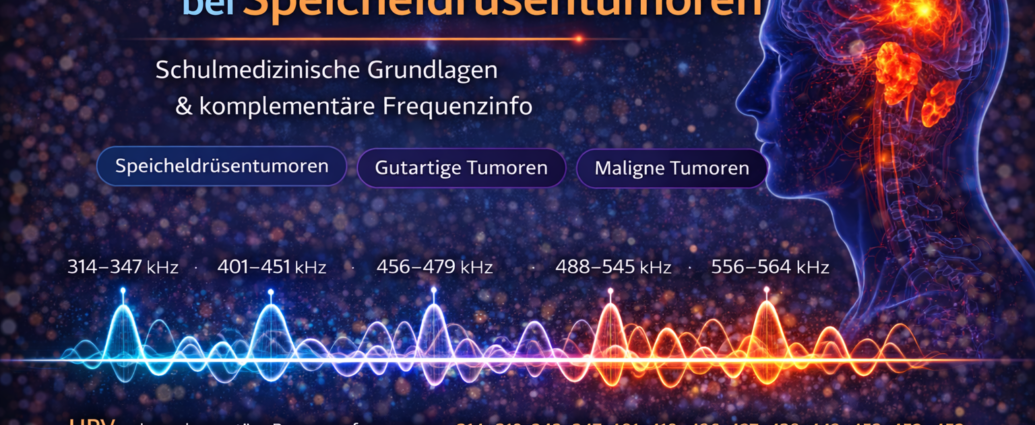
Within frequency therapy, several resonance chambers are particularly noticeable in salivary gland tumors:
- 314 to 347 kHz
- 401 to 451 kHz
- 456 to 479 kHz
- 488 to 545 kHz
- 556 to 564 kHz
The area between 401 and 451 kHz is a particularly prominent focus. HPV-, CMV- and mycoplasma-related resonance patterns overlap there. Also striking is the concentration in the higher ranges between 513 and 545 kHz and in the upper field between 556 and 564 kHz.
It is precisely these overlaps that make the salivary gland area particularly interesting for frequency therapy because they indicate a complex complementary resonance pattern.
Importance of frequency therapy in a complementary context
Within frequency therapy, salivary gland tumors are not only understood as local tissue changes, but also as an expression of an extended biological and informational medical process. The complementary frequency information supplements the conventional medical view with resonance spaces that can be considered in connection with viral and microbial stresses as well as with different tumor forms.
Particularly in the salivary gland area, where glandular structures, mucosal proximity, lymphatic involvement and additional microbial stresses come together, a multi-layered resonance image is created. This makes this tumor group particularly significant within frequency therapy.
Conclusion
Salivary gland tumors include benign, tumor-like and malignant neoplasms with very different biological behavior. The conventional medical approach focuses on localization, histology, growth, nerve involvement, imaging and individually planned treatment consisting of surgery, radiotherapy and chemotherapy.
The topic also opens up a complementary perspective for frequency therapy. The resonance frequencies of HPV, mycoplasma, EBV and CMV described in the literature form a structured frequency information that can be considered in connection with salivary gland tumors. Particularly striking are the resonance clusters between 401 and 451 kHz as well as in the higher areas 513 kHz.



Comments are closed, but trackbacks and pingbacks are open.