





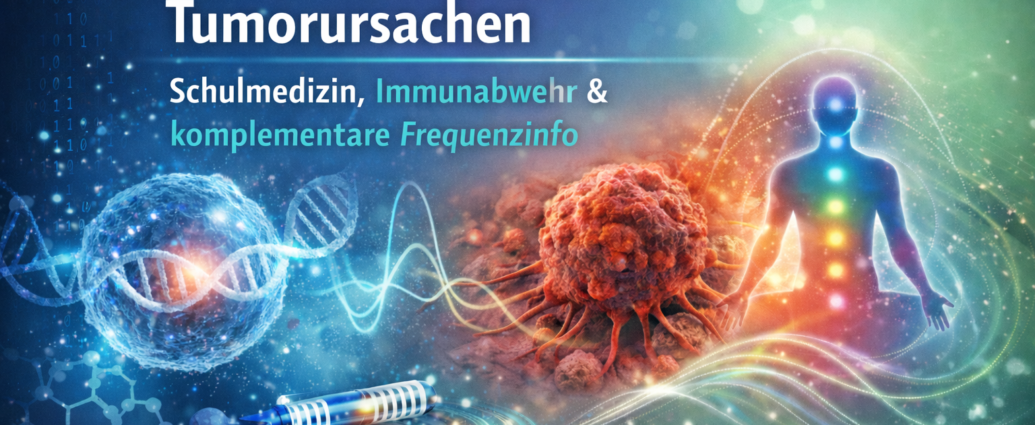
Conventional medical correlations, immune defense and complementary frequency information
Why the development of tumors should be considered holistically
How can Frequency therapy support with tumor causes here
The question of the causes of tumors has occupied medical science for decades. Today it is clear that tumor processes are not usually caused by a single trigger. Rather, it is a complex interplay of genetic susceptibility, environmental stress, chronic stimuli, changes in cell regulation, immune defense disorders and other biological influences. This is precisely why it makes sense not to take a one-dimensional view of the subject. If you want to understand the causes of tumor processes, you need to consider both conventional medical findings and regulatory and complementary perspectives.
From a conventional medical point of view Tumors when cells lose their natural control over growth, division and degradation. A healthy cell is integrated into a finely tuned network. It receives signals from its tissue, reacts to messenger substances, adapts to the internal environment and has protective mechanisms to limit or correct damage. If these protective systems are weakened over time, the risk of pathological cell changes can increase.
Frequency therapy is therefore becoming increasingly important for many people, particularly in the prevention and management of chronic stress. It offers complementary a perspective that takes into account not only biochemical factors, but also regulation, information patterns, and biophysical order. However, before the Frequency info it is crucial to clearly understand the conventional medical basis of tumor development.
How tumors develop from a conventional medical perspective
Tumors do not develop out of nowhere. The process usually develops over a long period of time. Individual cells change, lose their normal control and no longer react in the same way as healthy cells would. It is particularly significant that not all cells react equally sensitively to damaging influences. Some cells are more susceptible to changes, others are more resistant. This different sensitivity can be linked to genetic conditions, the condition of the tissue, local blood circulation, inflammatory stress and many other factors.
The literature describes that it often takes several influences before a tumor process can develop. A single exposure is often not enough. Only when a sensitive cell encounters stressful factors and the body's own protective mechanisms are weakened at the same time does the risk increase significantly. It is precisely this multifactorial process that is a central feature of modern cancer research.
Genetic changes and the susceptibility of individual cells
Not all cells react in the same way to potentially harmful influences. Some have genetic characteristics or functional weaknesses that make them more susceptible. If a cell is already disturbed in its regulation, it can react more quickly to stress than a stable, healthy cell. In this context, changes in the genetic material play an important role. These changes can be small and barely detectable at first, but they can also result in visible changes to chromosomes.
The literature describes that certain types of tumors are associated with such genetic changes. These include tumors of the brain as well as cancers of the intestine, breast, lung and bone. It is important to understand that genetic changes do not necessarily lead immediately to a disease. Rather, they can create the basis for a greater impact later on.
This finding is particularly important for prevention. It shows that health always depends on the stability of cell regulation. Those who support this stability indirectly promote the biological conditions that are necessary for long-term order in the tissue.
Chronic irritants, environmental pollution and carcinogenic influences
In addition to genetic factors, the environment and lifestyle play a significant role. The literature describes that chronic physical irritation, toxic stress and other external influences can increase the risk of tumor processes. These include smoking, ultraviolet radiation, X-rays, radioactive exposure and various chemical substances. Long-term exposure to harmful substances can also change the cellular environment and weaken the body's natural protective function.
It is particularly important to note that such factors do not always act in isolation. Much more frequently, a problematic situation arises when several stresses affect a susceptible organism simultaneously or in succession. A weakened cell, permanently irritated tissue, a stressed immune system and unfavorable environmental factors can combine to create an environment that favors pathological developments.
The geographical differences in cancer risk are also explained in the literature by such correlations. Nutrition, environmental factors, genetic predispositions and regional stresses can all influence how frequently certain types of tumors occur. This observation makes it clear that the development of tumors should always be viewed in a broader context.
Viral and microbial influences in the tumor process
Another aspect described in the literature concerns viral and bacterial contamination. Certain Viruses are associated with various forms of tumors. These include human papillomaviruses as well as various herpes viruses and adenoviruses. Bacterial factors are also described, which are considered to be a contributing factor in a broader sense.
From a conventional medical point of view, this does not mean that such exposure automatically leads to cancer. Rather, the decisive factor is the interaction with the individual susceptibility of the organism, the state of the immune system and the internal environment. An infection alone is not the same as a tumor disease. However, if several risk factors exist at the same time, an additional microbial load can further weaken the balance of the system.
It is precisely this complex link that shows why holistic prevention makes sense. It is not just a matter of identifying individual triggers, but of looking at the entire stress field of the organism.
The crucial role of the immune system
One of the most important factors in the control of tumor processes is the immune system. It takes on the task of recognizing conspicuous cell changes and intervening before pathological cell clusters can establish themselves. As long as this immune surveillance functions well, the body has a strong protective system against many abnormal developments.
The literature emphasizes that tumor processes can occur more frequently when immune function is significantly weakened. People with massive immunosuppression show an increased risk of certain forms of tumor. This makes it clear how important the body's own defenses are for maintaining biological order. If the immune system loses strength or is impaired by medication, chronic illness or long-term stress, its ability to control altered cells can diminish.
Nevertheless, even a functioning immune system is not always able to eliminate every malignant cell immediately. Some tumor cells develop mechanisms with which they can partially evade immune surveillance. This is precisely what makes tumor processes so complex. It is not only the strength of the immune system that is decisive, but also the ability of altered cells to adapt and evade the immune system's grasp.
Tumor antigens and the body's reaction
Healthy cells have features on their surface that are familiar to the immune system. If a cell undergoes pathological changes, these surface structures can also change. So-called tumor antigens then develop. The immune system can perceive such altered structures as foreign and react to them. In some cases, it is possible to eliminate the affected cells. In other cases, they persist or evade attack.
The literature describes that such tumor antigens can be detected in various types of tumors. These include certain skin tumors, bone tumors and some tumors of the gastrointestinal tract. The body can form antibodies against these antigens. However, not every immune reaction is automatically sufficient to effectively stop a tumor process. This shows once again that the mere presence of an immune response is no guarantee of complete control.
This shows just how important a strong, well-regulated immune system is. The better the overall constitution, the greater the chance that abnormal developments can be detected and limited at an early stage.
Tumor markers and their importance in medicine
Tumor markers play an important role in modern medicine, particularly in monitoring the progress of known diseases. The literature mentions various markers that can be elevated in the blood. These include CEA, AFP, beta-HCG, PSA, CA-125, CA-15-3, CA-19-5, beta-microglobulin, lactate dehydrogenase, CA-72-4 and other markers and growth factors.
It is important to note that elevated values do not automatically mean that cancer is present. Some markers can also increase with other stresses, inflammation or functional disorders. For this reason, they are used in conventional medicine primarily in connection with known diagnoses in order to observe the response to therapy, progression or changes in the course of the disease.
These markers also show how complex tumor processes are. They make it clear that the organism reacts to altered cell processes and that certain biological indicators can be detected in the blood. This is relevant for prevention insofar as it underlines the importance of early diagnosis and responsible medical monitoring.
Interleukins, interferon and immunological therapy concepts
The literature also describes the importance of immunological mechanisms such as interleukins and interferon. These substances are part of the body's own regulatory and defense processes. They can help to strengthen tumor-related immune reactions and promote certain direct or indirect defense mechanisms.
Therapeutic approaches using natural killer cells have also been described. This involves activating certain immune cells and putting them in a state in which they can attack altered cells in a more targeted manner. These concepts show how central immune regulation has become in the overall understanding of cancer. Modern medicine is increasingly recognizing that tumour development is not just a question of individual cells, but also a question of the interplay between tissue, defence, metabolism and signal transmission.
Why prevention should always be considered holistically
If we take a comprehensive look at the causes of tumor processes, a clear picture emerges: there is no single cause. Rather, problematic developments arise when genetic susceptibility, environmental stress, chronic stimuli, microbial factors and immunological weaknesses come together. This insight is particularly valuable because it broadens our view of prevention.
Prevention then does not just mean avoiding individual risks. Rather, it means strengthening the entire biological environment. This includes nutrition, regeneration, sleep, stress reduction, exercise, immunological stability and minimizing chronic exposure to environmental toxins and long-term stress. It is precisely at this point that the scope for complementary approaches such as frequency therapy begins.
Frequency therapy as complementary support for stress processes
Why frequency therapy is gaining importance in the holistic approach (frequency therapy for tumor causes)
Frequency therapy is used by many practitioners as a complementary approach to regulate the organism. The conventional medical diagnosis is not in conflict with frequency therapy, but rather an expanded understanding of health is created. While conventional medicine primarily examines biochemical, cellular and immunological mechanisms, frequency therapy also focuses on biophysical order, information patterns and vibrational relationships.
From a complementary perspective, the human organism is not only a chemical system, but also an information-processing system. Cells communicate, tissues react to stimuli and the body is dependent on constant adaptation. If this order is out of balance, this can weaken the body's ability to regulate itself in the long term. This is precisely where frequency therapy comes in: not as a substitute for medical clarification, but as complementary support within a holistic concept.
The inner milieu and the regulative perspective
A central idea of frequency therapy is the importance of the internal environment. This refers to the environment in which cells live and work. This includes nutrient supply, oxygen levels, energy balance, vegetative balance, metabolic quality, inflammation levels and resilience. If this environment is stable, the organism can regulate itself better. If it comes under permanent pressure, the ability to adapt decreases.
Frequency therapy attempts to accompany precisely this level of order in a complementary way. It does not view frequencies as an isolated technique, but as informative impulses that are seen in a larger context of regulation, stabilization and harmonization. Many users find this a valuable addition because it strengthens the feeling of actively and consciously supporting their own organism.
Always understand frequency lists in a complementary context (frequency therapy for tumor causes)
Frequency lists play an important role in frequency therapy. They are taken from the literature and categorized thematically. It is crucial that they are not understood in isolation. In the complementary approach, frequencies are not rigid patent remedies, but part of a larger understanding of regulation. Their significance always unfolds in connection with the stress situation, constitution, objectives and the overall health environment.
This is precisely why it makes sense to consider frequency lists not just technically, but as part of a holistic approach. The better the organism's environment is understood, the better the complementary frequency information can be classified.
Frequency info
Frequency therapy and frequency lists from the literature
In the field of frequency therapy, frequency lists from the literature are used in a complementary way to provide informative support for regulatory processes. This involves classification in larger subject areas such as general stabilization, stress regulation, support of the inner environment and promotion of vegetative balance. In this context, frequency lists are not considered in isolation, but are embedded in a concept that takes into account conventional medical findings, immune function, metabolic regulation and individual stress situations.
Complementary classification of frequencies for tumor stress topics
In a complementary understanding, the frequencies mentioned in the literature are often assigned to those areas that are associated with energetic destabilization, chronic irritation, microbial stress factors, vegetative imbalance and general regulatory weakness. The focus here is not on an isolated number, but on the question of how frequency patterns are used as part of a holistic program to support the self-regulation of the organism.
Frequency lists as part of a holistic prevention concept
Frequency lists from the literature are particularly useful when they do not stand alone, but are combined with other health-promoting measures. These include an immune-strengthening lifestyle, a conscious approach to chronic stress, sufficient regeneration, good quality sleep, targeted relief of the metabolism and an overall regulative lifestyle. This combination gives frequency therapy its true depth: as a complementary component of a comprehensive prevention and support concept.
Conclusion
The causes of tumors are complex and multi-layered. The literature shows that genetic susceptibility, environmental stress, viral and microbial factors, chronic stimuli and immunological weaknesses can all contribute to a stressful overall picture. This is precisely why it is so important not to take a one-dimensional view of tumor processes. In conventional medicine, the focus is on cell changes, tumor markers, immune function and precise diagnostics.
Frequency therapy complements this view with a biophysical and regulative perspective. It considers the human being as a whole and classifies frequency lists from the literature into a comprehensive concept of order, stability and inner balance. The result is an approach that takes conventional medical principles seriously and at the same time creates space for supplementary frequency information. It is precisely in this combination that many people see the special value of frequency therapy: as complementary support within a holistic understanding of health, stress and prevention.

Comments are closed, but trackbacks and pingbacks are open.