





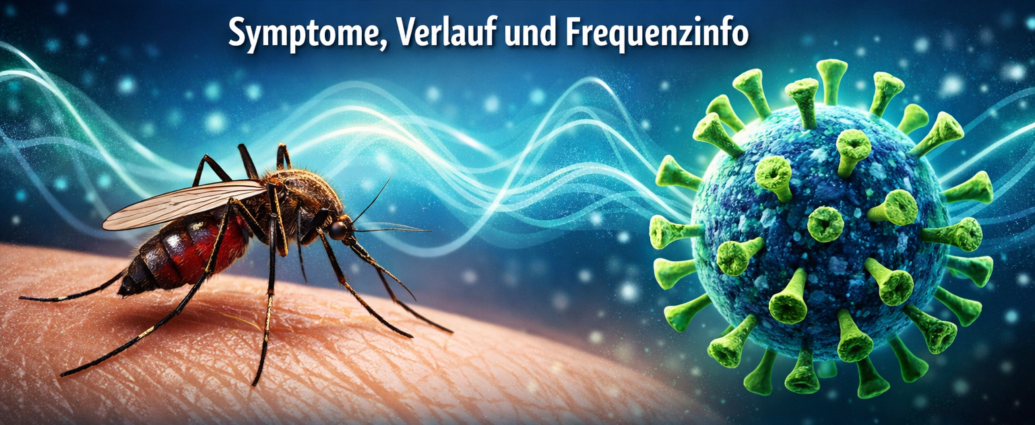
Symptoms, progression and frequency information
West Nile fever is a mosquito-borne viral infection from the group of Arboviruses. In the literature, West Nile virus is classified as a group B arbovirus. The transmission cycle is mainly between birds and mosquitoes, with mosquitoes of the type Culex are considered the most important vectors. Humans and other vertebrates, often including horses, can be infected, but play only a minor role in the natural cycle.
What is West Nile fever?
West Nile fever is a viral infection that is transmitted to humans through the bite of infected mosquitoes. The disease is an arboviral infection, i.e. a viral disease that is transmitted via arthropods. It is precisely this transmission route that makes West Nile fever medically significant, because the environment, season, occurrence of mosquitoes and animal reservoirs are closely linked to the infection process.
The literature describes humans more as secondary hosts. This means that the actual reproduction cycle of the Virus mainly occurs between birds and mosquitoes. Nevertheless, an infection in humans can cause a characteristic clinical picture, which can range from mild courses to rare neurological complications.
How is the West Nile virus transmitted?
Transmission occurs mainly through mosquito bites. In the natural cycle, the mosquito picks up the virus from infected birds and passes it on to other hosts during another blood meal. This creates a typical bird-mosquito-bird system in which humans are occasionally involved.
This form of transmission explains why West Nile fever is closely linked to seasonal and ecological conditions. Mosquito activity, weather, wetlands and animal populations significantly influence the risk. This makes it clear that West Nile fever must be understood not only as a single infection, but also in the context of the environment and vector dynamics.
Typical symptoms of West Nile fever
The literature describes that in around a third of sufferers, the body temperature can rise rapidly to 38 to 40 degrees Celsius, often accompanied by chills. Fatigue, severe forehead headaches, eye pain and pain in the abdomen and back are also typical. This combination shows that this is a systemic viral infection that can affect the entire organism.
A smaller proportion of those affected also develop a loss of appetite, nausea and a dry feeling in the throat. These symptoms also fit in with a general infectious process that is not only felt locally, but on several levels of the body.
Clinical signs and physical findings
The signs described include reddening of the face, conjunctival involvement and a coating on the tongue. The generalized enlargement of lymph nodes is also conspicuous in the literature. The occipital, axillary and inguinal lymph nodes are often particularly affected. These are usually moderately enlarged, not hard and only slightly sensitive to pressure.
In a small number of cases, slight enlargement of the spleen and liver are also described. In addition, a skin rash may occur, which is mainly localized on the trunk and consists of pale pink maculopapular changes. These findings show that West Nile fever not only causes fever and pain, but can also cause visible systemic reactions of the body.
How does the disease progress?
The course of the disease is usually described in the literature as self-limiting. This means that in many cases the disease resolves itself. It typically lasts around three to five days. It is precisely this limited course that is important for conventional medical classification, because in many cases it distinguishes West Nile fever from more severe, long-lasting infections.
Despite the usually mild course of the infection, it should not be underestimated. Even a temporary illness can put a considerable strain on the body, especially if high fever, severe headaches and general weakness occur at the same time. The subjective impairment can be considerable in the acute phase.
Neurological involvement and rare complications
In a few cases, transient meningeal involvement may occur. Changes in the cerebrospinal fluid are described in the literature, including an increase in cell count and an increase in protein concentration. Blood count changes such as leukopenia and moderate lymphocytosis may also occur.
Severe complications are generally rare. However, meningoencephalitis can develop in older people or very young patients. Severe courses with fatal outcomes have also been described in individual cases. This is precisely why West Nile fever is medically relevant, although many infections are mild.
Diagnosis from a conventional medical perspective
According to the literature, conventional medical diagnosis is based on virus detection and serological procedures. A special feature is that viremia can persist for several days, which makes virus isolation possible. In addition, an increasing specific antibody titer can confirm the suspicion.
This diagnostic classification is particularly important because West Nile fever can initially appear clinically like other febrile viral infections. A reliable differentiation is therefore based on laboratory diagnostics and the combination of symptoms, exposure risk and specific examination findings.
Treatment and medical classification
The treatment is described in the literature as symptomatic. This means that the focus is not on a specific standard therapy against the virus, but on supporting the organism according to the course of the disease and the symptoms. The focus is on rest, observation of the general condition and clinical assessment of possible complications.
The conventional medical perspective focuses primarily on the transmission route, typical symptom constellation, diagnostic confirmation and the observation of rare neurological courses. A differentiated classification is particularly important because severe complications only occur in a small proportion of cases.
Holistic view of the organism
From a holistic point of view, West Nile fever shows the extent to which a vector-borne viral infection can affect the entire organism. Fever, pain, lymph node reactions, skin symptoms and, in rare cases, neurological involvement illustrate that several regulatory systems can be challenged simultaneously. The organism reacts not only locally to the mosquito bite, but also systemically.
For this very reason, a complementary approach focuses not only on individual symptoms, but also on resilience, regenerative capacity, vegetative stability and the individual reaction situation. The understanding of infection is thus expanded by a level that places greater emphasis on the interaction of different body systems.
Complementary perspective on frequency therapy
Around the Frequency therapy is often associated with terms such as oscillation, Resonance and regulation. In a complementary understanding, the aim is to consider biological stress not only in material terms, but also in the context of functional and systemic patterns. The organism is understood as a dynamic system that reacts individually to stress.
Particularly in the case of vector-borne viral infections, such models attempt not only to view the pathogen in isolation, but also to take into account the overall reaction of the body, its adaptability and its inner order. In this context, frequency therapy and frequencies are seen as supplementary literature references within a larger understanding of resonance and system dynamics.
Frequency info
The following frequency ranges are mentioned in the literature for West Nile fever:
295-300, 302-310, 317-320, 339, 354-356, 373, 409, 420-423, 430, 444, 495, 570 kHz
In the complementary context of frequency therapy and frequencies, these frequency data are understood as supplementary literature references. Within complementary approaches, they are placed in a larger context of resonance, system dynamics and individual reactions.
Conclusion
West Nile fever is a mosquito-borne arboviral infection that circulates in the natural cycle mainly between birds and mosquitoes. In humans, it usually has a self-limiting course with fever, headache, muscle pain, lymph node reactions and occasionally a skin rash. In rare cases, neurological complications can occur. Conventional medicine is therefore in the foreground because it clearly describes the transmission route, symptoms, diagnosis and possible severe courses.
In the complementary environment, the view of frequency therapy and frequencies can also be understood as a thematic extension. The frequency ranges mentioned in the literature are referred to as Frequency info into a larger context.


Comments are closed, but trackbacks and pingbacks are open.