




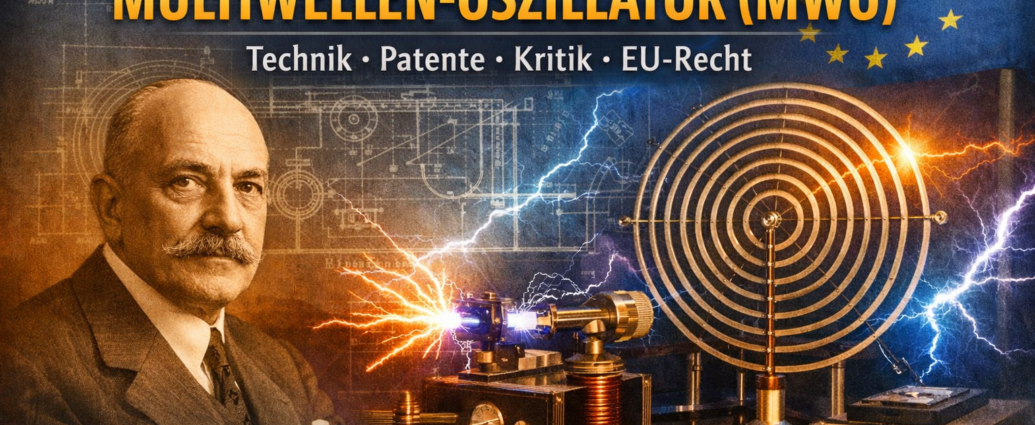
in the 1910s-1930s: Technology, patents, claims, measurement data, criticism and EU law
Historical analysis of the MWO from Georges Lakhovsky with a focus on technology, patents, criticism, safety and regulatory classification.
The multi-wave oscillator, or MWO for short, is one of the best-known and at the same time most controversial historical devices at the interface between high-frequency technology, medical history and speculative resonance therapy. In this concept, Georges Lakhovsky combined earlier electrotherapeutic high-voltage principles with his idea that living cells oscillate at characteristic natural frequencies and could be influenced by external electromagnetic fields.
Today, the MWO is primarily of interest as a historical and technical object. Its patents, books and self-portrayals show a clearly outlined device concept, but the therapeutic statements derived from it are not secure from a modern evidence-based perspective. In addition, there are considerable questions regarding safety, electromagnetic compatibility and regulatory permissibility.
Important note
This article is a historical and technical analysis. It does not constitute medical advice and contains no promise of treatment. The multiwave oscillator, as described in historical primary sources, is a high voltage and high frequency system with potentially significant risks. These include electric shock, RF burns, fire hazards, ozone and nitrogen oxide formation from discharges, and possible radio interference. Operation or replication may be legally regulated, in particular by EMC and RED regulations, and additionally by the MDR in the case of medical use. Experiments on humans and uncontrolled high-voltage setups are expressly not recommended.
Historical background
The multi-wave oscillator was not created in a vacuum. At the end of the 19th and beginning of the 20th century, high-frequency applications were already widespread in medicine and electrical engineering. Systems based on d'Arsonval or Oudin worked with high voltage, Resonance and electrotherapeutic application. Lakhovsky also worked in this environment.
He took existing technical concepts and combined them with his own biological theory. This theory was based on the assumption that cells and tissue could be understood electromagnetically as oscillating systems. He interpreted diseases, including cancer, as an expression of a disturbed cell vibration. From this he derived the idea that a broadband high-frequency field with many wavelengths could be therapeutically effective.
Historical timeline
High-frequency electrotherapy devices using d'Arsonval and Oudin technology were documented between 1890 and 1920. In 1925, the following appeared in Radio News a contribution on „Ultra Radio Frequencies“, which also showed a „two-meter oscillator“. In 1927 Lakhovsky published Contribution à l'étiologie du cancer, followed in 1929 Les ondes qui guérissent. In his later German-language publication, he declared that he had built the first multi-wave oscillator in 1930. The patent priority date is May 2, 1931. GB400257A appeared in 1933, and the central US patent 1,962,565 was granted in 1934.
Lakhovsky also claimed to have started treatments in several Parisian hospitals as early as 1931. This is historically significant as a self-statement, but does not meet today's standards of clinical evidence.
The basic technical principle of the MWO multi-wave oscillator
At the heart of the multi-wave oscillator is the idea of exciting many open resonators of different sizes simultaneously with pulsed high frequency. This should result in several wavelengths or resonance components being present in the field at the same time.
US patent 1,962,565 describes an excitation circuit with a transformer, trembler, capacitor, spark gap and coil coupling. The spark discharge generates electrical pulses that excite oscillations in coils and subsequently in concentric ring structures. The outer rings can be directly coupled, while the inner rings resonate inductively. This creates a resonator array with different dimensions and therefore different natural frequencies.
It is precisely this ring system that is the most striking technical feature of the MWO. The patents explicitly refer to concentric open rings that are insulated from each other. In some cases, the open ring ends terminate in small spheres, which are intended to act as capacitors. In addition, variants are mentioned in which the gaps between neighboring rings are offset.
Patent situation and primary sources Multiwave oscillator
The most important patent specification is US 1,962,565, It mentions France from May 2, 1931 as priority and describes the topology of the MWO in the greatest detail. The British patent GB400257A shows the same basic idea in a different representation and refers to the French priority. The patent family also includes BE387612A.
It is interesting to note a certain uncertainty in the French priority information. Different French reference numbers appear in different patent views. Without direct access to a secure French full text, it remains unclear whether these are different numbering systems or different files.
In addition to the patents, Lakhovsky's books and the German-language publication The multi-wave oscillator from 1934 are important primary sources. There he describes not only his technical concept, but also his biological theory and his therapeutic conclusions.
What Lakhovsky claimed
Lakhovsky formulated the theory that every cell vibrates at its own frequency. He interpreted illnesses as a loss or disruption of this natural ability to vibrate. The multi-wave oscillator should provide the oscillations that the organism needs for „resynchronization“ with a very broad frequency spectrum.
His spectral claims are particularly far-reaching. The German-language MWO text talks about fundamental wavelengths between 10 cm and 400 m, i.e. approximately from 3 GHz to 0.75 MHz. In addition, the text claims harmonics up to the infrared range and even up to visible light.
These statements are historically important, but from today's perspective they must be treated as assertions. The document itself lacks a modern, reproducible measurement methodology, as would be expected today. It is therefore not automatically technically reliable emission data.
Electrical parameters and measurement questions
The patents themselves provide the circuit topology, but no specific values for voltages, power, capacitance or inductance. This is a crucial point. Anyone trying to classify the MWO technically today quickly encounters uncertainties because every concrete specification is based either on later individual measurements or on reconstructions.
A later measurement report from 1983, which was reproduced in collections, mentions primary and secondary inductances of a Tesla coil of 14.6 µH and 3.1 mH for an investigated device. In addition, a maximum at 200 kHz is described. The report also refers to broadband EMI measurements, but at the same time points out that data above 7 GHz were erroneous.
Such information is interesting because it shows the magnitudes in which historical or reconstructed devices were examined. However, they are not automatically universally valid for all MWO versions and do not replace a reliable standard specification.
Resonance estimation of the ring structures
Even without specific component values, it is technically plausible to say that concentric open rings in the decimeter and meter range can have resonance components in the range of a few tens to a few hundred megahertz. This depends on the diameter, gap capacitance, conductor cross-section, coupling and environment.
This makes it fundamentally understandable why terms such as „two-meter oscillator“ appear in the historical context. However, what cannot automatically be deduced from this is a proven broadband effectiveness up to very high GHz ranges or even optical frequencies with therapeutic relevance. This is where the boundary between historical claims and modern technical assessment is very clear.
Reconstruction: only historical-technical, not as a construction manual
From today's perspective, a reconstruction of the MWO should only be discussed on a documentary or museum level, not as a practical construction manual. The reason is simple: the historical device concept combines high voltage, spark gap and broadband emissions. This is highly problematic in terms of both safety and regulation.
Therefore, only a systemic approach makes sense. The device can be divided into an excitation system with transformer, breaker, capacitor and spark gap as well as a radiator array with concentric split rings. Even at this level, it is clear that no serious technical assessment would be possible without professional measurement technology, shielding and a safety concept.
Modern scientific classification
The historical significance of the multi-wave oscillator is beyond question. What is more difficult is the evaluation of its claimed therapeutic effect. Lakhovsky's texts contain numerous healing claims and case reports, also in connection with cancer. However, these do not meet today's standards of scientific evidence.
From a modern perspective, there is no reliable evidence that biological systems can be specifically regulated in the way postulated by Lakhovsky via broadband resonance fields. The idea of a precisely treatable „cell's own frequency“ remains speculative. The distance between today's biomedical research and these assumptions is correspondingly great.
Safety assessment
Irrespective of any question of effectiveness, the MWO is safety-critical as a high-voltage and high-frequency system. The hazards range from electric shock and HF burns to arcing and fire risks and chemical by-products such as ozone and nitrogen oxides from spark discharges.
There is also the risk of electromagnetic interference. Spark-based systems operate in pulsed and broadband form. This is precisely why historical spark gap transmitters in broadcasting and communications technology were later replaced by narrower-band systems. From an EMC point of view, the MWO principle is therefore particularly sensitive. People with implants such as pacemakers or ICDs as well as sensitive electronics in the vicinity can also be at risk.
Legal classification in the EU
The regulatory assessment of a MWO-like device today depends heavily on its intended purpose and technical design.
MDR
As soon as a device with a medical purpose is advertised or used, the EU Medical Device Regulation (MDR) may become relevant. The decisive factor here is not whether the claimed effect is scientifically recognized, but whether the manufacturer intends the product for the diagnosis, treatment or alleviation of diseases.
RED
If a device intentionally or de facto emits radio waves, the RED Radio Equipment Directive comes into play. This is particularly important for radio-frequency devices with broadband radiation, as harmful interference with other radio services must be avoided.
EMC
Irrespective of this, the EMC Directive is relevant as soon as a device can cause electromagnetic interference or must itself be sufficiently resistant to interference. Spark and pulse devices are among the particularly problematic classes here.
LVD
Where electrical safety in the voltage range of the Low Voltage Directive is concerned, the LVD may also play a role. Historic high-voltage generators must be assessed particularly sensitively in this context.
Conclusion
Georges Lakhovsky's multi-wave oscillator is an exciting historical example of the combination of high-frequency technology, resonance thinking and medical history. The patents show a clearly recognizable technical concept of pulsed high-frequency excitation and concentric open ring resonators. The device is therefore well documented and of great interest in terms of history and the history of technology.
However, the therapeutic interpretations that Lakhovsky derived from this have not been reliably proven from today's scientific perspective. At the same time, there are considerable safety risks and regulatory hurdles. The MWO is therefore primarily relevant today as an object in the history of technology and ideas - not as a therapeutic device that can be used uncritically.
Sources and further documents
- US patent 1,962,565
- GB400257A
- BE387612A
- The multi-wave oscillator (German edition, 1934)
- Contribution à l'étiologie du cancer (1927)
- Les ondes qui guérissent (1929)
- Radio News (February 1925)
- MDR, RED, EMC and LVD legal texts of the EU
- ICNIRP guidelines on RF-EMF
Author: NLS Information medicine Ltd, Herbert Eder
Disclaimer: Frequency therapy is not recognized by conventional medicine and cannot replace therapy by trained doctors or alternative practitioners.

Comments are closed, but trackbacks and pingbacks are open.