





Author: NLS Informationsmedizin GmbH, Herbert Eder
The Respiratory syncytial virus, short RSV, is one of the best-known triggers of respiratory infections, especially in the cooler months of the year. It has been shown time and again that waves of infection usually occur from late fall into spring. During this time, there is an increased incidence of illness, especially in infants, young children, the elderly and people with weakened immune systems.
RSV is highly contagious and spreads primarily via droplet infection. This means that when infected people cough or sneeze, particles containing the virus can enter the environment and be ingested by others. Transmission is also possible via objects that have previously come into contact with infectious secretions. Anyone who then touches their mouth, nose or eyes can also become infected.
From a conventional medical point of view, it is a serious respiratory pathogen. From the point of view of information medicine and frequency therapy, it is also investigated whether certain Resonant frequencies of the pathogen can be recognized and taken into account in frequency-based applications.
What exactly is RSV?
RSV is a virus that primarily affects the respiratory tract. In adults, the symptoms often resemble a flu-like infection or an influenza-like illness. Typical symptoms are coughing, fatigue, respiratory irritation, sometimes fever and a general feeling of illness.
While adults often survive RSV relatively well, the infection can be much more severe in young children. The deeper airways are particularly affected. RSV can trigger inflammatory processes there, which manifest themselves as:
- Bronchiolitis
- Pneumonia
- Inflammatory irritation of the bronchial tubes
can manifest themselves. These courses are particularly significant in infants and young children, as their airways are still very narrow and swelling or mucus formation can quickly lead to breathing problems.
Seasonal occurrence and distribution
RSV often occurs in seasonal waves. An increase in the number of cases is particularly typical between Late fall and spring. During this time, real epidemics can develop, especially in community facilities, family groups, kindergartens, schools or care facilities.
The high contagiousness explains why RSV can spread quickly. The main transmission routes are:
- Cough
- Sneeze
- Close personal contact
- contaminated surfaces
- Indirect smear infection
This is precisely why hygiene is of central importance in respiratory tract infections.
Typical symptoms of an RSV infection
The symptoms of RSV can vary in severity. In adults, the symptoms often resemble a cold or flu. In children, especially at an early age, the symptoms can be more intense.
Possible symptoms are
- Common cold
- Cough
- Sore throat
- Fever
- Exhaustion
- Rapid breathing
- Whistling breath sounds
- Shortness of breath
- Weak drinking in young children
The Incubation period in naturally occurring infections is usually around four days. The acute illness often lasts about one week, However, in some cases it can last much longer. In particular, a chesty cough, weakness and persistent irritation of the airways can last for several weeks.
Why RSV can be particularly problematic in children
A striking feature of RSV is that severe epidemics mainly affect younger age groups. This distinguishes RSV to a certain extent from influenza viruses, where antigenic shifts can regularly trigger new waves in all age groups.
With RSV, on the other hand, the focus is often on early childhood. One of the reasons for this is that young children are more susceptible to inflammatory processes in the lower airways. Even relatively minor swelling of the bronchial tubes can make breathing significantly more difficult.
Possible severe courses include:
- Bronchiolitis
- Pneumonia
- Oxygen deficiency
- severe exhaustion
- need for inpatient treatment
Possible complications
In addition to the viral infection itself, it can also lead to a bacterial co-infection occur. Such additional stress can exacerbate the course of the disease and should be taken into medical consideration.
Indications of complications can be
- renewed rise in temperature
- Increasing shortness of breath
- Severe deterioration of the general condition
- persistent severe cough
- Conspicuous weakness or apathy
Close observation is particularly important for infants, the elderly and immunocompromised people.
Diagnosis and differential diagnosis
The diagnosis is usually made on the basis of the symptoms, the clinical picture and, if necessary, additional test procedures. In conventional medicine, the focus is on assessing the respiratory condition and symptomatic treatment. In some cases, antiviral therapy may also be considered, depending on the situation and severity.
Other pathogens that can cause similar symptoms must be distinguished from RSV. These include in particular
- Rhinoviruses
- Parainfluenza viruses
- Mycoplasma pneumoniae
- Chlamydia pneumoniae
A careful differential diagnosis is important, as similar symptoms do not automatically mean the same cause.
Treatment from a conventional medical perspective
Treatment is primarily based on the symptoms. This means that the focus is usually on Symptomatic therapy. Depending on the course, these include:
- Rest and protection
- Adequate fluid intake
- Observation of breathing
- Fever reduction if required
- Medical monitoring for more severe cases
In severe cases, especially with young children or pre-existing conditions, more intensive medical care may be required.
RSV from the perspective of frequency therapy
In frequency therapy, it is assumed that biological systems can react to vibration patterns, resonances and informational stimuli. Disease is not only seen as a biochemical process, but also as a disturbance of regulation, order and energetic balance.
In the context of RSV, frequency medicine concepts describe that the pathogen can be detected by means of appropriate procedures and can be treated within the scope of the RFR method should also be specifically processed. This is based on the assumption that certain resonance areas can be assigned to the virus.
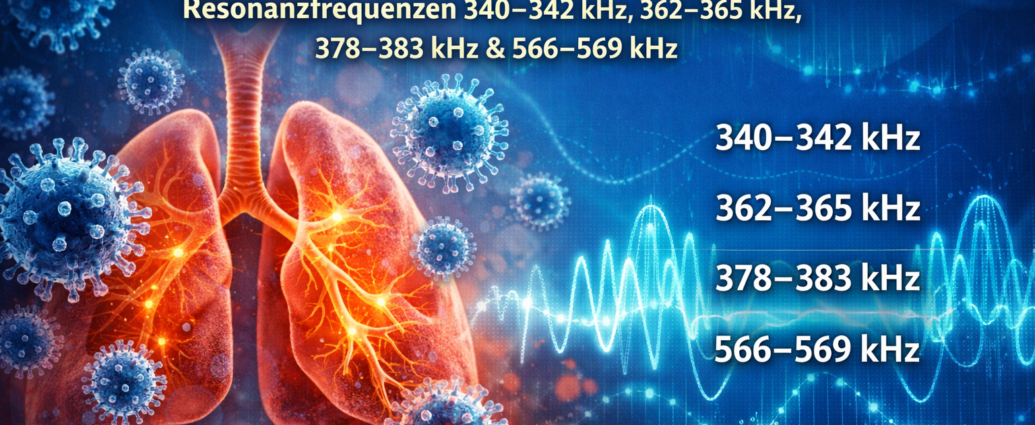
For RSV in this context, the following Resonant frequencies indicated:
- 340-342 kHz
- 362-365 kHz
- 378-383 kHz
- 566-569 kHz
These frequency ranges are assigned to the respiratory syncytial virus in the frequency therapy literature.
Significance of resonant frequencies for RSV
The idea behind such frequency information is based on the resonance principle. This states that certain structures, systems or even stressful influences can react particularly well to certain frequency ranges. In frequency therapy, it is derived from this that targeted frequency applications are used to support regulatory processes or influence disruptive stress patterns.
The above-mentioned frequency ranges are therefore considered relevant for RSV:
RSV frequency ranges
- 340-342 kHz
- 362-365 kHz
- 378-383 kHz
- 566-569 kHz
Within complementary frequency medicine, such ranges are regarded as an indication of specific resonance windows of the pathogen. In long-lasting or more severe cases, a corresponding application is often recommended from this perspective.
RFR method for RSV
The RFR method is described in this context as a procedure with which a virus is to be recognized and possibly also eliminated. Within the frequency medicine approach, the focus is on the assumption that a targeted resonance relationship can be established.
Especially for:
- long-lasting complaints
- recurring weakness
- more pronounced courses
- Delayed regeneration
From this perspective, more intensive or longer-term frequency-related monitoring is recommended.
However, a serious classification is important: in the case of severe shortness of breath, high fever, severe weakness or if children are affected, medical clarification should not be dispensed with. Frequency therapy should only be considered here, if at all, in a supplementary context.
Frequencies, airways and regulatory medicine
RSV shows very clearly how closely infection, breathing and regulation are connected. Breathing itself is a rhythmic process. It has frequency, dynamics and patterns. If there is a viral load, this rhythm often changes:
- the breathing rate increases
- the depth of breathing changes
- Bronchial tubes react with constriction or mucus production
- the organism becomes stressed
From a holistic perspective, an infection can therefore be understood as a disturbance of various rhythms. Frequency therapy attempts to have a regulating effect on these disturbed patterns. This does not necessarily mean that the virus is „killed“ in a way recognized by conventional medicine, but that the organism should be supported in its ability to react.
Holistic view of RSV
An integrative view of RSV encompasses several levels:
1. the infectiological level
It deals with infection, progression, symptoms, diagnosis and medical care.
2. the functional level
The focus here is on respiration, mucosal reaction, the immune system and regeneration.
3. the energetic-regulatory level
The focus here is on oscillation, resonance, stress patterns and frequency-oriented applications.
Information medicine in particular attempts to combine these levels. The aim is to achieve a more comprehensive understanding of illness and healing support.
RSV, susceptibility to infection and prolonged stress
Many people are familiar with the phenomenon that although a respiratory infection subsides superficially, coughing, weakness or irritability of the respiratory tract persist for a long time. In such phases, frequency therapy practice often focuses not only on the acute pathogen, but also on the general regulatory situation.
From this perspective, the following questions may become relevant:
- How much stress is the organism under overall?
- Is there evidence of weakened regulation?
- Is there any residual stress after an infection?
- Are there any additional bacterial contamination?
- Does longer-term support make sense?
Working with frequencies is understood here as part of a larger regulatory concept.
Why many people are interested in frequency medicine
Interest in frequency therapy is growing because more and more people do not want to view health in purely mechanistic terms. The organism is not just chemistry, but also communication, rhythm, signal processing and order.
This applies not only to infections such as RSV, but also to other chronic or severe strains, including Cancer diseases, where resonance, regulation and energetic support are also repeatedly discussed in complementary circles. However, it is particularly important to formulate this responsibly: Frequency therapy cannot replace oncological treatment, but is regarded by some users as complementary support in a holistic context.
Practical support in everyday life
Anyone dealing with RSV or other respiratory infections should not lose sight of the basics. These include:
- Rest
- Adequate fluid intake
- Observation of the condition
- Good indoor air
- Medical check-up in the event of deterioration
- careful hygiene
Frequency therapy is used as a complementary treatment, especially if the course of the disease is prolonged or a regulatory imbalance is suspected.
Conclusion
The respiratory syncytial virus is an important pathogen of respiratory tract infections, which occurs more frequently in the months from late fall to spring. It is highly contagious and can cause severe bronchial and lung diseases, especially in young children. The incubation period is usually around four days, the illness often lasts for around a week, but can also last longer. Bacterial co-infections are possible complications.
RSV is also interesting from the point of view of frequency therapy because certain Resonant frequencies be assigned:
- 340-342 kHz
- 362-365 kHz
- 378-383 kHz
- 566-569 kHz
As part of the RFR method these frequency ranges are considered relevant for the detection and complementary treatment of the virus. This approach is recommended in the complementary literature, especially for longer-lasting or more severe courses.
RSV thus impressively demonstrates how classical infection medicine and a holistic frequency approach can meet: on the one hand the medical treatment of acute respiratory tract infections, on the other hand the question of resonance, regulation and the possibilities of complementary frequency-oriented support.
Disclaimer
Frequency therapy is not recognized by conventional medicine and cannot replace therapy with trained doctors or alternative practitioners. This article is for general information purposes only and does not constitute a medical diagnosis or treatment recommendation. Medical help should be sought immediately in the event of shortness of breath, high fever, severe illness or complaints in infants and small children.
Comments are closed, but trackbacks and pingbacks are open.