





Author: NLS Information medicine Ltd, Herbert Eder
Mumps is one of the classic viral infectious diseases of childhood. The disease is triggered by the Paramyxovirus parotitidis, a pathogen that is primarily known for the typical painful swelling of the salivary glands. Although mumps is often perceived as a „childhood disease“, the infection can also occur in adolescents and adults, where it can sometimes be much more complicated.
From a conventional medical point of view, the focus with mumps is on infection control, monitoring possible complications and symptomatic treatment. In information medicine and Frequency therapy The additional question is whether the pathogen can spread via certain Resonant frequencies and can be accompanied within the framework of complementary approaches. This article addresses precisely this interface.
What is mumps?
Mumps is a contagious viral disease in humans that mainly affects the salivary glands. The parotid glands become inflamed particularly frequently, which leads to the typical visible swelling in the face and jaw area. The disease is transmitted by droplet infection, for example through coughing, sneezing or close contact with infectious saliva. Indirect transmission via contaminated objects is also possible.
After an infection has been contracted, it is usually assumed that a long-lasting to lifelong immunity are assumed. Nevertheless, mumps remains medically relevant because the disease is not always harmless and more serious side effects can occur, particularly in adults.
How is mumps transmitted?
Infection usually occurs via very fine particles of saliva and droplets that are released into the environment when speaking, coughing or sneezing. Infection can also occur when surfaces or objects contaminated with saliva are touched and then come into contact with the mouth, nose or eyes.
Typical transmission routes include:
- Coughing and sneezing
- Close personal contact
- Shared objects
- Contact with infectious saliva
The virus can spread rapidly, especially in communal facilities such as kindergartens, schools or family households.
Typical symptoms of mumps
Not every mumps infection is the same. Some sufferers develop a rather unspecific feeling of illness, others show the classic picture with pronounced swelling of the salivary glands.
The most common complaints include
- Chills
- Fever
- Headache
- Loss of appetite
- General feeling of illness
- Nausea or vomiting
- Painful swelling of one or more salivary glands
Particularly characteristic is the Pain when chewing or swallowing, as the inflamed salivary glands are additionally irritated by movement. The swelling can occur on one or both sides and often gives the face the typical „puffy“ appearance.
Why mumps is often more serious in adults
While children often survive mumps relatively uncomplicated, infections in adulthood can be more stressful. In this case, the disease is not always limited to the salivary glands, but can also affect other organ systems.
Possible investments include:
- Orchitis (inflammation of the testicles)
- Pancreatitis (inflammation of the pancreas)
- Myocarditis (inflammation of the heart muscle)
- Glomerulonephritis (involvement of the kidneys)
This additional organ involvement shows that mumps is by no means just a harmless glandular disease. Particular attention should therefore be paid to severe symptoms, a long course or unusual symptoms.
Neurological complications: When the nervous system is affected
Mumps has a pronounced Neurotropy, This means that the virus can also affect the nervous system. In severe cases, this can lead to serious neurological complications.
These include, among others:
- Meningoencephalitis
- Myelitis
- cerebellar ataxia
- Guillain-Barré syndrome
- Demyelinating processes
Even if such courses are not the rule, they make it clear why mumps should be taken seriously medically. Immediate medical clarification is required, particularly in the case of neurological abnormalities, stiff neck, severe drowsiness, movement disorders or pronounced weakness.
Prevention through vaccination
For prevention, the MMR vaccination available, i.e. the combination vaccination against Measles, mumps and Rubella. This vaccination strategy is a central component of prevention and is intended to significantly reduce the risk of infection and severe courses.
In a conventional medical context, vaccination is the most important preventive measure against mumps. Supplementary procedures from complementary medicine do not change the fact that prevention is primarily considered via established medical protective measures.
Treatment for mumps
As this is a viral disease, the treatment is usually symptom-oriented. This means that the focus is primarily on alleviating the symptoms and supporting the body's recovery.
This may include:
- Rest and physical protection
- Adequate fluid intake
- Soft or less painful food
- Observation of the general condition
- Medical check-up in the event of suspected complications
Which measures are appropriate in each individual case depends on the course of the disease and the person affected. Adults and people with severe pain or additional organ complaints in particular should receive medical support.
Mumps from the perspective of frequency therapy
In frequency therapy, illness is often understood not only as a biochemical process, but also as an expression of disturbed regulation, resonance and information processes in the organism. The body is seen as a system that can react to rhythms, vibrations and frequency-specific impulses.
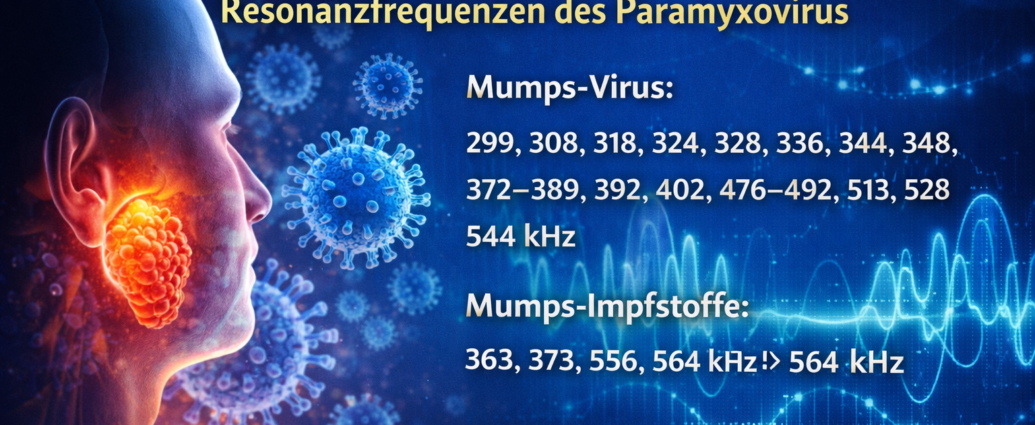
In connection with mumps, the literature on frequency medicine describes various Resonant frequencies which are assigned to the pathogen. These are
- 299 kHz
- 308 kHz
- 318 kHz
- 324 kHz
- 328 kHz
- 336 kHz
- 344 kHz
- 348 kHz
- 372-389 kHz
- 392 kHz
- 402 kHz
- 476-492 kHz
- 513 kHz
- 528 kHz
- 544 kHz
In addition, for Mumps vaccines The following resonant frequencies are specified:
- 363 kHz
- 373 kHz
- 556 kHz
- 564 kHz
This information originates from frequency therapy concepts and is described there as resonance-relevant areas.
What do these frequencies mean?
The idea behind such frequency values is based on the Resonance principle. In simple terms, this means that certain biological or stressful patterns may respond particularly well to defined frequency ranges. In information medicine, it is deduced from this that targeted frequency applications can possibly be used to recognize stress or provide regulative impulses.
In the case of mumps, the following frequency windows are described as particularly relevant:
Resonance frequencies of the mumps virus
299, 308, 318, 324, 328, 336, 344, 348, 372-389, 392, 402, 476-492, 513, 528, 544 kHz
Resonance frequencies of the mumps vaccines
363, 373, 556, 564 kHz
From the point of view of frequency medicine, these are specific areas that can be taken into account in corresponding systems.
The RFR method for mumps
Such statements belong to the field of complementary frequency therapy models and are not part of the generally recognized conventional medical standard therapy. Therefore, this approach should only be understood as a complementary consideration and never as a substitute for necessary medical diagnosis or treatment.
Why frequencies are interesting for viral loads
Viral infections pose challenges to the organism on several levels:
- the immune system is activated
- Inflammatory processes increase
- the energy balance is strained
- Vegetative regulation can become unbalanced
- Regeneration processes take time
In frequency therapy, it is assumed that such stress states can be described not only in material terms, but also in regulatory terms. The aim is then not necessarily just to „combat“ them directly, but also to support order, rhythmization and recovery.
Especially in the case of mumps, where other organs or even the nervous system can be affected in addition to the glands, the idea of holistic regulatory support is of interest to many users.
Frequency therapy, immune system and regeneration
Information medicine often deals with the question of how an organism reacts to stress and how its ability to self-regulate can be supported. In the case of mumps, this can be particularly important in the convalescence phase, i.e. when the acute infection subsides but the body is still weakened.
From a complementary perspective, the following aspects could play a role here:
- Support of the vegetative balance
- Support after febrile infections
- Promotion of subjective recovery
- Regulatory stabilization in the event of prolonged weakness
Again, such considerations are no substitute for medical monitoring of possible complications.
Mumps, frequencies and holistic medicine
The examination of mumps is an example of how differently illness can be viewed. Conventional medicine examines the pathogen, the route of infection, organ involvement and complications. Frequency therapy also looks at resonance patterns, stress fields and regulatory disorders.
An integrative view combines both perspectives:
The medical level
Diagnostics, complication detection, prevention and symptomatic care
The functional level
Stress on the glands, organ involvement, inflammatory dynamics and recovery
The energetic-regulatory level
Rhythm, Resonance, vibration and frequency-oriented accompaniment
This multi-layered approach is typical of information medicine.
Mumps in the broader context of frequency medicine
Anyone who studies frequency therapy quickly realizes that it is not just about individual pathogens, but about a more comprehensive understanding of biological communication. Viruses, Bacteria, organs, regulatory systems and even chronic stress states are considered in this model under the aspect of frequency and resonance.
Also for other serious illnesses, such as Cancer diseases, In complementary circles, frequency models are used time and again. However, particular caution is required here: such approaches must never give the impression of replacing oncological or other medical therapy. At best, they are discussed as supplementary support.
Conclusion
Mumps is a contagious viral disease that is mainly characterized by painful swelling of the salivary glands, but can also affect other organs and even the nervous system, especially in adults. The disease is transmitted by droplets and infectious saliva, treatment is primarily based on the symptoms, and the most important preventive measure is the MMR vaccination.
From a frequency therapy perspective, mumps is also associated with certain Resonant frequencies associated with this. The following areas are mentioned 299, 308, 318, 324, 328, 336, 344, 348, 372-389, 392, 402, 476-492, 513, 528 and 544 kHz. For mumps vaccines, the following are also 363, 373, 556 and 564 kHz indicated.
As part of the RFR method mumps is usually only described in the complementary literature as a relevant area of application in more severe cases. However, it remains crucial that medical clarification is essential in the case of pronounced complaints, organ involvement or neurological symptoms. Frequency therapy can at best be regarded as a complementary, not a substitute measure.
Disclaimer
Frequency therapy is not recognized by conventional medicine and cannot replace therapy with trained doctors or alternative practitioners. This article is for general information purposes only. Information and does not constitute a medical diagnosis or treatment recommendation. In the event of high fever, severe pain, neurological symptoms, testicular complaints, severe weakness or other severe symptoms, medical assistance should be sought immediately.

Comments are closed, but trackbacks and pingbacks are open.