

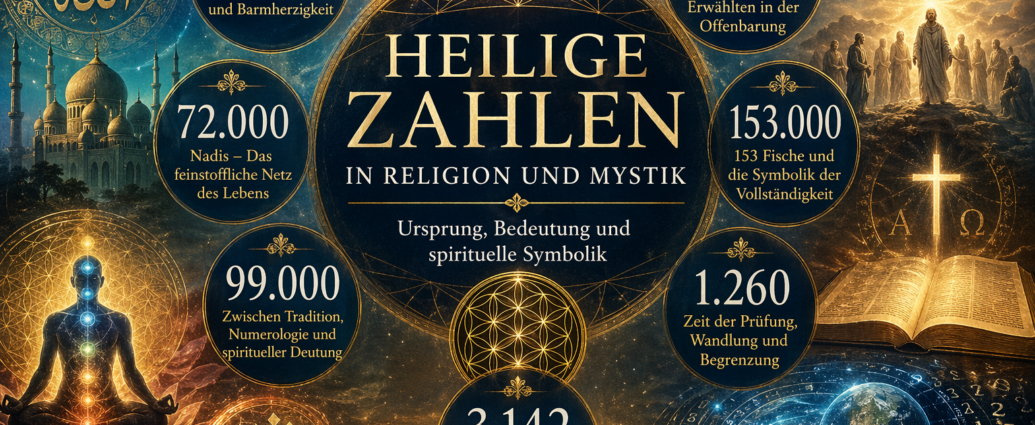
70,000, 72,000, 99,000, 144,000, 153,000, 1,260 and 3,142 in the mirror of religion, mysticism and spiritual order
Some numbers appear again and again in sacred writings, mystical teachings and spiritual traditions. But which of them are really sacred - and which were only symbolically elevated later?
Introduction: When numbers are more than math
Numbers are among the oldest tools of mankind. They were used for counting, measuring, building, trading and astronomical observation. But in almost all of the world's advanced civilizations, numbers were never just sober mathematical units. They were also an expression of a deeper order. They reflected the relationship between the cosmos and mankind, between creation and lawfulness, between the visible world and hidden reality.
In religion and mysticism in particular, certain numbers have been given special attention for centuries. Some appear in sacred writings, others in prophetic visions, in temple symbolism, in spiritual teaching systems or in meditative traditions. There they are not merely understood as quantities, but as carriers of meaning. They stand for completeness, testing, abundance, cosmic harmony, spiritual order or election.
This fascination remains unbroken to this day. Even modern readers, spiritual seekers and people with an interest in symbolism feel that certain numbers exude a peculiar power. They seem to point to a hidden pattern. This is exactly where the world of so-called sacred numbers begins.
In this article, we look at seven particularly striking figures: 70,000, 72,000, 99,000, 144,000, 153,000, 1,260 and 3,142. We clarify in which religious or spiritual traditions they appear, what symbolic meaning is attributed to them and how strongly their actual tradition is anchored. In doing so, we consciously distinguish between classically documented traditional numbers and numbers that have only recently been given an esoteric or numerological charge.
Sacred numbers: Why humans seek order in the invisible
The idea of sacred numbers stems from a deep human need: the desire to recognize structure in the world rather than mere coincidence. In religious cultures, the world was never just matter. It was ordered, animated, interwoven with meaning. The sky followed rhythms, nature obeyed cycles, man was embedded in cosmic connections.
Numbers thus became bridges between the rational and the spiritual. They are precise and mysterious at the same time. On the one hand, they can be calculated. On the other hand, they can be read symbolically. It is precisely this dual role that makes them so appealing.
In Judaism and Christianity, numbers often have a salvific character. In Islam, they often appear in traditions that express greatness, mercy or otherworldly reality. In Indian spirituality, we find numbers in connection with energy channels, consciousness structures and cosmic principles. In ancient philosophy, on the other hand, the number was sometimes regarded as the key to the whole of reality.
Sacred numbers are therefore never merely decorative symbols. They condense world views. They make visible how cultures have understood reality. And they show us that spirituality has always spoken a language of proportion, repetition and order.
70,000 - the number of the overwhelming divine dimension
The number 70.000 is conspicuous in several religious contexts, but it has its strongest spiritual presence in Islamic tradition. There it appears in hadiths as an expression of a greatness that transcends human measure. One particularly well-known motif is the idea that 70,000 believers enter paradise without reckoning. This number stands not only for a specific quantity, but for an overwhelming abundance of divine grace.
In other Islamic traditions, 70,000 also appears in images that describe the majesty of the afterlife, the power of the angelic world or the dimensions of divine judgment. In the religious symbolic language of Islam in particular, the number has a function that goes beyond simple counting. It marks a threshold: the measure of that which appears great, overwhelming and almost incomprehensible to man.
The number 70 and its multiplicity is also significant from a biblical perspective. In Scripture, 70 often stands for wholeness, for the fullness of the nations or for an ordered totality. If it becomes 70,000, then this symbolism grows to monumental proportions. It creates the impression of an order that far exceeds the scope of the individual.
Spiritually, 70,000 can therefore be understood as a number:
- of the immeasurable abundance,
- of divine greatness,
- the dimension beyond,
- and the expansion of the sacred into the barely imaginable.
In a modern spiritual interpretation, this number can also be read as an indication that the invisible is much more comprehensive than the visible. It is a reminder that, according to religious belief, spiritual reality is not small, limited or schematic, but infinitely richly layered.
72,000 - the subtle web of life in the yoga tradition
The number 72.000 is one of the best-known spiritual numbers in the Eastern world. Especially in the later yoga tradition and in tantric teachings, it is associated with the Nadis in other words, with the subtle energy channels of the human body. These nadis are said to run through the subtle body and carry the flow of life energy - often referred to as prana.
Even though different texts give different indications of the number of nadis, 72,000 has established itself as the most famous and symbolically most effective number. It describes the human being not just as a biological organism, but as an energetic being embedded in a multi-layered inner network.
The number is so fascinating precisely because it combines two levels. On the one hand, it conveys an idea of immense complexity. On the other hand, it appears ordered and structured. It says: the human being is not a random aggregate of matter, but a living microcosm.
In spiritual terms, 72,000 stands for:
- the multitude of internal connections,
- the subtle interplay of body, mind and consciousness,
- the idea of energetic harmony,
- and the cosmic structure within the human being.
In a broader sense, this number can also be read as a symbol that healing and the expansion of consciousness do not only take place on the visible physical level. Especially in modern holistic concepts, which also include ideas of Resonance, vibration and frequency, the idea of a subtle network is particularly relevant. This is where the ancient symbolic language of the nadis intersects with modern approaches that view people as energetic and information-bearing beings.
Also in the context of the Frequency therapy this way of thinking is interesting. Although nadis originate from a different cultural tradition, the basic idea of an organism that reacts to subtle impulses, resonance patterns and energetic order has parallels with modern holistic therapy concepts. Especially where regulation, information fields and subtle interactions are considered, the number 72,000 takes on an additional symbolic depth.
99,000 - a number between confusion, projection and modern numerology
In contrast to 70,000, 72,000 or 144,000, the 99.000 does not have a clearly anchored position as a classical sacred number of a great religious tradition. This is precisely why it is particularly revealing. It shows how easily the spiritual world of numbers and modern projections can intermingle.
It is obvious that 99,000 is based on an extension or confusion of the number 99 is based. This refers to the 99 names of God, The 99 names refer to those divine qualities that play a central role in Islamic piety. The 99 names are deeply rooted in the religious Practice rooted. They stand for mercy, wisdom, truth, justice, majesty and the closeness of God.
The number 99 is therefore highly spiritually charged. The number 99,000, on the other hand, has no comparable classical rank. Where it does appear, it is usually in:
- free numerological systems,
- modern esotericism,
- individual spiritual interpretations,
- or as a symbolic exaggeration.
That is an important difference. Not everything that has a spiritual effect or circulates on the internet is of equal value in terms of tradition. A number can be subjectively meaningful to people without being anchored in sacred scriptures or a stable religious tradition.
This is precisely why it is worth taking a sober look. 99,000 is less a classic sacred number than an example of how modern spirituality rethinks, exaggerates or recomposes familiar religious symbolism. Anyone seriously interested in number mysticism should be aware of these differences.
144,000 - the number of the elect and the architecture of the Apocalypse
The number 144.000 is undoubtedly one of the most famous sacred numbers of all. Its home is the Revelation of John, where it appears in connection with the sealed ones of God and the events of the end times. Hardly any other number has had such a strong influence on the Christian imagination.
Its power lies not only in the text, but also in its inner structure. 144,000 is not a random number, but is constructed mathematically and symbolically. In it we encounter the 12, which plays a central role in biblical thought: twelve tribes of Israel, twelve apostles, twelve gates of the heavenly Jerusalem. The twelve stands for divine order, for the people of God, for completeness in the history of salvation. If it is multiplied by itself and increased by 1,000, the result is a number of enormous symbolic density.
That is why 144,000 has been understood differently in the history of interpretation:
- as the literal number of a certain end-time group,
- as a symbolic representation of the full number of those saved,
- as an expression of divine election,
- as an image of absolute spiritual order.
From a theological point of view, this figure reveals a central motif of the Apocalypse: even in the crises of the end times, God's plan remains orderly. Salvation is not disorderly, random or indeterminate. It has structure, purpose and form.
In later spiritual movements, 144,000 was reinterpreted many times. There it appears partly as a number of awakening, partly as a code of collective change of consciousness, partly as a sign of special soul tasks. These modern interpretations may deviate from the biblical origin, but they show how powerful the number still is today.
Especially at a time when many people are searching for deeper order, 144,000 radiates a peculiar authority. It acts like a numerical seal - a number that not only counts, but also organizes, seals and spiritually bundles.
153,000 - or more precisely 153,600 - between scriptural findings and spiritual interpretation
The number 153.000 should be considered carefully, because the main biblical finding is actually 153.600. This number appears in connection with the census of workers or foreigners in the land under Solomon and is therefore actually part of the biblical tradition.
However, its symbolic aura depends less on the full number 153,600 than on the 153. We encounter this in the Gospel of John in the famous story of the miraculous catch of fish after the resurrection of Christ. There 153 Fish a seemingly unusually precise statement that has occupied theologians, mystics and interpreters of numbers for centuries.
Why 153 in particular? This very question has given rise to countless interpretations. The number has been associated with completeness, with the gathering of peoples, with spiritual abundance and with the unity of the Church. It has been studied mathematically, read symbolically and interpreted mystically. Its very precision suggests that it was not chosen at random.
The connection between 153 and 153,600 has not been handed down historically as a fixed dogmatic system. But symbolically it is obvious. This is because both numbers belong to the biblical realm and carry a hint of abundance, collection and orderly greatness.
However, it is important to differentiate:
- 153 is a highly symbolic number with a strong history of Christian interpretation.
- 153.600 is a biblical finding of monumental proportions.
- 153.000 is rather an abbreviated or imprecise form.
For a spiritual article, however, it is fair to say: The 153 has a special quality. It does not stand for mass alone, but for an orderly, wonderful abundance. It is precisely this combination of precision and abundance that makes it one of the most mysterious numbers in the New Testament.
1,260 - the number of limited examination periods
The number 1.260 is one of the central dates of Christian apocalypticism. In the Book of Revelation it appears as 1,260 days and is closely linked to other prophetic time measures such as 42 months or three and a half years.
This number unfolds its depth above all when it is understood symbolically. In biblical thought, the Seven as the number of completion. Three and a half is half of it. It therefore does not stand for final fulfillment, but for a limited interval, a time of trial, interruption or crisis. 1,260 is the form of this motif converted into days.
Therefore, 1.260 can be read as:
- Time of struggle,
- Time of the test,
- Time of prophetic witness,
- but also as a time that does not last forever.
And that is precisely its spiritual power: the darkness has a measure. The hardship has limits. The trial is real, but not absolute. From an apocalyptic perspective, this is of great significance. For this symbolism says that chaos is not the ultimate truth. Even in times of the greatest upheaval, a higher order remains effective.
Modern spiritual readers are often attracted to this number because it marks transitions. It can be understood as the number of the threshold period - the phase in which the old breaks down but the new has not yet become fully visible. In this sense, 1,260 is not just a biblical deadline, but a symbol for transformation processes in general.
This symbolism can also be used fruitfully in therapeutic and holistic contexts in which crises are understood as intermediate phases of reorganization. Especially where healing is not linear, but takes place through phases of irritation, clarification and reorganization, 1.260 reminds us that unrest can also be part of an overarching process of change.
3,142 - Pi, circular geometry and the spiritualization of mathematical order
The number 3,142 stands out because it is basically the rounded decimal representation of π is. This means that we are not initially moving in the classical space of revealed religions, but in mathematics. Nevertheless, π has become one of the most fascinating borderline numbers between science and spirituality.
Why? Because π is inseparable from the Circle and the circle is one of the oldest symbols of the sacred. It has no beginning and no end and stands for wholeness, eternity, unity, recurrence and cosmic order. Many spiritual traditions, sacred architecture and meditative symbols work with the circular form because it expresses perfection and undividedness.
If π determines the ratio on which every circle is based, then this mathematical constant easily becomes a symbol of hidden creative intelligence. From this perspective, 3.142 appears not merely as a number, but as a cipher of order in space.
However, it is important to make a clear distinction:
- π is mathematically universal.
- 3.142 is a rounded notation.
- The spiritual charge is predominantly modern.
Classical religions do not venerate π as a sacred number in the strict sense. However, in modern sacred geometry, in spiritual architecture, in philosophical views of nature and in holistic world views, π has become highly attractive. There it is seen as an indication that the universe is not only material, but also structurally meaningful.
Especially in the present, when many people are looking for bridges between science, resonance, consciousness and spiritual order, π takes on an almost meditative quality. The number reminds us that form and regularity are not at odds with mystery. On the contrary: the secret can reveal itself precisely in precise order.
In a broader sense, this also touches on modern approaches in which vibration, pattern, frequency and proportion are understood as basic elements of life. There, 3.142 does not appear as a dogma, but rather as an inspiring number at the interface of geometry, observation of nature and spiritual world view.
Sacred number or later projection? Why this distinction is crucial
Anyone dealing with spiritual numbers should not be too quick to lump everything together. There is a considerable difference between a number that is firmly anchored in centuries-old tradition and a number that has only recently been numerologically upgraded.
Strongly traditional figures
The numbers clearly anchored in your subject area include:
- 70.000 in Islamic traditions,
- 72.000 in the yoga tradition,
- 144.000 in Christian apocalypticism,
- 1.260 as a prophetic time number,
- 153 respectively 153.600 in a biblical context.
Uncertain or modern inflated figures
The evidence is much weaker:
- 99.000, presumably derived from the symbolism of the 99,
- 3,142, spiritually fascinating, but not classically canonically sacred.
This distinction is not a purely academic point. It helps to take spirituality seriously without falling into arbitrariness. Genuine depth arises where personal resonance and historical honesty come together.
The spiritual effect of large numbers
It is striking that several of these numbers are very large: 70,000, 72,000, 144,000, 153,600. Large numbers create a special effect in religious texts. They convey grandeur, excess, abundance and a sphere that transcends the everyday. They suggest that the sacred is not small and private, but vast, comprehensive and cosmic.
At the same time, her statement is not purely quantitative. It is not just about „a lot“, but about orderly much. Numbers are often constructed in such a way that they carry structure and meaning. Therein lies their spiritual power: they refer to a reality that is not chaotic, but permeated by measure, rhythm and inner lawfulness.
People who are interested in vibration, resonance and principles of order are particularly attracted to them. This is because sacred numbers indicate that reality is possibly not only organized in a material way, but also in an informational way. In such a context, numbers do not seem like coincidence, but like signatures of deeper connections.
Sacred numbers, resonance and the modern view of people
In the present, we are experiencing a new openness to connections between symbolism, consciousness and energetic concepts. Many people are not only interested in classical religion, but also in resonance phenomena, vibrational models and holistic systems of order. This is why old sacred numbers appear in a new light today.
Of course, ancient symbolism should not be uncritically equated with modern therapeutic models. However, it is noticeable that numerous traditions did not understand the human being as an isolated machine, but as a being that is integrated into fields, rhythms, proportions and subtle interactions. It is precisely here that points of contact arise with concepts that also play a role in frequency therapy.
The idea that order, disharmony and regulation can be understood not only biochemically, but also in terms of information or vibrations, opens up an interesting space for interpretation. Numbers such as 72,000 or 3,142 then become relevant not only historically, but also as an expression of deeper structural thinking.
Especially in the context of chronic stress and serious illnesses such as cancer, many people are looking for more comprehensive models of understanding life. Questions of order, resonance, regulation and energetic coherence are becoming increasingly important. Even if sacred numbers do not provide medical evidence, they show that human thought has been trying to relate health, the cosmos and inner order for thousands of years. This is precisely where their enduring fascination lies.
Conclusion: Which of these figures are really sacred?
Anyone who soberly assesses the figures mentioned in terms of traditional history comes to a clear conclusion:
The most religiously and mystically anchored are
- 70.000
- 72.000
- 144.000
- 1.260
Also important, but to be considered in a differentiated way, are
- 153 and 153.600
Significantly weaker or more modern in character are
- 99.000
- 3,142
But even this classification only tells part of the truth. Because numbers do not only live from their origin, but also from their effect. Some clearly originate from sacred texts, others only gain meaning through the spiritual imagination of later generations. The decisive factor is whether we honestly name their origin and carefully understand their symbolism.
Sacred numbers are ultimately more than just numbers. They are condensations of world views. They are signposts to ideas of order, abundance, testing, election and cosmic harmony. They remind us that religion and mysticism have always spoken a language of structure.
Perhaps this is precisely where their deepest power lies: they show that man has never ceased to search for a hidden measure behind the visible world.


Comments are closed, but trackbacks and pingbacks are open.