





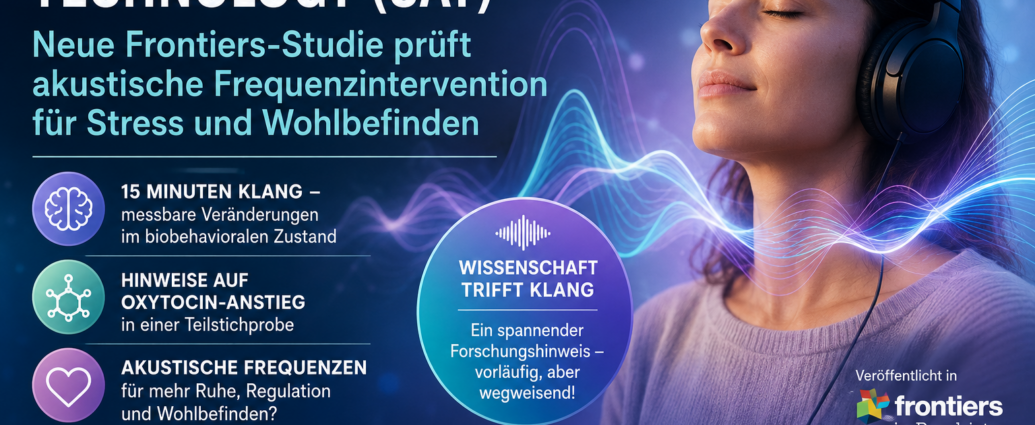
A new Frontiers study examines acoustic frequency intervention in the context of sonic augmentation technology for stress and well-being.
Abstract: A Frontiers study examines Sonic Augmentation technology as an acoustic frequency intervention. The findings regarding well-being and oxytocin are interesting, but still preliminary.
Introduction: When Sound Becomes a Research Question
Sound has an immediate effect on people.
In addition, even just a few minutes of music can calm you, energize you, bring back memories, or alleviate inner tension.
In modern research, sonic augmentation technology is being studied in greater detail.
For example, researchers are investigating whether structured acoustic patterns influence psychophysiological states.
In addition, researchers are investigating whether frequencies, rhythm, tempo, and sound architecture trigger changes in the experience of stress.
A new study in *Frontiers in Psychiatry* addresses this very question.
The study examined an acoustic intervention called Sonic Augmentation Technology, or SAT for short.
This is not an electromagnetic intervention.
It's not the classic kind either Frequency therapy in the strict technical sense.
SAT works with soundscapes, varying frequency patterns, and rhythmic structures.
Auditory stimuli are based on assumptions regarding autonomic regulation and the polyvagal theory.
Nevertheless, this study is of particular interest in the field of frequency therapy. It shows that the scientific discussion of frequencies is not limited to electrical, magnetic, or electromagnetic fields. Acoustic frequencies, audible sound patterns, and rhythmic impulses can also be understood as non-invasive stimuli that could influence the nervous system.
This is precisely where the connection lies with sound therapy, music therapy, and modern approaches to regulatory frequency medicine.
At the same time, it's important to be cautious.
The study does not provide conclusive evidence.
Nor does it provide any treatment recommendations or evidence of clinical efficacy.
Rather, it is an early indication of research.
It is interesting, methodologically limited, and scientifically valuable because it raises questions.
These questions need to be further investigated in larger, better-controlled studies.
What is Sonic Augmentation Technology?
The study describes Sonic Augmentation Technology as a polyvagal-informed auditory intervention.
This means that the design of the sounds is based on ideas about how the autonomic nervous system processes feelings of safety.
Threats, safety, relaxation, and activation are taken into account.
The Polyvagal Theory states: The body constantly evaluates signals. These evaluations occur both consciously and unconsciously. They take place through the body’s regulatory processes. Depending on whether the body perceives safety or danger, different states arise. These include calmness, social openness, and alertness. The fight-or-flight response may also occur. Withdrawal is another state.
Depending on the context, such a reaction can intensify or subside. A fight-or-flight response may occur. Withdrawal is also possible. This topic demonstrates how flexibly the body shifts between a state of relaxation and a state of alertness. In this way, it adapts to environmental demands, creating a dynamic equilibrium.
SAT uses structured sound patterns to promote a particular state. This state is associated with calmness, regulation, and psychophysiological recovery.
The intervention is passive. Participants do not have to do anything—they do not have to sing along, breathe in a specific way, or perform any mental exercises. They simply listen to a prepared sound sequence through headphones.
According to the study description, SAT differs from conventional music in that it is not based on fixed rhythmic structures, consistent tempos, or classical musical patterns of expectation. Instead, it makes use of changing acoustic properties. Among other things, the study cites variable tempos and frequency ranges embedded in soundscapes.
SAT thus bridges the gap between music, sound interventions, neurophysiologically inspired relaxation technology, and experimental frequency applications.
Why is this study relevant to frequency therapy?
In frequency therapy, it is often said that biological systems respond to vibration, rhythm, and frequency. Many approaches focus on electromagnetic fields, electrical impulses, light frequencies, or bioenergetic models.
The SAT study broadens our perspective. It shows that even Acoustic frequency interventions can be scientifically investigated if clear objectives, defined measurement points, and transparent methodological limitations are specified.
In the field of sound therapy in particular, there are many claims, but relatively few solid studies. Individual frequencies such as 432 Hz, 528 Hz, or Solfeggio frequencies has been associated with far-reaching effects, despite the lack of sufficient, reliable clinical evidence to support this. The SAT study takes a different approach: It does not examine a “healing frequency” in general, but rather a complex, structured auditory intervention, and assesses short-term changes in subjective well-being as well as neuroendocrine markers in a small subsample.
This is an important point for research on frequency therapy: not every claim regarding frequency is automatically scientifically sound. What matters is whether an intervention is clearly described, verifiable, comparable, and testable in controlled studies.
Study Design
The published article is titled "Feasibility Study" Study Investigation the short term Effects from Sonic Augmentation Technology™“ and was published on June 8, 2026, in Frontiers in Psychiatry.
The study included a total of 113 participants consisted of four groups. Some of the participants took part virtually, while others attended in person. The SAT intervention lasted 15 minutes. Psychophysiologically relevant self-reports were collected before and after the listening session.
The focus was on the so-called Biobehavioral State Index. This index is designed to capture short-term changes in areas such as relaxation, inner stability, breathing, physical tension, calmness, feeling overwhelmed, and interoceptive clarity. It is important to note that this tool was used in the study as an exploratory measurement instrument and has not yet been comprehensively validated.
In addition, saliva samples from a smaller subset of the sample were analyzed to investigate changes in endogenous oxytocin. Oxytocin is a complex neuropeptide that is associated with, among other things, social bonding, stress regulation, trust, a sense of security, and parasympathetic processes. However, it would be incorrect to simplistically refer to oxytocin as the „cuddle hormone“ or as a clear marker of healing. Its effects depend heavily on context, individual factors, and biological regulatory systems.
Key findings
1. Improvement in self-reported well-being
The study reports that a large proportion of participants reported an improvement in their biobehavioral state following the 15-minute SAT exposure. Changes were particularly pronounced in areas associated with relaxation, reduced arousal, and an improved sense of subjective regulation.
At first glance, this sounds remarkable. At the same time, one must read the text very carefully: this is a short-term pre-post observation. Participants were surveyed before and immediately after the intervention. Without an appropriate control group, it remains unclear whether this change can be attributed specifically to SAT.
Possible alternative explanations include:
- Expectation effects
- the calming effect of music in general
- the academic situation
- a short break from everyday life
- Relaxation through headphones and retreat
- Regression to the mean
- the desire to see a change following an intervention
This does not diminish the value of the study, but it does limit its significance. It shows that SAT is feasible and can be associated with improved subjective well-being in the short term. However, it does not yet prove that SAT is specifically therapeutically effective.
2. Stronger effects at higher initial loads
It is interesting to note that individuals with higher baseline levels of stress appeared to benefit more. The study examined, among other things, autonomic reactivity and symptoms of anxiety and depression. Participants with higher baseline scores in these areas showed greater changes in their biobehavioral state.
That makes sense: People who are more tense, stressed, or dysregulated at the outset have more room for short-term improvement. At the same time, this observation could be important for future research. Perhaps acoustic interventions are particularly beneficial for people whose nervous systems are chronically under high stress.
For the Practice However, this does not mean that treatment will be approved. Controlled studies, standardized measurement methods, and follow-up surveys are particularly necessary for anxiety disorders, depression, post-traumatic stress disorder, burnout, and chronic stress.
3. Evidence of changes in oxytocin levels
One particularly interesting aspect of the study concerns oxytocin. In a smaller subsample with complete saliva data, elevated oxytocin levels were observed after the SAT.
This is scientifically interesting because oxytocin is associated with social security, stress regulation, and parasympathetic processes. Theoretically, therefore, it could be a biological marker linked to a subjective sense of calm or a feeling of inner security.
But caution is key here as well. The oxytocin analysis is based on a small group. Single saliva measurements are biologically complex. Oxytocin levels fluctuate, are context-dependent, and are not easy to interpret from a methodological standpoint. Furthermore, an increase does not automatically prove that a clinically relevant effect has occurred.
The study itself frames this point cautiously and calls for larger sample sizes in order to better assess reliability, effect size, and biological significance.
What does „polyvagal-informed“ mean?
The polyvagal theory, popularized by Stephen Porges, describes the autonomic nervous system as more than just a simple interplay between the sympathetic and parasympathetic nervous systems. It emphasizes that social security, voice tone, facial expressions, breathing, heart rate, and internal body awareness can be closely interconnected.
In this context, sound becomes particularly interesting. The human voice, prosody, melody, and rhythmic patterns can convey signals of safety or threat. A soothing tone of voice has a different effect than a shrill warning signal. Gentle, orderly, yet lively sound structures could therefore theoretically influence autonomic states.
SAT addresses these considerations without simply playing soothing music. The intervention uses variable acoustic structures that, according to the study, are linked to autonomic regulatory rhythms. However, it has not yet been proven whether these theoretical mechanisms actually work in this way. The study primarily examines feasibility and short-term changes, not the complete mechanism of action.
Sound, Frequency, and the Nervous System
From a physical standpoint, acoustic frequencies are vibrations of the air that are detected by the ear and processed by the nervous system.
Unlike electromagnetic frequencies, they primarily act through the auditory system. They influence low-frequency vibrations through body resonance and utilize neural networks that connect sound, emotion, memory, attention, and body awareness.
Music can influence heart rate, breathing, muscle tension, mood, and subjective stress levels. This is something we know from everyday experience, and it is also being studied scientifically. However, it is crucial to distinguish between general relaxation effects and specific therapeutic effects.
A soothing sound intervention can have a calming effect without treating a specific illness, thereby promoting overall well-being. It supports emotional balance without replacing medical treatment and thus serves as a complementary measure to individual health care.
It can subjectively reduce stress without automatically altering a clinical diagnosis, and provides tangible relief in everyday life. As such, it offers a gentle, non-invasive approach for people seeking relaxation, without replacing regular treatment options.
It is precisely this distinction that is important when studies like this are conducted in the context of frequency therapy, sound therapy, or Information medicine be discussed.
What makes the study strong
The study has several positive aspects.
First, it was published in a peer-reviewed journal. Second, ethical guidelines, study registrations, and institutional affiliations are clearly stated. Third, the authors formulate clear research questions. Fourth, the study examines not only subjective states but also a biological marker in a subsample.
One particularly positive aspect is that the study openly acknowledges its limitations. This is scientifically important. Reputable research is not recognized by the grand promises it makes, but by the fact that it precisely defines the scope of its findings.
This is also a valuable approach for frequency therapy. Anyone who wishes to conduct serious scientific research into frequency interventions must be prepared to distinguish between hypothesis, observation, plausibility, and proof.
The main restrictions
The main limitation is the absence of a control group. Although control conditions were planned for two groups, this data was not included in the current publication for methodological reasons. As a result, the results are limited to a SAT condition with a before-and-after comparison.
Without a control group, it is impossible to determine whether SAT is more effective than:
- serene calm
- standard relaxation music
- Mozart's music
- Sounds of nature
- a placebo sound
- Breath control
- A guided relaxation exercise
- neutral auditory stimulation
Other limitations include the short observation period, the predominantly subjective measurements, the limited validation of the Biobehavioral State Index, the demographic composition of the sample, and the small oxytocin sub-sample.
This is crucial for clinical conclusions. The study cannot prove that SAT treats anxiety, depression, trauma, burnout, or chronic stress. It can only show that measurable short-term changes were observed following brief exposure.
Relevance to stress, burnout, and psychophysiological regulation
Stress isn't just a feeling. It affects breathing, muscle tension, the cardiovascular system, hormones, sleep, attention, Digestion, the immune system, and emotional regulation. That is why approaches that rely not only on cognitive conversations but also on body-oriented or sensory methods are of interest.
Sound can be one such approach. Many people find that music or certain soundscapes have an immediate calming effect. Especially when experiencing high levels of inner tension, it can be helpful not to “have to think” any more, but rather to enter a different state through perception, rhythm, and atmosphere.
SAT fits into this line of research. It is a type of passive auditory intervention that does not require the person to actively practice. This could be particularly relevant for people who are exhausted, overstimulated, or under significant mental stress.
Nevertheless, it is important to note that in cases of serious mental health issues, such an intervention should never be viewed as a substitute for medical, psychotherapeutic, or therapeutic care. At most, it can be further explored as a complementary, relaxation-oriented, or regulatory approach.
Significance for sound therapy and frequency therapy
This study sends an important message for sound therapy, music therapy, and frequency therapy. It shows that modern research does not have to stop at mere claims about “healing frequencies.” Instead, complex sound interventions can be systematically investigated.
This raises several questions:
Which sound parameters are truly relevant? Is it frequency? Tempo? Variability? Dynamics? This question can be summarized succinctly, because often a single factor seems to be decisive, while other factors also play a role.
Alternatively, low expectations could also play a role, as could the emotional quality and the rhythmic structure. Ultimately, it remains unclear whether it is the individual parameters on their own or the combination of all these factors that ultimately determines the sound.
Which people tend to react particularly strongly?
Are these individuals who experience high autonomic reactivity, chronic stress, anxiety, exhaustion, or trauma?
Which measurements are appropriate?
Are questionnaires sufficient, or are heart rate variability, breathing patterns, skin conductance, cortisol, oxytocin, EEG, or other physiological markers needed?
How long do the effects last?
Is a 15-minute intervention only beneficial in the short term, or can repeated use promote long-term regulation?
These questions are crucial for the future. Only once they have been answered in randomized controlled trials can we speak with any certainty about their effectiveness.
Contextualization in relation to serious illnesses such as cancer
Stress management also plays a major role in serious illnesses such as cancer. Anxiety, sleep disturbances, restlessness, exhaustion, and emotional distress can significantly impact patients. Sound, music, and relaxation-oriented frequency therapies are therefore often discussed as complementary treatments.
It is important to draw a clear line here: Acoustic frequency interventions such as SAT are not a cancer treatment. They are not a substitute for oncology, medical diagnostics, or evidence-based treatment. Such approaches are of interest, if at all, in the areas of well-being, relaxation, self-regulation, and supportive care.
This is precisely where future research could be particularly valuable: Can structured sound interventions reduce stress in high-stress patient groups? Can they promote sleep, relaxation, body awareness, or emotional stability? And if so, which methods are more effective than regular music or silent relaxation?
Such questions must be carefully examined without raising false hopes.
Why communication must remain cautious
The greatest danger with early-stage studies lies not in the research itself, but in its overinterpretation. “Improved well-being after 15 minutes“ quickly becomes „effective against anxiety.“ “A rise in oxytocin in a small subsample„ quickly becomes “activated healing.“ “An interesting research finding” quickly becomes “a proven therapy.”.
That is exactly what should be avoided.
A reliable assessment is as follows:
SAT is an interesting acoustic frequency intervention.
The study shows short-term improvements in self-reported well-being.
A small subsample showed evidence of changes in oxytocin levels.
The results are preliminary.
The published study does not include a control group.
Clinical efficacy has not been proven.
Further studies are needed.
This matter-of-fact language does not diminish the significance of the finding. On the contrary: it makes it more credible.
What future studies should aim to achieve
The next steps in the research should be clear. Randomized controlled trials with multiple comparison groups would be necessary. Ideally, SAT should be tested against standard relaxation music, neutral soundscapes, silence, and possibly other active interventions.
The following would also be important:
- larger and more diverse samples
- clearly defined target groups
- objective physiological measurements
- validated psychological questionnaires
- Follow-up surveys after a few days or weeks
- Review of repeated applications
- clear description of the sound parameters
- Analysis of Individual Response Patterns
It would be particularly interesting to measure heart rate variability, as it is closely linked to autonomic regulation. Respiratory rate, sleep quality, cortisol levels, skin conductance, and EEG patterns could also provide additional insights.
Only such studies could determine whether SAT is more than just a pleasant, short-term relaxation technique.
Conclusion: An exciting research finding, but no proof of efficacy
The Frontiers study on Sonic Augmentation Technology is an exciting contribution to research on sound, frequencies, stress, and well-being. It shows that a 15-minute acoustic intervention may be associated with short-term improvements in self-reported biobehavioral state. In particular, individuals with higher baseline autonomic or psychological stress levels appear to have responded more significantly in this study.
The evidence suggesting changes in oxytocin levels is also scientifically interesting.
However, they should not be overinterpreted. They are based on a small subsample and require further replication.
The study is particularly relevant to frequency therapy because it points the way toward a more rigorous research approach: moving away from sweeping claims of healing and toward verifiable questions, measurable outcomes, and methodological transparency.
The key takeaway is therefore this: SAT is an interesting research signal in the field of acoustic frequency interventions. However, SAT cannot currently be described as an evidence-based therapy for stress, anxiety, depression, or other clinical conditions. Larger, controlled, long-term studies are needed to establish this.
Source citation
Frontiers in Psychiatry: “Feasibility Study Investigating the Short-Term Effects of Sonic Augmentation Technology™,” published on June 8, 2026.
Legal and Medical Notice
Frequency therapy, sound therapy, and acoustic frequency interventions are not recognized by conventional medicine in many areas of application. The content presented here is intended to Information and scientific classification. They are not a substitute for a diagnosis, counseling, or therapy provided by trained physicians, psychotherapists, or alternative practitioners. In cases of mental health issues, serious illnesses, cancer, or prolonged stress, qualified medical or therapeutic help should always be sought.

Comments are closed, but trackbacks and pingbacks are open.