





Conventional medical basics, course, symptoms and complementary frequency information
Stomach cancer is one of the most significant tumor diseases of the digestive system worldwide. From a conventional medical point of view, it is usually an adenocarcinoma of the stomach. There are also other, much rarer tumor forms such as lymphomas, sarcomas, carcinoids or tumors of the connective and muscle tissue. For those affected, it is particularly important that stomach cancer often remains undetected for a long time and is therefore not always recognized at an early stage.
This is precisely why it is important to take a differentiated approach to the topic: firstly from a conventional medical perspective with a view to the development, risk factors, symptoms, diagnosis and treatment. This can then be supplemented by the complementary perspective of Frequency therapy be categorized. The focus here is on supporting the organism and considering the frequency ranges mentioned in the literature in a complementary context.
What is stomach cancer?
Stomach cancer refers to malignant tumors that arise from the tissue of the stomach wall. Over ninety percent of these tumors are Adenocarcinomas. They develop from glandular cells of the gastric mucosa. Although other types of stomach tumors also occur, they are much rarer.
The significance of this disease in conventional medicine lies not only in its frequency, but also in the fact that the cancer often develops in stages. Such changes often begin with long-term irritation of the mucous membrane and can develop into a malignant process via various preliminary stages.
How stomach cancer can develop
In conventional medicine, the development of stomach cancer is understood as a multi-stage process. It often begins with chronic inflammation of the gastric mucosa. As it progresses, normal mucosal structures may regress, cells may be remodeled and finally degenerative changes may occur.
Typical development steps can be
Chronic gastritis
Prolonged inflammation of the gastric mucosa can create the basis for later tissue changes.
Gastric mucosal atrophy
This leads to a reduction in normal mucosal structures. This can reduce the protective function of the stomach.
Metaplasia and dysplasia
At this stage, the cell structure changes increasingly. Healthy gastric mucosa develops into tissue that no longer corresponds to the normal structure. Such changes are considered important precursors.
Transition to carcinoma
These precursors can later develop into malignant tumors. Tumor develop.
Important risk factors from a conventional medical perspective
Several factors play a role in stomach cancer. Chronic colonization of the stomach with Helicobacter pylori is particularly well known. This bacterium can permanently irritate the gastric mucosa and promote inflammatory processes. Patients with such chronic exposure have a significantly increased risk of developing a tumor later on.
In addition, various other preconditions are associated with an increased risk:
Chronic atrophic gastritis
If the gastric mucosa is permanently damaged, the likelihood of structural changes increases.
Pernicious anemia
This form of anemia is also associated with changes in the gastric environment.
Menetrier syndrome
This is a rare disease of the gastric mucosa with a significantly altered mucosal structure.
Gastric dysplasia and adenomatous polyps
Such findings are considered precursors that must be carefully observed and clarified.
Hereditary burden
Genetic predispositions can also influence the risk of developing the disease.
Reduced stomach acid production
If there is too little stomach acid, this can promote the colonization of the stomach with other microorganisms.
The most important forms of gastric adenocarcinoma
In conventional medical classification, gastric adenocarcinomas are often divided into two main types. These differ both in their microscopic structure and in their behavior.
Intestinal type
The intestinal type usually shows more recognizable glandular structures. It frequently occurs in the lower section of the stomach and is often associated with chronic mucosal changes as well as environmental and nutritional factors.
Diffuser type
The diffuse type consists of fewer contiguous cells that penetrate the stomach wall more extensively. This form can occur in any part of the stomach, especially in the area of the stomach entrance, and is often considered to be more aggressive.
Early and advanced stages
Early gastric carcinomas are initially limited to the mucous membrane or the underlying layer. At this stage, the chances of recovery are generally more favorable. However, the problem is that early stages often cause hardly any symptoms.
Advanced tumors penetrate deeper into the stomach wall and can spread to neighbouring structures, lymph nodes or distant organs. This is referred to as a locally advanced or metastatic tumor.
Typical symptoms of stomach cancer
Stomach cancer often only causes very unspecific symptoms in the early stages. Many sufferers do not take the first signs seriously or initially associate them with more harmless stomach problems.
Possible complaints are
Early feeling of satiety
Even small meals can be perceived as stressful or unpleasant.
Nausea and vomiting
These symptoms can occur repeatedly and should be clarified if they persist for a long time.
Pain in the upper abdomen
In particular, pressure, burning or vague pain in the stomach area can be indications.
Difficulty swallowing
If the upper section of the stomach is affected, this can also cause problems with swallowing.
Loss of appetite
A noticeable decrease in the feeling of hunger is one of the frequently described warning signs.
Weight loss
Unintentional weight loss is always a serious sign and should be diagnosed.
Flatulence and bloating
These symptoms can also occur with stomach cancer, although they often appear unspecific at first.
Bleeding
Vomiting blood or black stools may indicate bleeding in the gastrointestinal tract.
Iron deficiency and anemia
Chronic, initially unnoticed blood loss can lead to anemia and cause fatigue or poor performance.
Diagnostics from a conventional medical perspective
The conventional medical clarification is based on the symptoms, the medical history and the clinical findings. A suspected case of stomach cancer is further clarified by various examinations.
Gastroscopy
The Endoscopy is one of the most important examinations. The gastric mucosa can be examined directly. Suspicious areas can be specifically assessed.
Tissue sample
Tissue samples are usually taken as part of the gastroscopy. Only the histological examination allows a reliable assessment of whether a malignant change is present.
X-ray examination with contrast medium
A contrast medium examination of the upper digestive tract can be used in particular to visualize changes in shape and mucosal irregularities.
Computed tomography and magnetic resonance imaging
These procedures help to better assess the extent of the tumor and detect possible metastases.
Combined imaging
Depending on the situation, other procedures can also be used to better visualize the metabolic activity and spread of the tumor.
Differentiation from other stomach complaints
Not every chronic stomach complaint is an indication of cancer. In conventional medical diagnostics, it is important to differentiate stomach cancer from other diseases. These include, above all, chronic gastritis and benign or chronic gastric ulcers. Careful examination is crucial precisely because symptoms can overlap.
Treatment of stomach cancer
Conventional medical treatment depends on the type of tumor, location, extent and general condition of the patient. If the tumor is limited to the stomach, surgical treatment is usually the main option.
Operation
If the tumor is localized, an attempt is made to remove the affected tissue completely. Depending on the extent of the tumor, a part of the stomach or the entire stomach can be surgically treated.
Chemotherapy
Chemotherapeutic treatments can be used before or after an operation. In advanced stages, they are often used to slow tumor growth and alleviate symptoms.
Radiotherapy
Radiation can also be used in certain cases to alleviate symptoms or as part of a combined treatment concept.
Symptom-oriented support
Support is particularly important for pain, nutritional problems, nausea, anemia and general weakness.
A holistic view of stomach cancer
A comprehensive approach is particularly useful for serious illnesses. Conventional medical diagnostics and therapy form the basis. In addition, many people are interested in complementary approaches that can support the organism in its ability to regulate itself.
This is where frequency therapy comes in as a complementary approach. The aim is not to replace conventional medical treatment, but to provide additional stimuli on an energetic and information-related level. The focus is on the question of whether the organism can be supported in its regulation by certain frequency patterns.
Frequency therapy for gastric cancer in a complementary context
Complementary frequency therapy often works with resonance patterns that are assigned to specific stress patterns in the literature. In the case of stomach cancer, such frequency ranges are not considered in isolation, but are integrated into a more comprehensive concept.
From a complementary point of view, the environment of the stomach environment can also be important. Topics such as chronic mucosal irritation, bacterial stress, general regulatory disorders, energetic weakening and the support of the digestive system are addressed in the Practice often considered together. Particularly in the area of chronic processes, the organism is viewed not only locally but also systemically.
Why the stomach plays a special role in the complementary area
The stomach is much more than just a digestive organ. It is closely connected with the autonomic nervous system, with metabolic processes, with the absorption of nutrients and with the general resilience of the organism. If profound changes occur in this area, this can affect the whole person.
Complementary concepts of frequency therapy therefore often involve several levels:
Mucosa and tissue regulation
The gastric mucosa is a highly active tissue that can react sensitively to stress.
Digestive function
Disorders in the stomach area often also affect the subsequent digestive sections.
Vegetative stress
Chronic complaints in the upper abdomen often affect the entire regulatory system.
Overall energetic condition
Particularly in the case of protracted illnesses, attention is often paid to general vitality and regulatory reserves in the complementary area.
Frequency info
According to the literature, the following resonance areas are mentioned particularly frequently in gastric carcinomas:
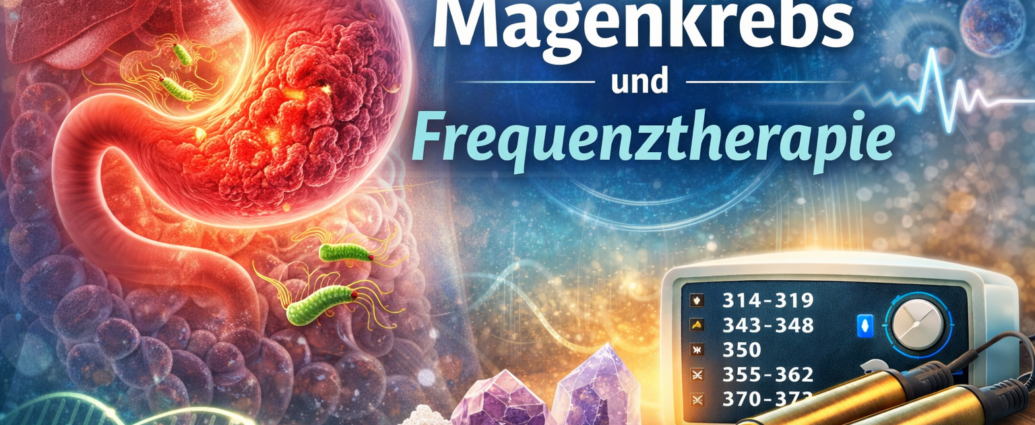
314-319 kHz
343-348 kHz
350 kHz
355-362 kHz
370-373 kHz
377-379 kHz
392-393 kHz
426-438 kHz
442-452 kHz
552-555 kHz
These frequency ranges are viewed in a complementary way and placed in a holistic context within frequency therapy. In practical application, they are not used in isolation from the overall picture, but are classified together with the individual energetic situation, the stress on the digestive system and the general regulatory state of the organism.
Thinking frequency therapy and stomach cancer together
Anyone dealing with stomach cancer should first understand the conventional medical side with its clear diagnostics and therapeutic options. Surgery, histological examination, imaging procedures and, if necessary, accompanying cancer therapies form the central medical basis.
In addition, frequency therapy can be incorporated as a complementary approach when the goal is to support the body holistically. Especially in complex stressful situations, many people are interested in approaches that address not only the affected tissue but also Digestion, taking into account regulation, energy balance, and overall load.
Conclusion
Stomach cancer is a serious tumor disease that often arises from long-standing changes to the mucous membrane and often only causes inconspicuous symptoms in the early stages. This makes it all the more important to carry out a careful diagnosis, a clear conventional medical classification and targeted treatment planning.
In the complementary field, frequency therapy is used as a supplementary approach to support the organism on an information medicine level. The frequency ranges described in the literature can be used as Frequency info be integrated into a holistic concept. The result is an approach that combines conventional medical principles with a complementary view of regulation, stress and individual support.

Comments are closed, but trackbacks and pingbacks are open.