





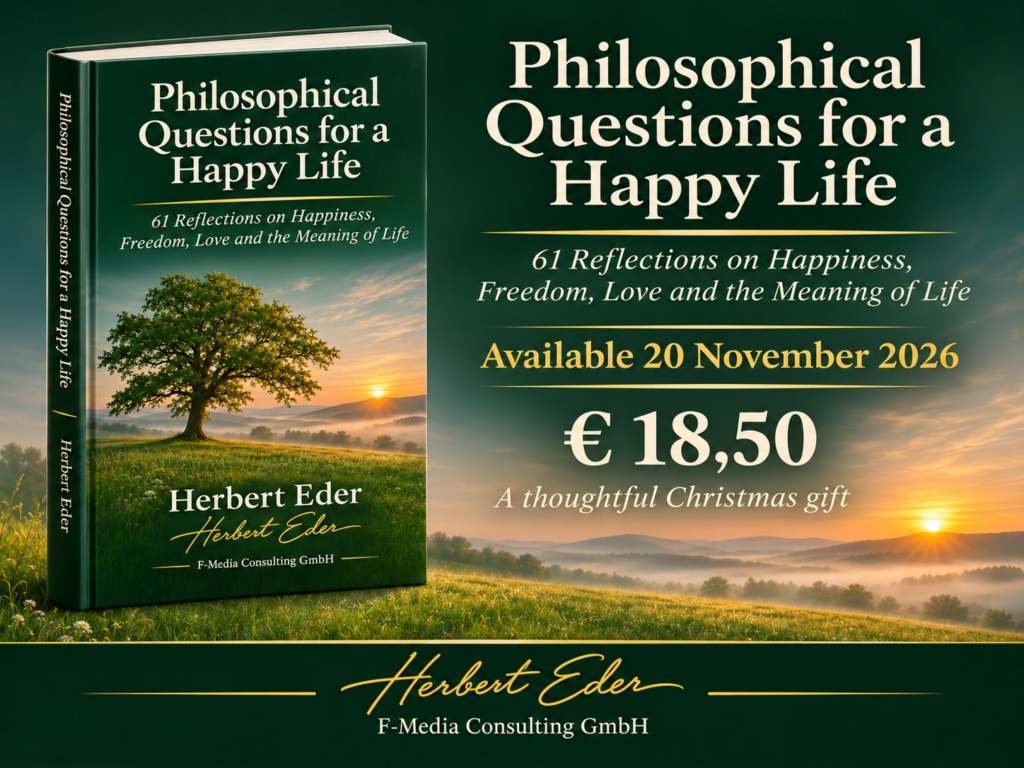
Give the gift of a quiet moment — and questions worth returning to.
Publication date: 20 November 2026 · Price: € 18,50 · English edition
Philosophical Questions for a Happy Life by Herbert Eder invites you to make room for the questions that matter: What does happiness mean to me? How do I want to spend my time? What makes a relationship worth nurturing? This English edition brings together 61 illustrated reflections on happiness, freedom, love and the meaning of life, with everyday examples and questions to explore for yourself.
Some books are read once. Others become companions you return to when life changes. This book offers a thoughtful place to pause, reconsider a familiar situation and discover which questions deserve more attention in your own life.
Enquire about your copy — € 18,50
A book about happiness with room for your own answers
A busy day rarely leaves much time for reflection. Responsibilities accumulate, messages arrive and other people’s expectations can begin to shape our choices. Yet the most personal questions often emerge in ordinary moments: after a difficult conversation, while making a decision or when a long-held ambition no longer feels right.
Herbert Eder approaches these moments through accessible philosophical reflections. You are invited to examine possible answers, consider objections and connect an idea with your own experience. Different views can sit alongside one another. You can agree, disagree or leave a question open.
The book also makes space for disappointment, grief and uncertainty. A happy life can include difficult experiences, unfinished plans and relationships that ask something of us. These reflections encourage a more attentive understanding of that complexity.
What you will find in the English edition
- 61 substantial reflections, each centred on its own guiding question.
- 61 accompanying illustrations with English wording.
- Nine thematic parts, from happiness and personal wishes to freedom, relationships, time, kindness and meaning.
- Everyday examples and thought experiments that make abstract ideas easier to explore.
- Closing reflection questions for personal writing, quiet contemplation or conversation.
From happiness and freedom to love and meaning
The journey begins with your own understanding of happiness. It explores unfulfilled wishes, possessions and contentment, the habit of postponing happiness and the possibility of finding something valuable in a difficult life.
Further sections consider impermanence, memory and the traces we leave in other people. Questions about ambition and comparison lead into freedom, habits, responsibility and personal boundaries. The book then turns towards love and independence: how to care for someone without losing yourself, how forgiveness relates to trust and how solitude differs from loneliness.
The final parts examine time, silence, generosity, compassion, hope and meaning. They invite you to consider what matters in an imperfect life and how small choices can express the values you want to live by.
Three ways these reflections can enter everyday life
When you are reconsidering your priorities
A question about your own sense of “enough” can open a useful conversation with yourself. Which ambitions still matter? Which commitments reflect an earlier version of your life? Reading slowly can help you notice distinctions that disappear in the rush to make a decision.
When a relationship needs a different conversation
Reflections on care, boundaries and trust offer starting points for discussing what each person needs. You might read a passage with your partner or a friend, then share where your experiences differ. The value can lie in listening carefully to the answer.
When you want to spend your time more consciously
A chapter about silence or unhurried time can become a small pause in your week. Choose one question, write a few lines and return to it later. A changed answer may reveal something you had not previously noticed.
Who is this book for?
This book is for English-speaking readers who enjoy thoughtful writing about ordinary human experiences. No academic background in philosophy is needed. It suits readers curious about their own choices, people navigating change and couples or friends looking for meaningful conversation.
You can follow the nine parts in order or begin with the reflection that speaks to you today. Each text can be read independently, making the book easy to revisit at your own pace.
A thoughtful Christmas gift for someone who enjoys deeper questions
What can you give someone who already has so much? A book can offer a quiet hour, a new perspective or the beginning of a conversation. The combination of illustrations and personal questions makes this English edition a thoughtful Christmas gift for a partner, friend or family member who enjoys reflecting on life.
Choose a theme that reminds you of the recipient and add a handwritten note. A few personal words can turn a book into an invitation to share time and ideas. It can also be a gift to yourself: a reason to set aside a little space for reading during a busy season.
About Herbert Eder
Herbert Eder brings a personal, accessible voice to questions about happiness, relationships and human experience. In this book, he connects philosophical possibilities with imagined everyday situations and invites readers to think further for themselves.
The examples explore familiar experiences without presenting identifiable life stories. Religious and worldview questions are considered as philosophical possibilities, with room for different convictions.
English edition at a glance
- Title: Philosophical Questions for a Happy Life
- Subtitle: 61 Reflections on Happiness, Freedom, Love and the Meaning of Life
- Author: Herbert Eder
- Language: English, including the cover and illustration wording
- Contents: 61 illustrated reflections in nine thematic parts
- Publisher: F-Media Consulting GmbH
Ask about buying the English edition
Would you like a copy for yourself or as a gift? Send an enquiry using the contact form and mention “Philosophical Questions for a Happy Life – English edition”. The English edition is published on 20 November 2026 at € 18,50. Please ask about available formats, shipping costs and delivery options for your country when making your enquiry.
Enquire about the English book — € 18,50
Frequently asked questions
When is the book published, and what does it cost?
The English edition is published on 20 November 2026. The book costs € 18,50. You can express your interest now using the contact form.
Is the whole book in English?
Yes. This is the English-language edition, including the book text, cover wording and the wording on its 61 illustrations.
Do I need to know philosophy?
No. The reflections use understandable language and familiar situations. Curiosity and a willingness to consider your own answers are enough to begin.
Must I read the chapters in order?
No. The thematic structure offers one route through the book, while each reflection can also be read on its own.
Can I order it as a Christmas gift?
You can enquire about a gift copy using the contact form. Please confirm availability, delivery time and shipping arrangements before planning for a particular date.
Discover the other language editions
Read about the German original or discover the Slovak edition. Further reflections appear in the Philosophical Questions about Life blog series (German).