





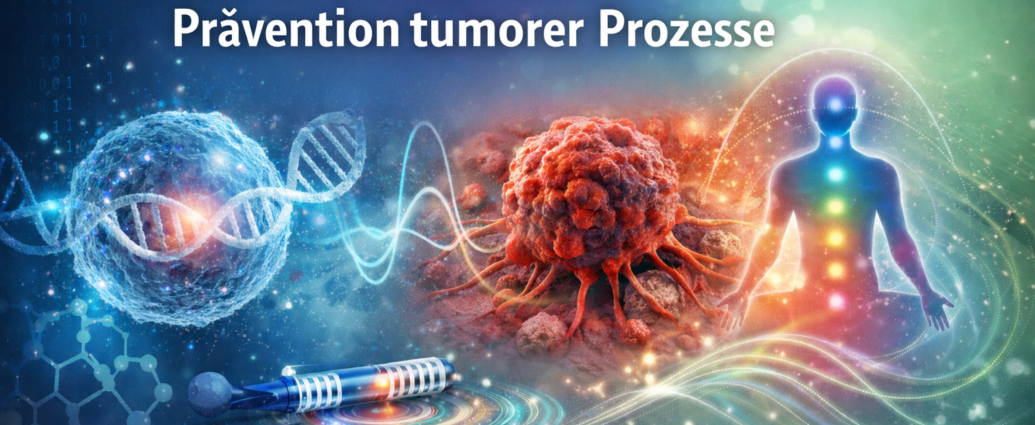
Conventional medicine, epigenetics and complementary frequency information
Tumor prevention is a topic that many people only become intensively involved in when serious illnesses have already occurred in their family, among friends or in their own environment. However, prevention begins much earlier. It begins when we understand the biological basis of health, view the body not only as a chemical system but also as a regulatory system and recognize how strongly lifestyle, environment, inner balance and epigenetic influences are interconnected. It is precisely at this point that the Frequency therapy as a complementary approach for many people.
Tumors arise from cells that have lost their normal control over growth, division and natural limitation. As long as healthy cell regulation, functioning repair systems and stable immune surveillance are in place, the organism can compensate for many problematic developments. However, if this order is disrupted over a longer period of time, pathological processes can develop. The modern view of prevention therefore includes not only the avoidance of individual risk factors, but also the conscious support of the entire internal regulation.
How tumor processes develop from a conventional medical perspective
From a conventional medical point of view, the development of tumor processes is not a sudden single event, but usually a longer biological process. It often begins with the smallest changes in individual cells. These changes can be triggered or promoted by various stresses. These include chemical pollutants, chronic inflammation, oxidative stress, hormonal imbalances, radiation, viral factors and errors in DNA repair. Such influences do not necessarily lead to a disease immediately, but they can change the order within the cell structure over a long period of time.
Healthy cells have protective mechanisms that are designed to prevent undesirable developments. They react to signals from their environment, stop their growth if necessary, repair damage or initiate regulated cell death if their stability is no longer assured. It is precisely these protective systems that are crucial for maintaining healthy tissue structures. If several of these control mechanisms are weakened at the same time, an environment can develop in which uncontrolled growth becomes more likely.
Conventional medicine distinguishes between benign and malignant tumors. Benign tumors often remain localized and tend to grow in a displacing manner. Malignant tumors, on the other hand, can invade surrounding tissue, spread cells and form metastases. This is precisely why early prevention is so important. The better the organism is supported in its natural regulation, the more favorable the conditions are for long-term stability.
The importance of cell regulation and inner balance
In order for tissue to remain healthy, the body needs precise control of cell division, differentiation and regeneration. This balance is no coincidence, but an expression of a highly complex biological order. Every cell is closely connected to its environment. It reacts to nutrients, oxygen, hormonal signals, immune messengers, stress factors and electrical or biophysical stimuli.
If this balance is disturbed over a longer period of time, not only the individual cell changes, but often also the entire environment in which it is embedded. The so-called internal environment therefore plays a central role. It influences how well cells communicate, how efficiently repair processes take place and how resilient the organism remains in the long term. Prevention therefore means not only avoiding a single risk factor, but also keeping an eye on the overall biological order.
Epigenetics and its role in tumor processes
The Epigenetics has significantly expanded our understanding of health and the development of disease in recent years. It deals with the question of how genes are activated or deactivated without the actual DNA sequence changing. Put simply, epigenetics describes which information from the genetic potential is actually read and which remains silenced. This makes it clear that it is not only the genes that are decisive, but also the environment in which they act.
Epigenetic processes react sensitively to external and internal influences. Diet, sleep, chronic stress, environmental toxins, emotional stress, exercise, inflammatory processes and metabolic conditions can all influence epigenetic patterns. This is precisely why prevention is so important. Lifestyle can help determine whether cell-protective mechanisms are promoted or whether stressful processes are intensified.
In connection with tumor processes epigenetics is particularly interesting because it shows that health is dynamic. The organism is not a rigid system, but a highly adaptable network. If protective mechanisms are positively influenced, if the tendency to inflammation is reduced, if regeneration is improved and if the internal environment is stabilized, this can also have an effect on epigenetic control processes. This is a strong argument for a holistic approach to prevention.
Epigenetics, lifestyle and cell environment
An epigenetically favorable environment is not created by a single measure, but by the sum of many daily influences. These include a diet rich in vital nutrients, sufficient sleep, regular exercise, good stress regulation, social stability and a conscious approach to environmental pollution. It is equally important to reduce chronic overstimulation. Constant stress, lack of sleep, an inflammation-promoting diet and toxic stress can disrupt the balance in the long term and promote unfavorable regulatory patterns.
Epigenetics makes it clear that prevention can be actively shaped. This gives many people a feeling of self-efficacy. Health is not just a predisposition, but also an expression of an environment that acts at cellular level. This is precisely why it makes sense to understand prevention not only as protection against illness, but also as the conscious shaping of biological order.
Viral strains, environmental factors and long-term influences
In addition to genetic and epigenetic mechanisms, environmental and stress factors also play an important role. The medical literature describes that certain Viruses may be associated with individual tumor forms. Chemical stress, free radicals, chronic inflammation and the effects of pollutants are also discussed as contributory factors. The decisive factor is always the interaction. It is rarely just a single influence, but rather the permanent overstraining of the natural regulatory capacity.
Long-term stress in particular is treacherous because it often goes unnoticed. The body initially adapts, balances and compensates. However, if this adaptation is required over a period of years, protective mechanisms can lose their stability. Prevention is therefore not just a question of diagnosis or early detection, but also a question of daily stress reduction.
The immune system as a central protective authority
A stable immune system is one of the most important factors in the prevention of tumor processes. It recognizes conspicuous cell changes, reacts to inflammatory stress and helps to maintain biological order. If the immune system is well regulated, many harmful developments can be limited at an early stage. However, if it is chronically weakened, for example through constant stress, lack of sleep, toxic stress or persistent inflammation, its monitoring power decreases.
This results in a clear preventative principle: everything that supports immune stability also indirectly strengthens the foundations of healthy cell regulation. This includes nutrition, regeneration, mental balance, sufficient exercise and a conscious lifestyle with as little chronic stress as possible. Prevention therefore always also means immune care.
Frequency therapy as a complementary approach
While conventional medicine primarily examines biochemical, genetic and cell biological processes, frequency therapy also looks at the organism from a biophysical perspective. It assumes that the human body is characterized not only by metabolic processes, but also by orderly information and vibration patterns. From this perspective, health is associated with harmonious regulation, functioning communication and stable adaptability.
Frequency therapy is complementary It is used as a complementary approach to a comprehensive understanding of health. Many practitioners appreciate that it focuses not only on individual symptoms but also on the interplay between stress, regulation, energy balance, and inner harmony. Particularly in the field of preventive care, many people find it to be a supportive approach for maintaining the body’s balance at an early stage.
Frequency therapy and epigenetic thinking
In an extended holistic understanding, a bridge can also be drawn between frequency therapy and epigenetic thinking. If epigenetics shows that the environment, stress, regeneration and milieu influence biological control processes, then it becomes understandable why regulatory biophysical impulses are also taken into account in a complementary framework. Frequency therapy views the body as an information-processing system. The aim is to support regulatory processes, promote order and support adaptability.
For many users, this is where the special appeal lies: not only chemical and structural factors are taken into account, but also vibration, Resonance and Information. In the context of a holistic prevention model, this can be understood as an extension of an epigenetically oriented health culture that does not view the organism one-dimensionally, but in a networked way.
Why the inner environment is so crucial
A central element of any holistic prevention program is the internal environment. This refers to the biological environment in which cells live, communicate and adapt. This includes nutrient supply, oxygen situation, pH balance, metabolic quality, inflammatory tendencies, hormone levels, vegetative stability and energetic resilience. If this environment is harmonious, the organism can react flexibly. If it is permanently stressed, the ability to adapt decreases.
This is precisely where frequency therapy is often classified as complementary. It is not understood as an isolated individual measure, but as a complementary stimulus within a comprehensive approach that combines nutrition, sleep, regeneration, exercise, relief and awareness work. This creates a preventative model that is not limited to defence, but is geared towards stabilization and inner order.
Frequency information for the prevention of tumor processes
In the field of frequency therapy, frequency lists from the literature are classified in a complementary manner in thematic contexts. This is not just about individual numbers or rigid specifications, but about the question of how regulative impulses can be meaningfully integrated into a holistic concept. In this context, frequency lists are often assigned to areas such as general regulation, energetic stabilization, vegetative balancing, environmental support and accompanying stress regulation.
Particularly in the context of tumor prevention, it is crucial that Frequency info is not considered in isolation. Rather, the complementary approach is to understand frequencies in connection with the cellular environment, immune function, regeneration, stress regulation and epigenetically relevant lifestyle factors. This gives frequency therapy its depth. It is not perceived as an isolated technique, but as part of a broader understanding of biological order.
Frequency lists and holistic classification
Frequency lists from the literature are shown in the Practice are usually not applied schematically, but rather in relation to the overall picture. This overall picture includes constitution, degree of stress, ability to recover, vegetative state, emotional stability and the question of what supportive measures are already in place. The actual value of frequency information lies precisely in this holistic classification. Frequencies are not understood in isolation, but as part of a regulatory accompaniment that is intended to strengthen the organism's ability to adapt.
Holistic prevention as a model for the future
The more we know about cell health, immune regulation, epigenetics and environmental stress, the clearer it becomes that prevention is a multi-layered process. It encompasses traditional conventional medicine with diagnostics, prevention and scientific risk assessment as well as a lifestyle that takes regeneration, nutrition, exercise and mental stability seriously. In addition, frequency therapy opens up a complementary view of order, information and regulatory support.
It is precisely this combination that makes the approach attractive to many people. Conventional medicine provides clarity, certainty and diagnostic orientation. Frequency therapy broadens the horizon to include biophysical and holistic aspects. Together, this results in an understanding of health that does not reduce people to individual laboratory values, but sees them as a complex, adaptable and information-processing system.
Conclusion
The prevention of tumor processes begins long before a visible disease. It begins at the level of cell health, environment, immune function, regeneration and epigenetic control. In conventional medicine, the focus is on risk reduction, prevention, early detection and the stabilization of natural protective mechanisms. Epigenetics expands this picture by recognizing that lifestyle, environment and inner balance can have a profound effect on biological control processes.
Frequency therapy complements this understanding with a biophysical perspective. It focuses on vibration, resonance, information and regulatory support. Many people see this combination of conventional medicine, epigenetics and frequency therapy as a particularly valuable way of understanding health consciously, profoundly and holistically. In this way, prevention becomes not just the avoidance of illness, but the active cultivation of order, stability and inner balance.
Comments are closed, but trackbacks and pingbacks are open.