





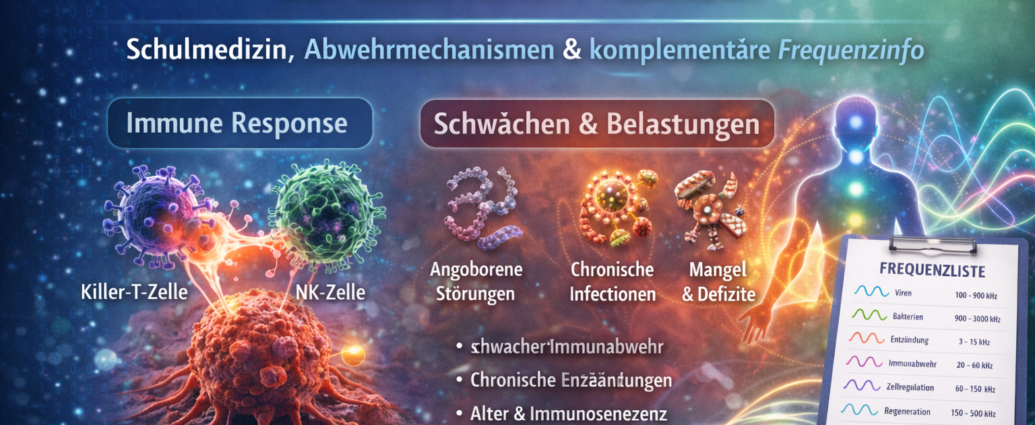
Conventional medical principles, defense mechanisms and complementary frequency information
Why the immune system plays a central role in tumor processes
The immune system is one of the most important protective systems of the human body. It has the task of recognizing harmful intruders, monitoring altered cells and maintaining biological order. This protective function is particularly important in tumor processes. The organism constantly tries to recognize and limit conspicuous cell changes at an early stage. As long as this monitoring works well, many derailed cell processes can be controlled before they become a major problem.
The literature describes that tumor processes are closely linked to the performance of the immune system. A well-regulated immune system can recognize and, in many cases, specifically attack altered cells. At the same time, it has been shown that a weakened or overloaded immune function can increase the risk of such cells escaping control. This is precisely why the immune response is so important for understanding tumor processes.
In a conventional medical context, the focus is on the question of how immune cells, inflammatory processes, cellular signaling pathways and the general immune system interact. In addition to this, in the complementary field, the Frequency therapy is seen by many people as an accompanying approach to support regulation, balance and inner stability. However, before the Frequency info it is worth taking a closer look at the biological basis of the immune response.
How the immune system recognizes altered cells
The human body is constantly renewing cells. During this ongoing renewal process, changes can occur again and again. Many of these deviations are corrected by the body's own repair systems. Others are recognized and eliminated by immune surveillance. The immune system has various protective mechanisms with which it can differentiate between the body's own healthy structures and abnormal changes.
The literature describes that altered cells can have characteristics on their surface that differ from those of healthy cells. Such surface changes can be perceived by the immune system as foreign or conspicuous. This triggers defense reactions with the help of which the organism attempts to control the affected cells. This form of immune surveillance is a decisive component of the natural defense against pathological developments.
It is particularly important that this monitoring is not only directed against classic pathogens. It also relates to cells that are altered in their internal order. This makes it clear that the immune system not only combats infectious agents, but is also actively involved in controlling derailed cell processes.
Tumor antigens and the body's biological alarm function
The literature describes that altered cells often carry so-called tumor antigens on their surface. These structures can signal to the immune system that the cells are no longer normal healthy cells. Some of these antigens are associated with viral loads, while others arise from the body's own protein structures, which occur in derailed cells in an altered or amplified form.
This creates a kind of alarm signal for the immune system. It recognizes that something about this cell no longer corresponds to biological order. This is where the actual immune response begins. Various immune cells are activated, messenger substances are released and the body attempts to limit or remove the abnormal cell structures.
These processes show how finely tuned the body's own defenses are. Health is not only the absence of disease, but also the ability of the organism to recognize disorder at an early stage and react appropriately. This ability is of central importance, especially in connection with tumor processes.
Killer cells, T cells and the cellular defense system
A particularly important part of the immune response consists of specialized defence cells. The literature mainly describes killer T cells, helper T cells and natural killer cells. These cell types perform different tasks, but work closely together. Killer T cells recognize conspicuous target cells and can initiate their destruction. Helper T cells support this reaction by activating and coordinating other components of the immune system.
Natural killer cells also play an important role. They react in particular when altered cells lose typical recognition characteristics that normally identify them as the body's own. This is particularly relevant in tumor processes because some derailed cells try to evade immune surveillance. Natural killer cells can intervene here as an additional protective instance.
This interaction shows how complex and intelligently the immune system is organized. It does not work with just one mechanism, but with an entire network of recognition, signal transmission, coordination and active defense. The more stable this network is, the better the organism can cope with stress.
When tumor cells escape the immune system
Despite the efficiency of the immune system, some altered cells can escape detection. The literature describes various mechanisms by which tumor cells can evade recognition. Some change their surface in such a way that they become more difficult for certain immune cells to identify. Others release substances that weaken immune responses or inhibit the activity of immune cells.
This creates a difficult situation: although the body may recognize that something is wrong, it can no longer intervene effectively enough. If this situation is not corrected over a longer period of time, individual derailed cells can develop into a stable tumor process. This shows how important a strong and well-regulated immune function is.
The literature also shows that immunological tolerance can develop. This means that the organism fights conspicuous structures less strongly over time. This is particularly problematic for tumor processes, as it can lead to a state in which the body's natural protective response weakens. Prevention therefore always means promoting the conditions that support active immune surveillance.
Congenital and acquired immune deficiencies as a stress factor
The efficiency of the immune defense is not the same for all people. The literature describes both congenital and acquired immune deficiencies. Congenital disorders affect certain components of the immune system from birth. They can lead to individual defense mechanisms not being fully functional. Acquired immune deficiencies, on the other hand, develop in the course of life, for example due to chronic stress, infections, deficiencies, illnesses or severe exhaustion of the organism.
This is particularly important in connection with tumor processes. If essential components of the immune system are not working properly, the body's ability to control abnormal cell changes in good time is reduced. The literature therefore describes immunodeficiency as an important component in the overall picture of tumor development.
This is not just about rare severe immunodeficiencies. More frequent stresses such as chronic stress, lack of sleep, alcohol abuse, drug exposure, obesity, malnutrition or long-term metabolic disorders can also significantly impair immune function. This leads to a clear preventive consequence: if you want to strengthen your immune system, you need to take your entire lifestyle into account.
Nutrition, micronutrients and immune balance
A powerful immune system is dependent on a good supply of nutrients. The literature describes that protein deficiency in particular, as well as deficiencies in iron, copper, zinc, selenium and certain vitamins, can weaken the immune response. Vitamins such as A, C, E, B6 and folic acid are also mentioned as important in this context. If such substances are lacking over a longer period of time, cell-mediated defense mechanisms, antibody formation, cytokine production and other immunological processes can be impaired.
This is particularly important for prevention. Health is not only achieved at a genetic level, but also through the quality of the internal environment. A balanced diet, good intestinal absorption, stable digestive processes and an adequate supply of micronutrients support the prerequisites for a strong immune response.
This also makes it clear why holistic prevention always encompasses several levels. It is not enough just to look at a single symptom or laboratory value. Rather, it is about strengthening the biological foundations on which immune stability can develop in the first place.
Age, immunosenescence and declining resistance
With increasing age, many functions of the organism change. The immune system is also subject to this change. The literature describes that the immune response can lose momentum in the course of life. This process is often described as immunosenescence. The body's ability to react quickly and precisely to new stresses decreases.
This becomes particularly important from an advanced age. The ability to regenerate decreases, inflammatory processes can become more chronic and the defense against altered cells can lose efficiency. Prevention therefore becomes even more important in old age. A stable lifestyle, sufficient exercise, regular regeneration, a good supply of nutrients and a low-inflammatory lifestyle can help to stabilize the immune system for as long as possible.
Inflammation as the first step of the immune response
Inflammation is one of the body's first reactions to injury, infection or tissue stress. The literature describes redness, swelling and increased blood flow as classic characteristics. These processes are an expression of an active biological protective reaction. Inflammation is not fundamentally negative, but initially part of the healing and defense mechanisms.
Messenger substances such as eicosanoids, prostaglandins, leukotrienes, interleukins, chemokines and interferons coordinate these processes. They ensure that immune cells are attracted, activated and directed to the site of stress. There they support the elimination of harmful influences and, ideally, promote subsequent healing.
However, it becomes problematic when inflammations do not subside and become chronic. An originally protective reaction can then develop into a permanent state of stress. This is precisely why the regulation of inflammatory processes is a central component of holistic health care.
Cell-to-cell communication and the coordination of immune defense
The immune system does not work in isolation, but through a constant exchange of information. The literature describes that cell-to-cell interactions can trigger a chain of reactions that ultimately lead to the activation of T-cells, B-cells and other defense mechanisms. This communication is necessary for the body to be able to react in a targeted manner.
If this signal transmission is disrupted, the immune response can also lose quality. This is why health is not just a question of individual cells, but also always a question of functioning communication. This idea is particularly interesting when we later turn our attention to complementary approaches such as frequency therapy. The idea of order, communication and information flow in the organism also plays an important role there.
Immune surveillance and the natural control of tumor cells
The literature describes immune surveillance as an ongoing process. The body constantly searches for altered cells and attempts to eliminate them. As long as this is successful, biological order is maintained. Only when individual cells escape this surveillance and are able to multiply over a longer period of time does the risk of a more pronounced tumor develop.
This monitoring works particularly well where conspicuous cells show clear foreign characteristics. It becomes more difficult when tumor cells are only faintly recognizable or actively use mechanisms to suppress the immune system. This is precisely why the stability of the immune system is so crucial. It determines how long and how successfully the organism can defend its internal order.
Frequency therapy as a complementary accompaniment to immune balance
Why frequency therapy is considered in a holistic context
Frequency therapy is used by many people as a complementary approach to support regulation, inner balance and the functional stability of the organism. While conventional medicine focuses primarily on cellular, immunological and biochemical processes, frequency therapy also views the human being as a biophysical and information-processing system.
From this perspective, health is not only the result of chemical reactions, but also an expression of orderly communication, harmonious vibration patterns and regulatory stability. Especially in cases of chronic stress, immunological exhaustion or impaired vegetative balance, many users find frequency therapy to be a useful addition to a comprehensive health concept.
Frequency therapy and the idea of regulatory support
In the complementary understanding, frequency therapy is not about replacing the organism or overriding its natural processes. Rather, the body should be accompanied in an informative way. The aim is to support the level of order at which regulation, adaptation and self-organization take place. This idea is particularly relevant for many people in connection with immune balance and the inner environment.
If the literature demonstrates how important communication, signal transmission, and coordinated defense mechanisms are to health, then it becomes clear why regulatory and biophysical approaches are receiving additional attention. In this context, frequency therapy seeks to promote harmonization and stabilization and to support the organism complementary to support him in his ability to adapt.
The inner environment as a bridge between conventional medicine and frequency therapy
A central link between conventional and complementary medicine is the internal environment. This includes metabolism, oxygen supply, inflammatory tendency, vegetative balance, regeneration, nutrient supply and general resilience. A stable internal environment improves the conditions for immune strength, cell health and orderly regulation.
Frequency therapy is often used when people feel that their body has been out of balance for a long time. It is understood in a complementary sense as an accompanying stimulus that is intended to support the body in developing more order and adaptability again. This perspective seems particularly valuable for many people when it comes to issues such as immune balance, regulatory exhaustion and chronic stress.
Always understand frequency lists in a complementary context
Frequency lists play an important role in frequency therapy. They originate from the literature and are assigned to different subject areas. However, it is crucial that these lists are not considered in isolation. Complementary application always presupposes that frequencies are set in relation to the constitution, stress situation, regulatory status and overall therapeutic idea.
Especially when it comes to topics such as immune response, Cell communication, This classification is particularly important when it comes to the regulation of inflammation and general stabilization. In this context, frequencies are not understood as a rigid individual solution, but as part of a holistic model in which the self-regulation of the organism takes center stage.
Frequency info
Frequency therapy and complementary support for immune balance
In the field of frequency therapy, frequency lists from the literature are used in a complementary way to accompany regulatory processes in connection with immune balance, vegetative stability and inner order. The application is not detached, but always embedded in a greater understanding of stress, regeneration and functional adaptability of the organism. This complementary classification plays a particularly important role in areas such as resistance, cell communication and general regulatory support.
Frequency lists from the literature for immunological stress topics
In a complementary context, the frequency lists from the literature are often assigned to those areas that are associated with immunological weakness, chronic stress, vegetative imbalance and inflammatory irritation. The focus is not on the individual frequency in isolation, but on its embedding in programs that take into account the overall condition of the person. The aim is to accompany the self-organization of the organism on an informative level and to provide complementary support for inner balance.
Frequency therapy as part of a comprehensive health concept
For many users, the greatest strength of frequency therapy lies in the fact that it can be sensibly combined with other health-promoting measures. These include a nutrient-rich diet, adequate sleep, stress regulation, exercise, a low-inflammatory lifestyle, intestinal balance and consciously designed regeneration. This combination creates a holistic approach in which frequency therapy can be used as a complementary level of Information, order and regulatory support.
Conclusion
The literature clearly shows that the immune response plays a central role in tumor processes. A well-functioning immune system can recognize altered cells, attack abnormal structures and maintain biological order over a long period of time. At the same time, it is clear that immune deficiencies, chronic inflammation, deficiency states, ageing processes and disturbed cell communication can impair the immune response. This is precisely why prevention, regeneration and immunological stabilization are so important.
Frequency therapy supplements this view in a complementary sense with a regulatory and biophysical perspective. It focuses on order, information flow, balance and functional adaptability. The frequency lists from the literature are not isolated, but are always placed in the context of a holistic understanding of health. This creates a comprehensive approach in which conventional medical knowledge and complementary frequency information are combined and together enable an expanded view of health, immune balance and inner stability.


Comments are closed, but trackbacks and pingbacks are open.