





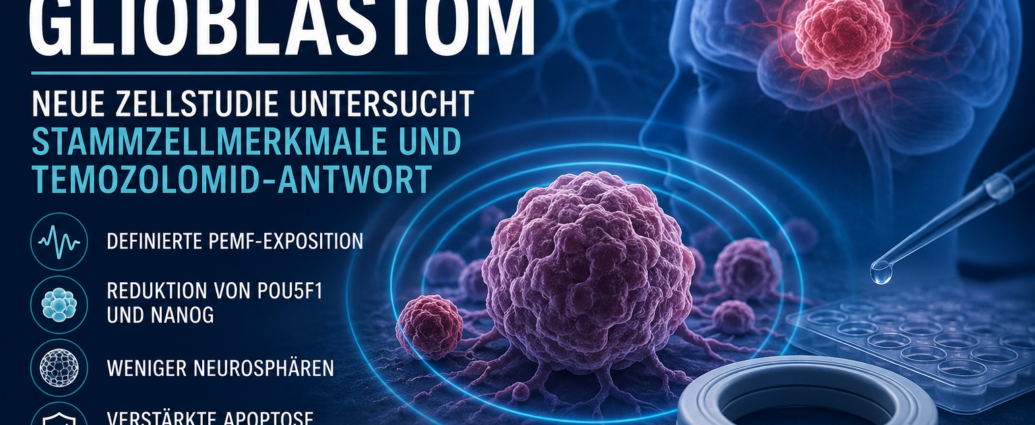
New cell study examines stem cell characteristics and response to temozolomide
Abstract
A new study published in *Scientific Reports* examines the effects of specific low-frequency PEMF on glioblastoma cell models. The article summarizes the findings, opportunities, and limitations for research into frequency therapy.
Introduction: Why This Study Deserves Attention
Glioblastomas are among the most aggressive tumors of the central nervous system. They grow in an infiltrative manner, are biologically very heterogeneous, and often exhibit a high degree of resistance to established treatment strategies. It is precisely this resistance to treatment that makes glioblastoma one of the most challenging areas of research in oncology.
Against this backdrop, any preclinical study that investigates new biological targets is of interest. A new "version of record" publication in Scientific Reports dated June 1, 2026, examines defined low-frequency pulsed electromagnetic fields (PEMF) in glioblastoma cell models. The study is titled:
„Exposure to a defined pulsed electromagnetic field suppresses stem cell properties and enhances temozolomide-induced apoptosis in glioblastoma cells“
The paper was published in Scientific Reports, Volume 16, Article 16759. It was first published on April 9, 2026, and the version of record was published on June 1, 2026. The DOI is: https://doi.org/10.1038/s41598-026-47481-y
This study is relevant to research on frequency therapy because it combines a specifically described electromagnetic exposure protocol with measurable tumor-biological endpoints. At the same time, it must be emphasized from the outset that this is laboratory research using cell models. The study does not demonstrate that PEMF is therapeutically effective or safe for patients with glioblastoma.
What is a glioblastoma?
Glioblastoma is a highly malignant Brain tumor, which originates from glial cell populations. It is characterized by rapid growth, diffuse infiltration into surrounding brain tissue, genetic and molecular diversity, and a marked ability to adapt to therapeutic pressure.
Standard treatment typically involves a combination of surgical removal (to the greatest extent possible), radiation therapy, and chemotherapy, particularly with temozolomide. Despite this intensive treatment, the prognosis often remains poor. One reason for this is that glioblastoma cells do not all respond in the same way. Within the tumor, there may be cell populations that are particularly adaptable, capable of self-renewal, and appear more resistant to treatment.
These so-called stem cell-like properties are at the heart of many current research approaches. If we can successfully influence these properties, it could help us better understand treatment resistance in the long term. This is precisely where the new PEMF study comes in.
What does PEMF stand for?
PEMF stands for pulsed electromagnetic fields, i.e., pulsed electromagnetic fields. This is not a single method, but rather an umbrella term for a wide variety of forms of electromagnetic exposure. Key factors include parameters such as frequency, field strength, pulse shape, duration, repetition rate, exposure time, and biological target system.
This is precisely why it is scientifically problematic to speak in general terms about „PEMF effects.“ One electromagnetic field is not automatically comparable to another. A study using a precisely defined low-frequency protocol says nothing about any other devices, frequencies, or applications.
This study is particularly interesting because it does not rely on vague, general claims, but instead examines a specific exposure pattern in a controlled cell model.
Purpose of the study
The researchers sought to investigate whether a specific low-frequency PEMF exposure affects the biological properties of glioblastoma cells. Their study focused on several aspects:
First, we examined whether cell viability was affected. This involves determining how many cells remain viable after a specific treatment.
Second, the authors focused on so-called stem cell characteristics. These characteristics are particularly relevant in glioblastoma because stem cell-like tumor cells are associated with treatment resistance, recurrence, and aggressive behavior.
Third, the study investigated whether PEMF influences the formation of neurospheres. Neurospheres are spherical cell aggregates that can form under certain culture conditions and are frequently used in tumor research as a functional indicator of stem cell-like properties.
Fourth, the study examined whether PEMF alters the response to temozolomide. Temozolomide is a key chemotherapeutic agent in the treatment of glioblastoma. From a biological perspective, increased sensitivity to temozolomide would therefore be of particular interest.
The key findings of the study
According to the abstract, daily exposure to PEMF over four days led to a slight reduction in cell viability. This means that the cells responded measurably to the electromagnetic exposure protocol, though not in the form of dramatic cell death.
The changes were particularly striking in genes associated with stem cell-like properties. Among other things, the study reports a downregulation of POU5F1 and NANOG. Both genes are frequently discussed in biological research in connection with pluripotency, self-renewal, and cellular plasticity.
In addition, reduced neurosphere formation was observed. Following PEMF exposure, the glioblastoma cells formed fewer and smaller neurospheres. Functionally, this suggests that certain stem cell-like properties of the cell populations studied were attenuated.
Another key finding concerns the combination with temozolomide. The authors report that PEMF enhanced the proapoptotic effects of temozolomide. Apoptosis refers to a form of programmed cell death. If a treatment increases apoptosis in tumor cells, this may indicate increased sensitivity to therapeutic stress.
Why stem cell characteristics are so important in glioblastoma
In glioblastoma, it is not just the sheer size of the tumor that matters. Cell populations that can adapt to changing conditions are particularly problematic. Such cells can survive under therapeutic pressure, reorganize themselves, and potentially contribute to tumor recurrence.
Stem cell-like tumor cells are therefore the subject of intensive research. They are not identical to normal stem cells, but they exhibit certain characteristics reminiscent of stem cell biology: self-renewal, plasticity, resistance to stress, and the ability to generate tumor-promoting cell populations.
If a defined PEMF protocol reduces markers such as POU5F1 and NANOG in a cell model while simultaneously inhibiting neurosphere formation, this is relevant from the perspective of basic research. It does not mean that a clinical effect has been proven. However, it does mean that under certain conditions, electromagnetic exposure could influence cellular programs that are important for tumor plasticity.
Temozolomide: Why the combination is of interest
Temozolomide is an alkylating chemotherapeutic agent and plays a central role in the treatment of glioblastoma. It damages the DNA of tumor cells and can thereby trigger cellular stress and cell death. However, not all tumor cells respond to it equally well. Resistance mechanisms are a major clinical problem.
The study therefore examined not only PEMF alone, but also its combination with temozolomide. The reported enhancement of proapoptotic effects is an important preclinical finding. Should this finding be confirmed in further models, it could eventually raise the question of whether electromagnetic exposure can influence the response to medication.
But caution is warranted here as well. An enhanced response to temozolomide in cell cultures does not necessarily translate to clinical outcomes. The human Tumor is located within a complex tissue environment. In addition, the blood-brain barrier, immune responses, the microenvironment, oxygen supply, dose distribution, tumor heterogeneity, and long-term safety all play a role.
Relevance to Frequency Therapy and Bioelectromagnetics
This study does not fall into the category of general claims about the effects of electromagnetic fields. It does not prove that any electromagnetic device can treat cancer. Rather, it demonstrates what rigorous bioelectromagnetic research should look like: precise protocols, defined cell models, measurable endpoints, and cautious interpretation.
For the Frequency therapy That is an important distinction. In this field, people often jump too quickly from laboratory findings to conclusions about clinical effects. That is exactly what should be avoided. Good research begins with clear questions: What field parameters were used? Which cell lines were studied? Which molecular markers were measured? What control groups were included? Which effects were strong, and which were only moderate? Were the findings functionally confirmed?
The new *Scientific Reports* paper provides a building block for addressing the broader question of whether specific electromagnetic fields can influence cellular signaling pathways, tumor cell plasticity, or drug responses. This is basic and translational research. It is not a recommendation for patient use.
Scientific classification
The scientific rigor of this cell study is quite good. The article was published in a peer-reviewed journal, the research question is clearly formulated, and the endpoints examined go beyond a simple measurement of cell survival. It is particularly positive that, in addition to viability, molecular markers, neurosphere formation, and the response to an established chemotherapeutic agent were also examined.
Nevertheless, significant limitations remain. Cell models are artificial systems. While they allow for controlled experiments, they only reflect the real-world situation in the human brain to a very limited extent. A glioblastoma in the body does not consist solely of tumor cells. It interacts with blood vessels, immune cells, connective tissue structures, nerve cells, metabolic conditions, and numerous signals from the microenvironment.
The issue of exposure is also complex. An electromagnetic field acting in a cell culture dish cannot automatically be extrapolated to deep brain tissue. Within the body, geometry, tissue conductivity, field distribution, penetration depth, local heating, dosimetry, and safety play a major role.
Therefore, such a study should not be overinterpreted. It provides hypotheses and biological evidence. It is no substitute for animal models, safety studies, or clinical trials.
What this study shows
The study shows that a specific low-frequency PEMF protocol can elicit measurable biological effects in glioblastoma cell models.
It shows that daily exposure over four days slightly reduced cell viability.
It shows that certain genes associated with stem cell characteristics have been downregulated, including POU5F1 and NANOG.
It shows that neurosphere formation has been reduced.
It shows that, in this model, PEMF was able to enhance the proapoptotic effects of temozolomide.
These points are relevant to bioelectromagnetic research because they describe specific biological endpoints.
What this study does not show
The study does not show that PEMF can treat glioblastoma in humans.
It does not show that PEMF is an alternative to surgery, radiation therapy, or chemotherapy.
It does not show that commercial frequency devices have any medical effect on cancer.
It does not demonstrate that the use of this treatment would be safe for patients.
It does not indicate which field parameters would be useful, achievable, or clinically relevant in the human body.
Nor does it show that frequency therapy is generally effective against cancer.
This distinction is crucial. Especially in the field of cancer, scientific statements must be phrased with particular care. Patients with glioblastoma are facing a difficult, often life-threatening situation. Research should offer hope, but it must not make unsubstantiated claims of a cure.
Implications for future research
The study raises important follow-up questions. First and foremost, it would be crucial to determine whether independent research groups can reproduce the findings. Replication is a cornerstone of scientific rigor.
Second, additional glioblastoma models need to be investigated. Cell lines are helpful, but patient-derived models, organoids, or more complex 3D systems could provide a more realistic picture.
Third, it is necessary to determine which signaling pathways are affected by PEMF. The changes observed in POU5F1, NANOG, and neurosphere formation are interesting, but they do not yet fully explain the underlying molecular mechanisms.
Fourth, it would be necessary to determine whether the observed temozolomide potentiation is stable, dose-dependent, and specific. It would be important to know whether PEMF is effective only under certain conditions or whether the effect can be reproduced more broadly.
Fifth, thorough safety studies are needed over the long term. Any intervention is particularly delicate when it comes to brain tumors, because the brain is a highly complex and sensitive organ.
Classification from the perspective of medical informatics
From the perspective of Information medicine This work is exciting because it demonstrates that electromagnetic stimuli are not only technically measurable but can also be studied biologically. It links a physical exposure pattern to molecular and functional cellular responses.
However, this does not mean that all concepts of frequency therapy are automatically validated. On the contrary: the study makes it clear that rigorous research requires precise definitions. Frequency, field strength, pulse shape, duration, cell type, endpoint, and control conditions must be clearly described.
This has important methodological implications for information medicine: Anyone wishing to engage in a scientific discussion of electromagnetic or frequency-based methods must rely on verifiable parameters. Only then can observation give rise to research. And only research can potentially lead to clinical relevance in the long term.
Why Caution Is Scientifically Sound
Some readers would like to see clear statements such as: „PEMF helps treat glioblastoma“ or „frequency therapy enhances chemotherapy.“ Based on this study, such statements would be incorrect.
Scientific rigor does not lie in interpreting results in the most favorable light. Scientific rigor lies in clearly stating exactly what has been demonstrated and what has not. This study is interesting because it demonstrates measurable effects in a preclinical setting. However, it is valuable precisely because it remains within a controlled framework.
This presents an opportunity for research into frequency therapy. If the field wants to be taken seriously, it doesn’t need exaggerated claims, but rather sound studies, clear language, and transparent boundaries.
Practical implications for patients
This study does not provide any direct treatment recommendations for patients with glioblastoma. Anyone diagnosed with glioblastoma should always discuss medical decisions with specialized physicians, neuro-oncologists, and the treating clinical team.
PEMF or other frequency-based therapies should not be considered a substitute for established oncological treatments. Even when used as an adjunct therapy, they must not be administered without professional evaluation, particularly if surgery, radiation therapy, chemotherapy, anticonvulsants, corticosteroids, or other medications are being used concurrently.
This study is a research contribution. It can help identify scientific questions for the future. However, it is not a basis for self-treatment or for medical claims.
Conclusion
The new *Scientific Reports* study on PEMF and glioblastoma is a significant preclinical contribution to bioelectromagnetic research. It shows that defined low-frequency PEMF exposure in glioblastoma cell models can have measurable effects on cell viability, stem cell markers, neurosphere formation, and temozolomide-induced apoptosis.
Of particular interest is the link to stem cell-like properties, as these play a key role in treatment resistance and tumor plasticity in glioblastoma. Equally noteworthy is the reported enhancement of the proapoptotic effects of temozolomide.
At the same time, the context remains clear: this is cell research. The study does not demonstrate therapeutic efficacy in humans. It does not replace clinical trials and does not justify any claims of a cure.
For frequency therapy, therefore, the most important message is not a therapeutic promise, but a methodological standard: only precisely defined protocols, controlled experiments, independent replication, and cautious interpretation can advance this field of research in a credible manner.
Source
Scientific Reports / Nature Portfolio
Article: „Exposure to a defined pulsed electromagnetic field suppresses stemness and enhances temozolomide-induced apoptosis in glioblastoma cells“
Journal: Scientific Reports, Volume 16, Article 16759
Release date: April 9, 2026
Version of Record: June 1, 2026
DOI: https://doi.org/10.1038/s41598-026-47481-y
Disclaimer
This article is intended solely for informational purposes and is not a substitute for medical advice, diagnosis, or treatment. Frequency therapy is not recognized by conventional medicine and cannot replace treatment by trained physicians or alternative practitioners. Especially in cases of cancer such as glioblastoma, diagnosis and treatment must always be performed by qualified medical professionals.


Comments are closed, but trackbacks and pingbacks are open.