





Symptoms, diagnostics and complementary frequency information
Author: NLS Information medicine Ltd, Herbert Eder
Introduction
Glioblastoma is one of the most aggressive tumors of the central nervous system. It is described in the literature as the most common malignant primary glial neoplasm of the brain. Due to its rapid growth, infiltrative spread and pronounced biological activity, it represents a major challenge for both conventional medicine and the Frequency therapy is a particularly important topic.
Glioblastoma mainly develops in the cerebral hemispheres and primarily affects adults. It occurs less frequently in the brain stem in children or in the spinal cord. In many cases, this form of tumor develops without a long warning period; in other situations, it arises from pre-existing low-grade or anaplastic tumors. Astrocytomas. It is precisely this combination of biological aggressiveness, genetic instability and clinical dynamics that makes glioblastoma one of the most intensively studied tumor forms in neuro-oncology.
The following WordPress article focuses first on the basics of conventional medicine. Only at the end follows the Frequency info with the complementary resonance frequencies mentioned in the literature.
What is a glioblastoma?
The Glioblastoma multiforme, often short GBM is a highly malignant glial tumor Brain tumor, which consists of a heterogeneous mixture of poorly differentiated neoplastic astrocytic cells. The literature emphasizes that this tumour type accounts for more than half of all primary malignant glial brain tumors and represents a significant proportion of all intracranial tumors.
Glioblastoma is typically located in the cerebral hemispheres. Structures whose involvement can quickly lead to cognitive, motor and behavioral changes are particularly frequently affected. Less frequently, glioblastomas are found in the brain stem, especially in children, or in the spinal cord.
The clinical relevance of glioblastoma is extraordinarily high precisely because it grows not only by displacement but also by deep infiltration. Even if the Tumor may appear relatively inconspicuous in the early stages, it may have already penetrated deep into functionally important areas of the brain.
Primary and secondary glioblastoma
Two main forms of glioblastoma are distinguished in the literature:
Primary glioblastoma
Primary glioblastoma develops rapidly and without any detectable prolonged precursor. It accounts for the majority of cases and mainly affects older adults, particularly those over the age of 50.
Secondary glioblastoma
Secondary glioblastoma develops from pre-existing low-grade or anaplastic astrocytomas, i.e. WHO grade II or WHO grade III tumors. This form typically occurs in younger patients.
This distinction is important in conventional medicine because both forms can differ not only in their development but also in their molecular patterns.
Genetic basis of glioblastoma
Among astrocytic tumors, glioblastoma has the largest number of genetic alterations in the literature. This type of tumour is characterized by the accumulation of numerous mutations and pathway disorders. It is precisely this genetic instability that explains the aggressive growth and high adaptability of the tumor.
The changes particularly emphasized in the literature include
Loss of heterozygosity on chromosome 10q
The loss of heterozygosity on the chromosome arm 10q is a particularly common genetic mutation in primary and secondary glioblastoma. This mutation is described as relatively characteristic of glioblastoma and is associated with an unfavorable short-term prognosis.
p53 mutations
Changes in the p53 tumor suppressor gene are among the earliest described genetic abnormalities in astrocytic brain tumors. In the literature, p53 immunoreactivity is particularly associated with tumors in younger patients.
EGFR changes
The Epidermal Growth Factor Receptor plays an important role in the control of cell proliferation. In glioblastoma, overexpression, gene rearrangements and shortened isoforms are described, which can promote tumor growth.
MDM2
Amplification or overexpression of MDM2 can weaken the activity of p53. This opens up another pathway by which tumor cells can evade the physiological control of cell growth.
PDGF-alpha
The Platelet-derived growth factor-alpha acts as an important growth stimulus for glial cells. Enhancements of this signaling pathway are described particularly in secondary glioblastoma.
Further genetic changes
Changes in the following areas are also mentioned:
- PTEN
- MMAC1-E1
- MAGE-E1
Together, these mutations contribute to an excessive and misdirected proliferation of astrocytic cell lines.
Histological features of glioblastoma
In the literature, glioblastoma has a characteristic histopathological appearance. Typical are small areas of necrotic tissue surrounded by highly anaplastic tumor cells. This structure is called pseudopalisading necrosis described.
Other typical features are
- Poorly differentiated pleomorphic astrocytic cells
- pronounced nuclear atypia
- High mitotic activity
- Frequent microvascular proliferations
- Necrosis
- pronounced tissue heterogeneity
The combination of necrosis and microvascular proliferation in particular helps to distinguish a glioblastoma from less aggressive astrocytic tumors in conventional medicine.
Possible causes and contributing factors
In the literature, glioblastoma is not reduced to a single cause. Rather, a complex interplay of genetic predisposition, acquired changes and accompanying biological stresses is assumed. It is also described that a congenital or acquired predisposition together with combined viral exposure can play an important role in the etiology of glial tumors.
This point is particularly interesting for frequency therapy because not only the tumor tissue itself, but also accompanying biological factors can be taken into consideration.
Typical symptoms of glioblastoma
The symptoms of a glioblastoma depend heavily on its location. The literature explicitly emphasizes that the symptoms often depend more on the location than on individual histological characteristics.
Frequently mentioned symptoms are
- Nausea
- Vomiting
- Headache
- Hemiparesis
Involvement of the frontal or temporal lobes is particularly characteristic:
- increasing memory loss
- Personality changes
- Behavioral problems
- mental slowdown
Depending on the location, other neurological deficits may also occur. It is remarkable that some patients develop symptoms very quickly, while others show relatively few symptoms over a longer period of time despite a large tumor mass. This is precisely what makes the clinical dynamics of glioblastoma so unpredictable.
Why glioblastoma is often detected late
In early stages, glioblastoma can occasionally show changes in imaging that also occur in less aggressive lesions. The literature describes that early-stage glioblastoma can mimic benign-looking brain changes in MRI examinations.
In addition, symptoms can be unspecific at first. Headaches, concentration problems, fatigue or slight personality changes are not always immediately associated with a serious brain tumor. The clinical picture only becomes clearer as the mass, edema or neurological deficit increases.
Diagnostics for glioblastomas
The conventional medical diagnosis is based on neurological examination, imaging and histological confirmation.
MRI
Magnetic resonance imaging is the central imaging procedure. It shows the location, extent, accompanying edema, infiltration and contrast agent behavior of the tumor.
CT
Computed tomography can also provide initial indications, especially if an intracranial pressure event or a space-occupying lesion is already suspected.
Stereotactic biopsy
If in CT or MRI suspected glioblastoma, the literature recommends the stereotactic Biopsy as a diagnostically valuable measure.
Craniotomy with resection target
In the case of surgically accessible tumors, as much tumor tissue as possible should be removed during the craniotomy. At the same time, tissue is obtained for histopathological analysis.
Since glioblastoma is histologically extremely diverse, tissue examination remains crucial for a reliable diagnosis.
Conventional medical treatment of glioblastoma
The treatment of glioblastoma is predominantly described in the literature as palliative described. The aim is to reduce tumor mass, alleviate symptoms and influence the course of the disease as favorably as possible.
Operation
If possible, surgical tumor reduction is sought. This involves
- Relief of the brain
- Reduction of the space requirement
- Obtaining tissue
- Improvement of the starting position for further therapies
Radiotherapy
It is one of the central treatment procedures for glioblastoma.
Chemotherapy
Special mention is made of Temozolomide, which is now one of the most important standard drugs in conventional medicine for the treatment of glioblastoma.
Symptomatic therapy
Depending on the clinical picture, the following are also used
- Anticonvulsants such as phenytoin, carbamazepine or Tegretol
- Corticosteroids to reduce cerebral edema
These accompanying measures are crucial to control seizures, swelling and pressure symptoms.
Why glioblastoma is particularly interesting for frequency therapy
Glioblastoma is of particular interest for frequency therapy because several levels come together here: a highly aggressive astrocytic tumor form, massive genetic instability, pronounced tissue heterogeneity and additional biological stresses described in the literature.
Within information medicine, therefore, not only the tumor itself is considered, but also the resonance field in which cell behavior, tissue pressure, edema formation, necrosis and possible additional stresses can be reflected. This is precisely where complementary frequency info to.
Frequency info - complementary resonance frequencies for glioblastomas
In the literature Glioblastomas following Complementary resonant frequencies called:
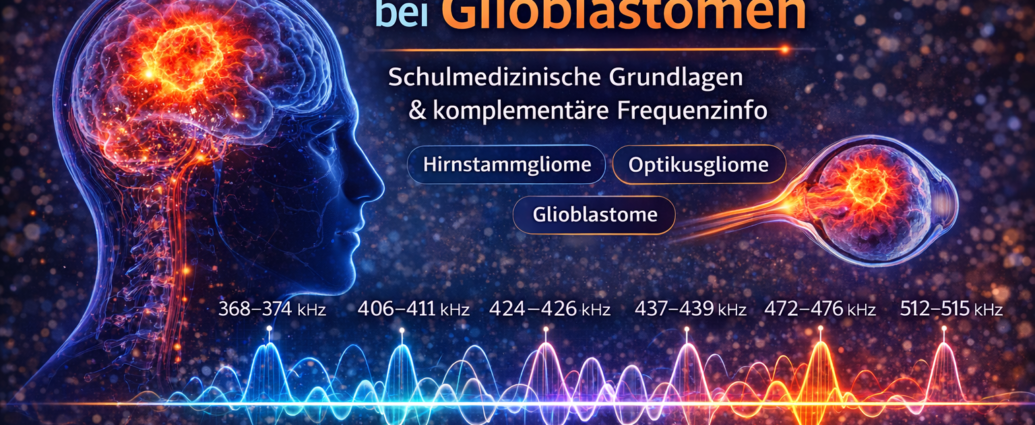
328, 339, 368, 370-374, 406-411, 424-426, 437-439, 442-451, 472-476, 512-515, 540-545, 555-558 kHz
These frequency ranges can be divided into several resonance fields within frequency therapy.
Lower resonance range
- 328 kHz
- 339 kHz
- 368 kHz
- 370-374 kHz
This shows a first coherent range in the lower to middle kilohertz window.
Medium resonance field
- 406-411 kHz
- 424-426 kHz
This area forms an important average density within the literature data.
Upper central resonance field
- 437-439 kHz
- 442-451 kHz
- 472-476 kHz
Especially between 437 and 451 kHz is a prominent frequency focus. This zone appears to be particularly central within the complementary frequency analysis.
Higher resonance ranges
- 512-515 kHz
- 540-545 kHz
- 555-558 kHz
These upper frequency ranges form the end of the literature data and indicate further resonance clusters.
Frequency info compact
Glioblastoma - complementary resonance frequencies:
328, 339, 368, 370-374, 406-411, 424-426, 437-439, 442-451, 472-476, 512-515, 540-545, 555-558 kHz
Complementary classification of the frequency ranges
The following resonance chambers are particularly striking for frequency therapy:
- 368 to 374 kHz
- 406 to 426 kHz
- 437 to 451 kHz
- 472 to 476 kHz
- 512 to 558 kHz
The area between 437 and 451 kHz shows a particularly strong compression and acts like a central frequency field of the glioblastoma. Equally striking is the staggering of upper frequency ranges from 512 kHz to 558 kHz.
Within information medicine, such clusters are not only regarded as individual values, but also as complementary resonance spaces in which characteristic tissue and stress patterns can be reflected.
Notes on the reaction in the complementary frequency context
The literature describes that effective work in the RFR context leads to Tumor necrosis and peripheral edema can lead to a high intracranial pressure. This can increase the intracranial pressure. It is therefore emphasized that such frequency work must be carried out very carefully and that accompanying measures such as Diuretics and Corticosteroids may become necessary.
A common sign of an effective reaction is Headache called. In glioblastoma in particular, the interaction between frequency work, pressure dynamics and neurological condition therefore remains a central topic of complementary observation.
Conclusion
Glioblastoma is one of the most aggressive and clinically challenging tumors of the brain. In conventional medicine, the focus is on genetic changes, imaging, histological confirmation and a palliative multimodal treatment concept. Tumor location, infiltration, edema formation and the effects on neurological functions are particularly important.
The topic of glioblastoma also opens up a complementary perspective for frequency therapy. The resonance frequencies described in the literature form a structured frequency information that can be viewed as complementary within information medicine. Particularly striking are the clusters between 406 and 451 kHz and the higher ranges between 512 and 558 kHz.


Comments are closed, but trackbacks and pingbacks are open.