





Symptoms, diagnostics and complementary frequency information
Author: NLS Information medicine Ltd, Herbert Eder
Introduction
Astrocytomas are among the most important tumors of the central nervous system. They are described in the literature as neoplasms that predominantly arise from cells derived from astrocytes. Astrocytes perform numerous supporting, regulatory and protective functions in the brain and spinal cord. When these cell lines give rise to a Tumor Depending on the location, growth rate and biological behavior, this can have a significant impact on neurological function.
The group of astrocytomas is not uniform. Rather, it includes slow-growing, low-grade forms as well as aggressive variants up to the Glioblastoma. It is precisely this range that makes the topic so important for both conventional medicine and Frequency therapy particularly interesting. In conventional medicine, the focus is on tumour grade, localization, imaging, histology and treatment planning. In the field of frequency therapy and information medicine, complementary resonance patterns and frequency ranges are also considered, which are assigned to individual tumor forms in the literature.
In the following, the focus is initially on the conventional medical aspects of astrocytoma. Only at the end does the Frequency info with the complementary resonance frequencies described in the literature.
What is an astrocytoma?
A Astrocytoma is a tumor of the central nervous system that consists predominantly of cells derived from degenerated or permanently altered astrocytes. Astrocytes are star-shaped glial cells that support the nervous tissue in the brain and spinal cord, accompany metabolic processes and are involved in the regulation of the neuronal environment.
Astrocytomas can occur in different regions of the brain and cause very different symptoms depending on their location. The regional effects mainly consist of
- Compression of the brain tissue
- Infiltration of neighboring structures
- Destruction of brain parenchyma
- Increase in intracranial pressure
- Increase in blood volume in the affected area
- Increase in cerebrospinal fluid volume
These processes lead to neurological deficits, pressure symptoms and functional disorders that are typical of the clinical picture of astrocytoma.
What types of astrocytomas are there?
Several astrocytic tumor forms are described in the literature. These include, among others:
- Pilocytic astrocytoma
- Subependymal giant cell astrocytoma
- Pleomorphic xanthoastrocytoma
- Low-grade astrocytoma
- Anaplastic astrocytoma
- Glioblastoma
In addition, there are various classification systems based on histopathological characteristics. These include the Bailey and Cushing system, which Kernohan grade, which WHO classification and the St. Anne/Mayo division.
The WHO classification is particularly common:
WHO Grade I
Corresponds to the pilocytic astrocytoma.
WHO Grade II
Corresponds to the low-grade diffuse astrocytoma.
WHO grade III
Corresponds to the anaplastic astrocytoma.
WHO grade IV
Corresponds to the Glioblastoma multiforme.
This categorization is not relevant for Practice of great importance, as it allows conclusions to be drawn about growth, aggressiveness, therapy concept and prognosis.
How does an astrocytoma affect the brain?
Astrocytomas affect the brain not only by their mere presence, but also by the way they grow. The literature particularly emphasizes that they can displace, infiltrate and functionally damage the brain parenchyma. This impairs the activity of normal nerve tissue.
A central problem is the Increase in intracranial pressure. As the brain is located in a bony space, any additional mass can have significant consequences. As an astrocytoma grows, the pressure on adjacent structures, vessels and cerebrospinal fluid spaces increases. This results in typical symptoms such as
- Headache
- Nausea
- Vomiting
- Reduced alertness
- cognitive limitations
- Papilledema
- Ataxia
In addition, there are locally attributable neurological deficits that depend on the respective tumor location.
Typical symptoms of astrocytomas
The symptoms of an astrocytoma depend greatly on the location, size and growth rate of the tumor. The following symptoms in particular are described in the literature:
Early general symptoms
- Headache
- depressed or altered mental state
- Declining concentration
- Neurological abnormalities without initially clear classification
Signs of increased intracranial pressure
- Headache
- Nausea
- Vomiting
- Reduced attention
- cognitive limitations
- Papilledema
- Balance problems
- Ataxia
Focal neurological symptoms
- Weakness
- Paralysis
- Sensory disorders
- Cranial nerve palsies
- epileptic seizures
Lateralizing and localizing signs
- Hemiparesis
- Sensitive failures
- Changes in muscle reflexes
- Pathological reflexes such as Hoffman's or Babinski's sign
This combination of pressure symptoms and focal deficits is particularly important for the clinical classification of astrocytomas.
Genetic factors and family history
A familial clustering of astrocytomas is described in the literature. It occurs in particular in the context of hereditary tumor syndromes. These include, among others:
- Turcot syndrome
- Neurofibromatosis type 1
- Germline mutations of p53, as is the case with Li-Fraumeni syndrome occur
In addition, molecular signaling pathways associated with the development and progression of astrocytomas are mentioned. These include, for example
- p53-MDM2-p21
- p16-p15-CDK4-CDK6-RB
These molecular changes contribute to the loss of normal cell regulation and promote tumor growth.
Pilocytic astrocytoma and low-grade forms
The juvenile pilocytic astrocytoma is associated in the literature with genetic predisposition and combined viral loads. There is a particularly frequent link to Neurofibromatosis type 1, an autosomal dominant disease that can be associated with benign and sometimes malignant tumors.
Optic gliomas, a significant proportion of which are pilocytic astrocytomas, are particularly relevant in this context. Morphologically, the tumor can be solid, with or without cystic degeneration. Well-differentiated pilocytes and microcysts with mucopolysaccharide-like material are typical.
The symptoms of these low-grade tumors also depend heavily on the location. Typical symptoms are usually caused by pressure or hydrocephalus and include:
- Nausea
- Vomiting
- Headache
- Ataxia
- Visual disturbances
Transition to more aggressive tumor forms
The literature describes that the transformation of a low-grade astrocytoma into a higher-grade, malignant form can occur under certain conditions. The occurrence of further pathogenetic factors is particularly emphasized. Aggressive tumor forms such as the anaplastic astrocytoma or the Glioblastoma show significantly more destructive growth and can rapidly impair neurological functions.
The more malignant the tumor, the higher the risk:
- Invasiveness
- Cell division rate
- Edema formation
- Danger of necrosis
- Functional impairment of the brain tissue
It is precisely at this point that the distinction between slow and highly aggressive astrocytic tumors becomes particularly important.
Diagnosis of astrocytomas
The conventional medical diagnosis comprises several levels and is comprehensively described in the literature.
Laboratory tests
These include, among others:
- Basic metabolic parameters
- Blood count
- Prothrombin time
- activated partial thromboplastin time
These examinations are used for a general assessment of the patient's state of health and to prepare for further diagnostic or therapeutic measures.
Imaging
For tumor imaging are used:
- CT
- MRI with and without contrast agent
- Imaging procedures with fluorescence-labeled tumor-specific proteins
- PET
- SPECT
- technetium-based processes
These methods can help,
- distinguish solid tumor parts from edema
- to differentiate a recurrence from radiation necrosis
- localize functionally important structures
- to better determine the extent of the mass
Biopsy
The histological examination is decisive for the exact classification of the astrocytoma.
Conventional medical treatment of astrocytomas
Treatment depends on the tumor grade, location, symptoms and general condition of the patient. Various conventional medical measures are mentioned in the literature.
Treatment of seizures
Anticonvulsants can be used in the case of epileptic seizures or corresponding stimulation, including, for example:
- Phenytoin
- Carbamazepine
Treatment of edema
In the case of vasogenic edema around the tumor Corticosteroids to reduce pressure and swelling.
Surgery
Surgical removal or debulking surgery plays a central role. The aims of the operation are
- Reduction of the tumor mass
- Relief of the brain
- Obtaining tissue for histology
- Improvement of further therapy planning
Stereotactic biopsy
If complete removal is not immediately possible or appropriate, a stereotactic Biopsy provide important diagnostic information.
Why astrocytomas are particularly interesting for frequency therapy
Astrocytomas are particularly relevant for frequency therapy because they not only cause structural changes in the brain, but also have a profound effect on the regulation of nerve tissue, cerebrospinal fluid dynamics and intracranial pressure. In addition, there are genetic factors, family history and additional pathogenetic factors mentioned in the literature that can influence the tumor process.
Within frequency therapy and information medicine, therefore, not only the tumor tissue itself is considered, but also the entire resonance field, in which regulation, stress and functional disturbance are reflected. This complementary approach is of particular interest in the case of astrocytomas, because different tumor grades and forms of progression also suggest different resonance patterns.
Frequency info - complementary resonance frequencies for astrocytomas
In the literature Astrocytomas following Complementary resonant frequencies called:
328, 340-345, 353-355, 370-374, 436-439, 442-453, 555-558 kHz
These frequency ranges are used within frequency therapy as complementary frequency info considered. They can be divided into several characteristic resonance fields.
Lower resonance range
- 328 kHz
- 340-345 kHz
This area forms the early frequency window of the astrocytoma.
Medium resonance field
- 353-355 kHz
- 370-374 kHz
This shows a peak in the mid-kilohertz range, which complementary is particularly noticeable.
Upper central resonance field
- 436-439 kHz
- 442-453 kHz
This block is the most prominent focus of the literature. The dense frequency range above 436 kHz is particularly interesting for frequency therapy.
Upper finishing area
- 555-558 kHz
These frequencies form the upper resonance limit within the literature on astrocytoma.
Frequency info compact
Astrocytoma - complementary resonance frequencies:
328, 340-345, 353-355, 370-374, 436-439, 442-453, 555-558 kHz
Complementary classification of the frequency ranges
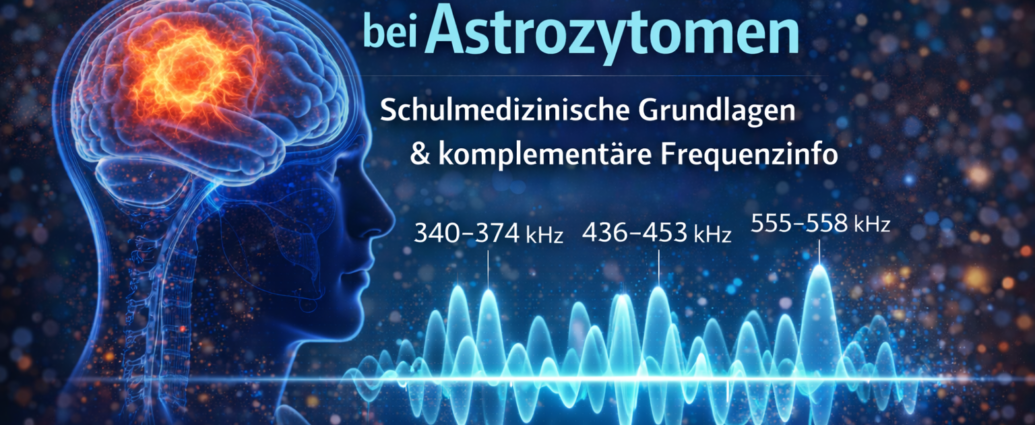
Three zones are particularly striking for frequency therapy:
- 340 to 374 kHz
- 436 to 453 kHz
- 555 to 558 kHz
These clusters speak for coherent resonance spaces within information medicine. Especially the area between 436 and 453 kHz acts like a central frequency field of the astrocytoma. Such condensations are considered complementary not only as individual frequencies, but as the expression of a larger resonance pattern.
Frequency therapy raises the question of how such resonance windows can be understood within an overall picture of intracranial pressure, tissue changes, regulation and additional biological factors. This creates an in-depth complementary perspective on astrocytoma.
Notes on the reaction in the complementary frequency context
The literature describes that effective work in the RFR context can lead to tumor necrosis and perifocal edema, which can increase intracranial pressure. In this context, headache is mentioned as a common sign of an effective response. The possible need for accompanying measures such as diuretics and corticosteroids is also pointed out.
In the context of frequency therapy, it is therefore particularly relevant that complementary frequency work in astrocytoma is always understood in the overall context of the brain, the pressure behavior and the neurological condition. Especially in the case of space-occupying processes, the reaction of the organism remains a central aspect of consideration.
Conclusion
Astrocytomas are among the most important tumors of the central nervous system and range from low-grade, slow-growing forms to highly aggressive variants such as glioblastoma. The conventional medical approach focuses on tumor grade, neurological symptoms, imaging, molecular background and individually tailored therapy.
Astrocytoma also opens up a complementary perspective for frequency therapy. The resonance frequencies described in the literature provide structured frequency information that can be considered as a supplement within information medicine. The clusters in the range of 340 to 374 kHz, 436 to 453 kHz and 555 to 558 kHz.


Comments are closed, but trackbacks and pingbacks are open.