





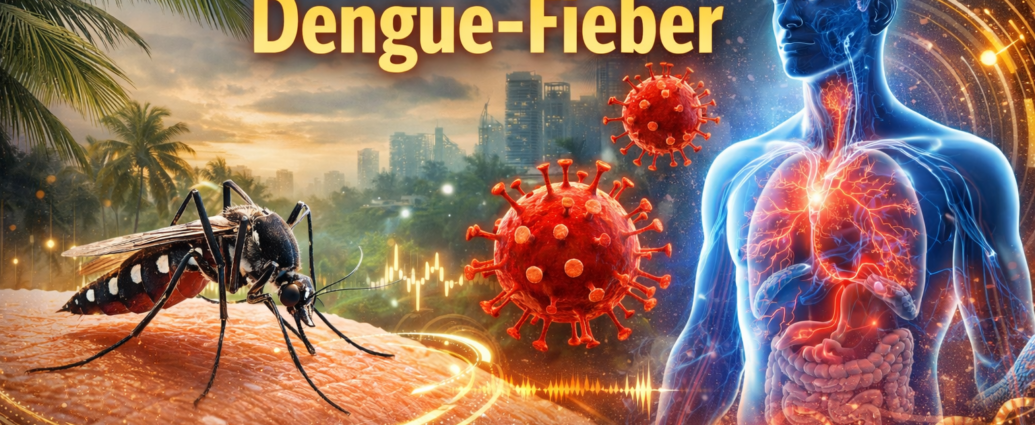
Symptoms, progression and frequency information
Dengue fever is one of the most important mosquito-borne viral infections worldwide. The disease is a major health problem, particularly in Asia, Africa and America. Dengue is caused by one of four closely related serotypes from the flavivirus group. It is transmitted by diurnal mosquitoes, which makes the infection process very different from many other vector-borne diseases. From a conventional medical point of view, dengue fever is particularly relevant because initial infections can often be comparatively mild, while re-infections with a different serotype can lead to significantly more severe symptoms.
What is dengue fever?
Dengue fever is a viral infectious disease that is transmitted to humans by mosquitoes. It is one of the classic arboviral diseases and is very important in many tropical and subtropical regions. The literature describes dengue as an infection with several closely related virus types that do not react in exactly the same way immunologically. It is precisely this circumstance that plays a central role in the further course of the disease.
The initial infection often causes a febrile illness with a self-limiting course. This means that the infection often subsides after some time. Nevertheless, dengue fever is by no means medically harmless, as reinfections with a different serotype can be associated with more severe and potentially dangerous courses.
Transmission by diurnal mosquitoes
It is transmitted by mosquitoes, which are mainly active during the day. This fact is particularly important for prevention because classic protective measures that are only geared towards the night are not sufficient here. Humans are infected by the bite of an infected mosquito, whereupon the Virus can spread in the organism.
The close link between infection and vector also explains the strong dependence on climate, urbanization, water accumulation and mosquito populations. Dengue is therefore not only an infectious disease, but also an environmental and public health issue.
The role of the four serotypes
A central feature of dengue fever is the presence of four closely related serotypes. This fact makes the disease biologically particularly interesting and clinically significant. A first infection does not automatically provide complete protection against all further forms, but can even be associated with an increased risk of severe courses if a subsequent infection with a different serotype occurs.
It is precisely this connection that explains why dengue fever is not only assessed as a one-off infection in conventional medicine, but also with regard to possible subsequent reinfections. Serotypic diversity is therefore one of the key factors in understanding the disease.
Typical course of an initial infection
The primary infection is usually described in the literature as relatively mild and self-limiting. However, this does not mean that it is without symptoms. Even a milder course can be associated with fever, a general feeling of illness and significant weakening of the organism. Typically, in many cases the infection heals without serious complications.
Particularly in regions with a high dengue prevalence, the initial infection is often perceived as part of the general infection process. Nevertheless, it remains medically significant because it can create the basis for a changed risk of subsequent reinfection.
Severe forms with reinfection
Of particular relevance is the possibility that re-infection with a different antigenic type can lead to a much more severe clinical picture. In the literature, this is associated with dengue hemorrhagic fever. High fever, bleeding complications, circulatory problems, myocarditis and encephalitis can then occur.
These severe courses make dengue fever an infection that must be taken seriously despite often mild initial manifestations. The organism may react significantly differently upon re-exposure, which makes the clinical dynamics of this disease particularly complex.
Dengue hemorrhagic fever and shock
The hemorrhagic form is one of the most feared complications of dengue. It can be accompanied by a tendency to bleed and circulatory failure. In the literature, it is also referred to as hemorrhagic shock. Such cases are medical emergencies and require intensive monitoring.
These complications in particular show that dengue fever should not just be understood as a classic febrile infection. Rather, in certain situations it can lead to a profound disruption of the circulatory system, vascular system and organ function.
Possible organ involvement
In addition to fever and circulatory problems, other organ systems can also be affected. The literature mentions myocarditis and encephalitis, among other things. This makes it clear that dengue is not just a general viral fever, but can also involve the heart and nervous system in severe cases.
This organ involvement considerably increases the medical significance of the disease. They show that dengue in certain forms represents a multisystemic event that goes far beyond the usual picture of an infection.
Why dengue fever is so important worldwide
Dengue fever is a major health problem worldwide because it occurs in densely populated regions with high mosquito exposure and can spread rapidly there. The combination of several serotypes, diurnal vectors and the possibility of severe secondary infections makes the disease particularly challenging.
Dengue is also closely linked to environmental factors. Urban density, water accumulation, climatic conditions and international mobility all contribute to dengue remaining a relevant issue in many regions.
Conventional medical treatment
The treatment is described in the literature as symptomatic. This means that the focus is not on a specific standard therapy for direct healing, but on stabilizing the organism according to the clinical course. Medical care is based on fever, circulatory status, fluid balance and possible complications.
Close monitoring of circulation, signs of bleeding and organ function is particularly important in severe cases. The conventional medical perspective therefore focuses strongly on the early detection of critical developments.
Prevention from a conventional medical perspective
The available literature describes that no vaccine is available. Prevention therefore focuses primarily on protection against mosquito bites. As the transmitting mosquitoes are active during the day, personal protection is also particularly important during the day.
The control of breeding sites, the reduction of standing water and individual protective measures are therefore crucial approaches to reducing the risk of infection. Dengue prevention is therefore closely linked to environmental control and public health care.
Holistic view of the organism
From a holistic perspective, dengue fever shows very clearly how strongly a viral infection can challenge the organism on several levels. Fever, circulatory stress, a possible tendency to bleed and organ involvement make it clear that the focus here is not just on a single symptom, but on a complex reaction pattern of the entire system.
This is precisely why a complementary approach focuses not only on the acute signs of illness, but also on the ability to regenerate, vegetative stability, resilience and the individual response. The organism is understood as a whole that responds to infectious stress with different patterns.
Complementary perspective on frequency therapy
Around the Frequency therapy is often associated with terms such as oscillation, Resonance and regulation. Complementary understanding is about looking at biological stress not only on a material level, but also in connection with functional and systemic patterns. The focus is not on the isolated number, but on the classification in a larger understanding of the reaction situation and regulation.
Particularly in the case of complex courses of infection, such models attempt to consider not only the virus or the main symptom, but also the overall reaction of the organism. In this context, frequency therapy and frequencies are seen as supplementary literature references within an expanded understanding of resonance and system dynamics.
Frequency info
The following frequency ranges are mentioned in the literature for dengue fever:
315, 320, 327, 336-337, 339, 372, 376, 378, 396, 402, 409, 422, 450, 512, 564 kHz
In the complementary context of frequency therapy and frequencies, these frequency data are understood as supplementary literature references. Within complementary approaches, they are placed in a larger context of resonance, system dynamics and individual reactions.
Conclusion
Dengue fever is a globally significant flavivirus infection transmitted by diurnal mosquitoes. Initial infections are often comparatively mild, while reinfections with a different serotype can be associated with significantly more severe and potentially dangerous symptoms. The focus is on conventional medicine because it clearly describes the transmission route, serotypes, possible complications and the importance of symptomatic treatment.
In the complementary environment, the view of frequency therapy and frequencies can also be understood as a thematic extension. The frequency ranges mentioned in the literature are referred to as Frequency info into a larger context.


Comments are closed, but trackbacks and pingbacks are open.