





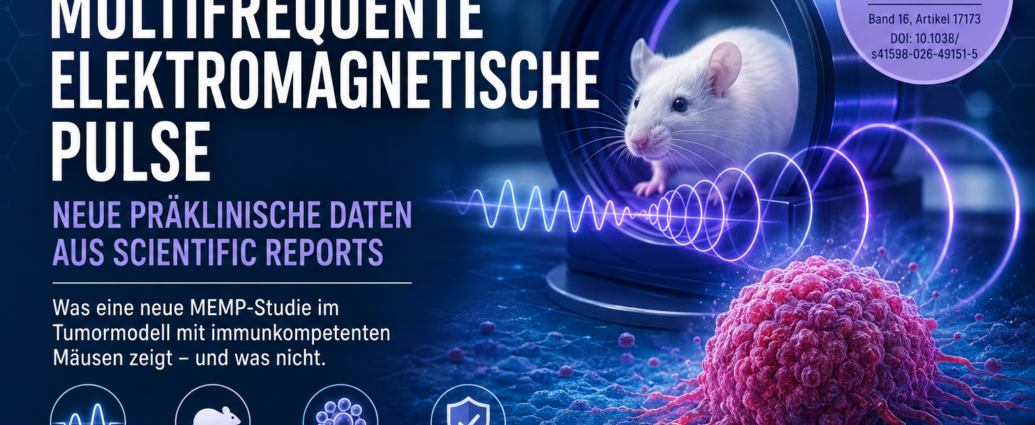
New preclinical data from *Scientific Reports*
Abstract: A 2026 study published in *Scientific Reports* examines multifrequency electromagnetic pulses in a mouse tumor model. The article assesses the opportunities, limitations, and significance of this research for frequency therapy.
Introduction: Why This Study Is Important to the Debate on Frequency Therapy
In the discussion about Frequency therapy, Information medicine For years, there has been a tension between electromagnetic fields and bioelectromagnetic methods: On the one hand, there is growing scientific interest in electromagnetic fields and their biological effects. On the other hand, statements are frequently made in the public sphere that lack sufficient scientific evidence or blur the distinction between experimental research and therapeutic application.
That is exactly why the new release in Scientific Reports Interesting. The study titled „Effects of Multifrequency Electromagnetic Pulses on tumor “growth in immunocompetent mice" examines multifrequency electromagnetic pulses not as a general wellness or therapeutic claim, but as a clearly defined experimental procedure in a preclinical tumor model.
This is crucial for context: The study does not provide a basis for claims such as „frequencies cure cancer.“ However, it does provide scientifically relevant evidence that defined electromagnetic pulses can, under controlled laboratory conditions, trigger biological effects on tumor growth, tumor tissue, and immunological markers.
About the Publication
The study was published in Scientific Reports, a journal in the Nature portfolio, under the title:
Effects of Multifrequency Electromagnetic Pulses on Tumor Growth in Immunocompetent Mice
Key bibliographic information:
Journal: Scientific Reports
Volume: 16
Item Number: 17173
Year: 2026
Publication: April 22, 2026
Version of Record: June 3, 2026
DOI: 10.1038/s41598-026-49151-5
The study examined a method known as Multifrequency Electromagnetic Pulse Treatment, short MEMP, as it is known. This involves multifrequency electromagnetic pulses in a non-invasive, non-thermal setting. The study used extremely low frequencies and high magnetic flux density.
It is important to note that the study describes a preclinical research model. It should not be equated with a clinical trial involving patients.
What was studied?
The researchers wanted to investigate whether systemically administered multifrequency electromagnetic pulses could influence the growth of established solid tumors in an immunocompetent animal model.
A syngeneic mouse model was used for this purpose. This means that tumor cells were implanted into mice whose immune systems were essentially intact. In this case, the model used was an MC38 colon adenocarcinoma model in C57BL/6 mice.
This is an important methodological point. Many preclinical tumor studies use immunodeficient animals so that transplanted tumor cells can grow at all. Such models are useful for certain research questions, but they only partially reflect the interaction between the tumor and the immune system. An immunocompetent model at least provides a better way to address the question of whether a treatment not only affects the tumor cells themselves but may also alter the tumor microenvironment and the immune response.
Why the immunocompetent model is important
Tumors are not simply collections of abnormal cells. They are in constant interaction with their surroundings. These include blood vessels, connective tissue, inflammatory responses, immune cells, metabolic processes, and signals from the tissue.
When investigating a physical method such as MEMP, therefore, it is not only the direct effect on tumor cells that is of interest. Equally important is the question of whether this alters the tumor microenvironment. Does it lead to increased necrosis? Do oxidative stress signals arise? Are immune cells recruited to the tumor? Is there evidence of altered recognition by the immune system?
The study addresses precisely these questions. It examined not only tumor growth but also histological and immunohistochemical markers, including evidence of immune cell infiltration, oxidative stress, and DNA damage.
The key findings of the study
The authors report that MEMP treatment slowed tumor growth and prolonged the survival of the treated animals in the mouse models studied. In a small subgroup, complete tumor regression was even observed.
What is particularly striking is that the observed effects were not described merely as a delay in growth. In the treated tumors, broader areas of necrosis were found, along with evidence of oxidative stress and limited but detectable markers of DNA damage.
The study also describes changes in immune cell markers. While CD4- and CD8-T cells were not significantly elevated, there was evidence of an increase or greater presence of CD68-positive macrophages in treated tumors. This could indicate involvement of the innate immune system.
This observation is interesting, but it should be interpreted with great caution. The authors themselves emphasize that further research is needed to truly understand the mechanisms involved.
Possible mechanism of action: tumor cell stress, necrosis, and immune response
The data suggest a possible model: The electromagnetic pulses could induce a state in tumor cells in which structural and metabolic stress increases. Evidence for this includes the described markers of oxidative stress and DNA damage.
If tumor cells are damaged or undergo necrosis as a result, signals may be released that are recognized by the immune system. In tumor immunology, such signals are often described as danger signals or damage-associated molecular patterns. They can attract immune cells and influence local inflammatory responses.
The study suggests that MEMP may not only act directly on tumor cells, but may also alter the tumor microenvironment. The findings regarding macrophages are particularly significant in this context. Depending on the context, macrophages can have either tumor-promoting or tumor-suppressing properties. Therefore, it is not enough to simply find more macrophages in the tumor; what matters is the functional role they play there.
This is precisely where the study remains cautious: it provides clues, but not yet a definitive mechanistic explanation.
Why the results are scientifically interesting
This work is relevant to bioelectromagnetic research for several reasons.
First, it examines a specific physical process. This clearly distinguishes the study from general statements about „frequencies,“ which often lack clear specifications regarding frequency, field strength, duration of exposure, control group, or biological model.
Second, she is working with a tumor model that allows for an immunological approach. As a result, the study focuses not only on direct damage to tumor cells but also on the question of how an electromagnetic stimulus might affect the entire tumor-organism system.
Third, it integrates tumor growth, imaging, histology, and immunological markers. This provides a broader picture than a cell culture study alone.
Fourth, despite positive preclinical findings, the work remains in the preclinical stage. It is a research contribution, not proof of clinical efficacy.
Implications for Frequency Therapy Research
This study is significant for the debate on frequency therapy because it demonstrates what rigorous research in this field can look like: not through sweeping claims of healing, but through controlled experiments, defined parameters, and verifiable biological endpoints.
Anyone conducting scientific research on frequency therapy should emphasize precisely this distinction. The point is not to immediately draw therapeutic conclusions from every positive preclinical observation. The goal is to understand mechanisms, test hypotheses, and determine, step by step, whether certain forms of electromagnetic exposure are biologically relevant, reproducible, and safe.
The study therefore does not support the claim that frequency therapy can cure cancer. However, it does support the scientific need to conduct a nuanced investigation of bioelectromagnetic effects.
"Preclinical" does not mean "clinical"
The most important point for readers is this: Preclinical research is an early stage in the scientific development process.
A mouse model can provide clues. It can demonstrate that a procedure has biological effects. It can shed light on possible mechanisms. It can help point the way for further research.
But a mouse model does not answer the crucial clinical questions:
Does this procedure work on humans as well?
Is it safe for patients?
What types of tumors would be suitable in the first place?
What dosage would be appropriate?
How often would treatment be needed?
What adjunct therapies would be feasible or problematic?
Are there any risks associated with certain medical conditions or implants?
How does this treatment work in combination with surgery, chemotherapy, radiation therapy, immunotherapy, or targeted drugs?
Until these questions have been investigated in controlled clinical trials, no therapeutic recommendations may be derived from a preclinical study.
What this study does not show
Just as important as the results is a clear distinction between what the study does and does not show.
It does not show that electromagnetic pulses cure cancer in humans.
It does not show that frequency therapy can replace oncological treatment.
It does not show that cancer patients derive clinical benefit from such treatment.
It does not indicate which frequencies, field strengths, or treatment protocols would be appropriate for humans.
It does not show that commercially available devices or other frequency systems have the same effects.
It does not show that the results are applicable to all types of tumors.
These points are crucial because, particularly in the field of frequency therapy, people often jump to conclusions too quickly, drawing therapeutic promises from laboratory findings.
What this study actually shows
The study shows that a clearly defined MEMP procedure can elicit biological effects on tumor growth and tumor tissue in an immunocompetent mouse model.
It shows that tumor progression was slowed in this model.
It shows that treated animals survived longer.
It shows evidence of increased necrosis in treated tumors.
It shows markers of oxidative stress and limited DNA damage.
It shows evidence of changes in the immune cell environment, particularly among CD68-positive macrophages.
It shows that complete tumor regression was observed in a very small subgroup.
That is scientifically relevant. But it remains in the preclinical stage.
Interpretation of complete tumor regression in n=2
Particular attention should be paid to the observation that complete tumor regression was reported in two treated mice. Such results are striking and may provide important insights.
At the same time, we must be particularly cautious here. A subgroup of two animals is very small. Such findings may support a hypothesis, but they are not sufficient to draw reliable general conclusions.
The “re-challenge” aspect is also interesting: The animals that had previously undergone regression were re-exposed to the same tumor cell line and demonstrated more robust resistance than naive control animals. This could indicate an immunological memory response. But here, too, the number of cases is very low. The finding is exciting, but preliminary.
For researchers, this is a sign that it is worth investigating this mechanism more closely. For clinical Practice It is not yet a basis.
Limitations of the Study
The authors themselves point out significant limitations. These include the small number of cases, the rapidly growing subcutaneous tumor model, and the fact that histological differences may have been influenced in part by variations in tumor burden.
These limitations are not insignificant. In oncology in particular, findings from mouse models often have limited applicability to humans. Tumors in humans develop over long periods of time, are genetically heterogeneous, grow in complex organ environments, and are influenced by individual immune, metabolic, and therapeutic factors.
A subcutaneous mouse model is controllable and scientifically useful, but it only partially reflects clinical reality.
Why proper language is especially important here
The study is a good example of why precise language is necessary in the field of frequency therapy.
It would be inaccurate to say, „Frequencies stop cancer.“
A more credible statement would be: „In a preclinical mouse model, a specific MEMP procedure slowed tumor growth and altered tumor-related tissue markers.“
It would be inaccurate to say: „Electromagnetic pulses are a new cancer treatment.“
A more accurate statement would be: „The data provide preclinical evidence of the biological effects of electromagnetic pulses in a tumor model; clinical efficacy in humans has not been demonstrated.“
It would be inaccurate to say, „This proves the effectiveness of frequency therapy.“
A more accurate statement would be: „The study reinforces the relevance of bioelectromagnetic research, but it is no substitute for controlled clinical trials.“
This distinction is essential if frequency therapy is to be taken seriously from a scientific standpoint.
Implications for Patients
For patients with cancer, this study should not be interpreted as a treatment recommendation. It should not lead to the postponement, modification, or discontinuation of conventional medical diagnostics or oncological therapies.
Cancer requires evaluation by a specialist and a treatment plan. Surgery, chemotherapy, radiation therapy, immunotherapy, hormone therapy, and targeted therapies can be life-saving, depending on the type and stage of the tumor.
Bioelectromagnetic research may raise new questions in the long term. However, this study does not provide any immediate recommendations for human applications.
Significance for Research and Health Informatics
Nevertheless, this work is valuable for information medicine and frequency therapy research. It demonstrates that physical stimuli can interact with biological systems and that such interactions can be experimentally verified.
The key to moving forward lies not in exaggeration, but in better research:
more precise exposure parameters,
larger groups of animals,
independent replicas,
various tumor models,
Long-term observation,
systematic safety data,
more detailed immunological analyses,
Comparison with existing therapies,
possible combinations with established oncological procedures,
and only then carefully planned clinical trials.
This is the only way an interesting preclinical finding can eventually become a sound medical concept—if the findings are confirmed.
Conclusion
The *Scientific Reports* study on multifrequency electromagnetic pulses is an important preclinical contribution to the field of bioelectromagnetic tumor research. It does not examine a vague claim regarding frequency, but rather a defined electromagnetic method in a controlled animal model.
The results are interesting: slowed tumor growth, prolonged survival, evidence of necrosis, oxidative stress, limited DNA damage, and possible immunological involvement. In particular, the observation of complete tumor regression in a small subgroup is scientifically noteworthy, but must be interpreted with great caution due to the small number of cases.
For research into frequency therapy, the study provides credible evidence that specific electromagnetic pulses can influence tumor-related biological processes. However, it does not constitute proof of efficacy for cancer treatment in humans.
Therefore, the correct conclusion is not: „Frequencies cure cancer.“
The correct conclusion is: „Well-defined bioelectromagnetic methods warrant further, methodologically sound research—especially where tumor biology, immune response, and physical regulation intersect.“
Source citation
This article is based on the following publication:
Piredda, R., Rodríguez Martínez, L. G., Martinez-Ortega, J., et al. Effects of Multifrequency Electromagnetic Pulses on Tumor Growth in Immunocompetent Mice. Scientific Reports 16, 17173 (2026). DOI: 10.1038/s41598-026-49151-5.
Important note
Frequency therapy and information medicine techniques are not generally recognized by conventional medicine and are not a substitute for diagnosis or treatment by trained physicians or alternative practitioners. Especially in cases of cancer, evaluation and treatment by a specialist are essential. This article is intended for scientific Information and does not constitute a promise of a cure or a recommendation for treatment.

Comments are closed, but trackbacks and pingbacks are open.