





From Herbert Eder | Series of Articles DNA Frequencies
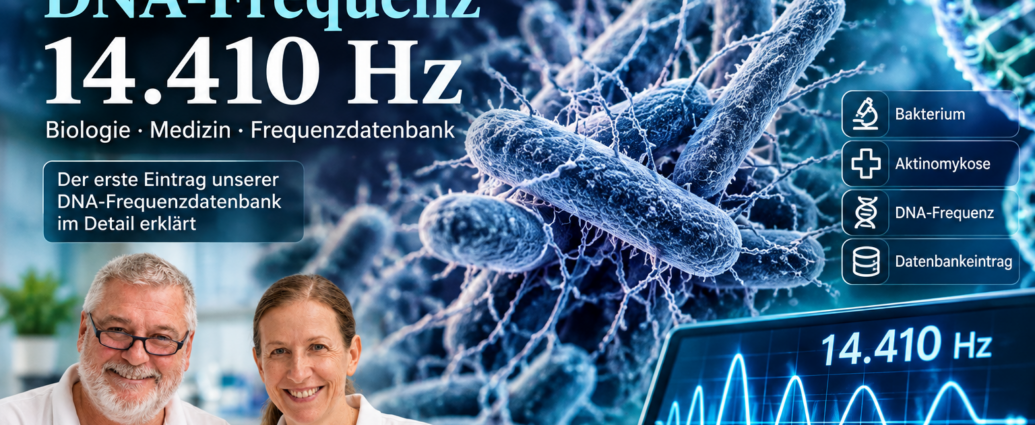
Actinomyces israelii is the first entry in our DNA frequency database.
In addition, this bacterium is assigned a frequency of 14,410 Hz there.
The name refers to two topics. It refers to a microorganism described in medical literature. The frequency assignment, as well as its origin and meaning, must be considered separately.
What is Actinomyces israelii? Where is this bacterium found? Under what circumstances can it cause disease? And what can actually be inferred from the assigned Hertz value?
This article combines the biological background with a clear explanation of the database entry. In doing so, we distinguish between findings about the bacterium and statements regarding its frequency. This is because the scientific description of an organism does not automatically confirm the therapeutic significance of a number listed next to it.
Actinomyces israelii: An Overview of the Database Entry
In the provided workbook „ATHLON DNA_FRQ_Blok okt 2026.xlsx,“ Actinomyces israelii is listed first. The numerical value is listed there as „14410.“ In accordance with the unit confirmed for the entire collection, this entry is designated as 14,410 hertz shown.
| Characteristic | Information |
|---|---|
| Name in the database | Actinomyces israelii |
| Original numerical value | 14410 |
| Unit | Hertz, abbreviated Hz |
| Spelling in the article | 14,410 Hz |
| Conversion to kilohertz | 14,410 kHz |
| Data Source | ATHON DNA_FRQ_Blok Oct 2026.xlsx |
| Source | First worksheet, row 1, cells A1 and B1 |
| Proof of Origin for the Frequency Value | Not specified in the relevant data set |
This last piece of information is important for context: The entry contains no explanation of the measurement method, no calculation formula, and no associated scientific evidence for the frequency value.
Thus, the table first documents a Mapping between a name and a frequency. Whether and how this classification was experimentally substantiated cannot be determined from this line alone.
What is Actinomyces israelii?
Actinomyces israelii is a type of bacterium.
In addition, the BacDive microbiological database of the Leibniz Institute DSMZ classifies the species as belonging to the family Actinomycetaceae and describes a documented strain as Gram-positive, rod-shaped, and nonmotile.
“Gram-positive" refers to a characteristic that becomes visible when a specific microbiological staining method is used.
bacdive.dsmz.de
Filamentous structures are also characteristic of members of the genus Actinomyces. Visually, these may resemble fungal hyphae. Biologically, however, they are bacteria, not fungi. This distinction is important because a similar appearance does not imply a common biological classification. Canada
The scientific name consists of two parts: Actinomyces refers to the genus, israelii the species. When working with a frequency database, the full scientific name should always be used. An entry for a specific species must not be applied to all members of a genus without justification.
The same applies to research findings: A study conducted on a precisely described bacterial sample is, first and foremost, a study of that specific sample. Its applicability to other strains or conditions must be assessed separately.
Between Normal Flora and Disease
Actinomyces bacteria may be part of the natural microbial flora of the human body. The Canadian health authority notes that they are found primarily in the oral cavity and on other mucosal surfaces. Diseases can develop when protective tissue barriers are compromised and the bacteria penetrate deeper into the body. Canada
This highlights a fundamental connection: The presence of a microorganism does not automatically mean that a disease is present.
For medical evaluation, it is important to consider where an organism is detected, what symptoms are present, and what other findings are available. A microbiological detection must therefore be evaluated in the context of the body site being examined and the clinical picture.
This results in a clear limitation for our frequency database: The entry „Actinomyces israelii – 14,410 Hz“ does not contain any Information whether the bacterium is present in a particular person. Nor can it show whether it is causing symptoms in that person.
A frequency list is a documentation tool. It is not a personal test result.
What is the medical significance of Actinomyces israelii?
Actinomyces israelii may be involved in the development of a Actinomycosis be involved. This is a bacterial infection that can be associated with, among other things, abscesses and prolonged inflammatory changes. The head and neck region is frequently affected; other areas of the body may also be involved. In addition, multiple types of bacteria may be involved in a single infection. Canada
Symptoms depend on the affected area of the body
If the mouth, jaw, or throat are affected, symptoms may include swelling, difficulty chewing, or purulent discharge. Other manifestations may involve the chest, abdomen, or pelvis. The symptoms vary accordingly. nhs.uk
However, such symptoms are not specific enough to indicate actinomycosis on their own. They can have various causes and should be evaluated by a doctor.
This note is particularly important in an article about frequency assignments: A description found online is no substitute for a test. Similarly, selecting a frequency program does not determine which pathogen is actually present.
Why the Diagnosis Isn't Always Obvious
A retrospective study of 28 cases from six French hospitals described a wide variety of clinical presentations of actinomycosis. The researchers emphasized the difficulties in making a timely diagnosis and the importance of appropriate microbiological and histological examinations. Europe PMC
This observation argues against simplistic self-diagnoses. The medical significance of a bacterium cannot be determined based on a single symptom, and certainly not based on a database entry.
How is actinomycosis diagnosed and treated?
If there is reason to suspect a particular condition, doctors can have appropriate samples tested. In the clinical study mentioned, confirmation through microbiological or histological findings played a key role. „Histological“ means that tissue is examined under a microscope. Collaboration between the treatment team and the laboratory is important in this process. Europe PMC
A diagnosed case of actinomycosis is treated with antibiotics. Depending on the specific condition, a longer course of treatment and additional measures—such as draining an abscess—may be necessary. The appropriate treatment depends on the individual findings. nhs.uk
The frequency value of 14,410 Hz does not replace this diagnosis and treatment. The table cannot be used to determine the choice of antibiotic, the duration of treatment, or any other medical decision.
The significance of the database entry for this article lies in its documentation and classification—not in any self-treatment instructions derived from it.
The DNA frequency of Actinomyces israelii: What does 14,410 Hz mean?
Hertz describes the frequency of a periodic phenomenon. One hertz corresponds to one repetition per second. The unit thus indicates how often a phenomenon repeats. It does not automatically describe its intensity, energy, or biological effect. NIST
If a technical signal were to occur with 14,410 Hz If this were generated, it would correspond to 14,410 cycles per second.
The spelling should remain consistent:
14,410 Hz = fourteen thousand four hundred ten hertz.
The period is used here as a thousands separator. In kilohertz, the value is 14,410 kHz. This notation should not be confused with 14.41 Hz.
The numerical value is only one part of a description
A frequency value alone does not explain how a signal is generated or which quantity changes periodically.
A complete technical description would require additional information: Is it sound, an electrical voltage, or another type of signal? What is the signal waveform? What is the amplitude? How long is the signal generated? And how is a possible response measured?
The first data set in this workbook does not contain such information. Therefore, it would not be reasonable to derive a complete application log from this row.
What does “DNA frequency” mean in this entry?
In this series of articles, we will DNA frequency as a designation for classification within the collection in question needed.
This does not imply that 14,410 Hz is an experimentally confirmed natural frequency of the entire DNA of Actinomyces israelii. Nor does the table entry provide evidence of a specific effect on the bacterium.
The correct statement is therefore:
„In the DNA frequency database used, Actinomyces israelii is assigned a value of 14,410 Hz.“
It would be a significant stretch to claim that this substance can specifically recognize, inhibit, or eliminate the bacterium. Additional studies specifically addressing this claim would be necessary.
This distinction is not merely a linguistic detail. It determines whether information is documented or whether a previously unsubstantiated effect is claimed.
What has actually been documented about the DNA of Actinomyces israelii?
Publicly available genomic data is available for Actinomyces israelii. For example, the ATCC Genome Portal describes a genome assembly of strain ATCC 12102 with a total length of 4,091,706 nucleotides. The dataset also lists sequencing technologies and quality characteristics. ATCC Genome Portal
This provides a concrete example of how molecular biology documentation is structured: It identifies a specific strain, describes the genetic data analyzed, and presents technical information in a clear and understandable way.
However, this genomic data is not the same as a frequency assignment.
The number of nucleotides indicates the length of the recorded genetic sequence. The value 14,410 Hz, on the other hand, indicates a repetition rate. Without an additional, specified method, there is no automatic conversion between the two values.
If a frequency were calculated from a DNA sequence, it would therefore have to be clear which sequence and which method were used. Any biological effect claimed subsequently would have to be investigated separately.
What documentation would be required for frequency allocation?
To evaluate the entry beyond its mere documentation, information about its origin would be particularly helpful.
First, it would need to be clarified whether 14,410 Hz was measured, calculated, or taken from another collection. These possibilities are not equivalent.
For a measured value, the sample under examination, the measurement principle, and the observed quantity would be crucial. For a calculated value, the input data and the calculation method would need to be verifiable. For a cited value, the original source would be important.
Only then could we address the next question: What is the significance of this value for the biological system under study?
A claim regarding therapeutic efficacy would require one additional step. This would involve evaluating a precisely described method of use in terms of its benefits and safety.
The clinical and genomic sources cited in this article describe cases of the disease and genetic data, respectively. They do not provide evidence that the use of 14,410 Hz treats actinomycosis. Europe PMC
Audio Playback: A Sound Alone Does Not Constitute Evidence of a Pathogen
When a frequency is played back through a speaker or headphones, an acoustic signal is produced. When we hear, sound waves are converted into nerve signals through mechanical processes in the ear. NIDCD
However, this does not mean that a specific bacterium in the body is being targeted or detected. The technical representation of a number and the biological significance of that number are two different matters.
Similarly, one's personal perception of a sound cannot indicate whether Actinomyces israelii is present.
When it comes to audio playback, volume and duration also remain important factors. Excessive noise exposure can damage your hearing. A term like “DNA frequency” does not alter these fundamental risks. NIDCD
What happens when you octave 14,410 Hz?
In this series, we define "octave" as the repeated halving or doubling of a frequency value.
Based on the database entry, the following results are obtained when halving the value:
14,410 Hz → 7,205 Hz → 3,602.5 Hz → 1,801.25 Hz
This numerical relationship is mathematically unambiguous. Each step to the right corresponds to half of the previous value.
However, to ensure that the documentation is clear and easy to follow, one thing must remain clear: The original value in the database is 14,410 Hz. The other figures are derived from these calculations.
No consistent biological effect can be inferred from this mathematical relationship. Anyone who claims that a value halved has the same effect as the original value is making an additional claim that would have to be verified independently of the calculation.
The conversion therefore merely explains the relationship between the numbers. It is not a treatment guideline.
What does this entry mean in terms of practical classification?
The database entry can serve as a starting point for exploring Actinomyces israelii. It raises questions about the organism's biology, its medical significance, and the origin of frequency assignments.
Its usefulness increases when this information is documented separately. This makes it clear which statements come from the table and which are supported by specialized sources.
However, it would not be appropriate to use the entry as the basis for a separate diagnosis or treatment.
For general oral health care, the NHS emphasizes the importance of healthy teeth and gums. Any symptoms that might indicate an infection should be evaluated by a doctor or dentist. nhs.uk
Working with frequency databases must not delay this clarification.
Frequently Asked Questions About Actinomyces israelii and 14,410 Hz
What DNA frequency is associated with Actinomyces israelii?
In the workbook used for this series of articles, the value is 14,410 Hz Recorded. This entry documents the item's classification within the collection.
Is 14,410 Hz a scientifically proven treatment frequency?
No corresponding evidence is provided in the relevant dataset. The clinical and genomic sources cited here do not confirm treatment at this frequency. Therefore, it is not presented as a proven treatment frequency in this article.
Is Actinomyces israelii a fungus?
No. It is a bacterium. Its filamentous forms do not change this biological classification. bacdive.dsmz.de
Does a database entry mean that I have the bacterium?
No. The table does not contain test results for any specific person. It cannot confirm either colonization or infection.
Can the frequency replace a course of antibiotics?
This cannot be justified based on the database entry. A diagnosed actinomycosis requires medical treatment. Prescribed treatments must not be altered or discontinued on one’s own based on a frequency list.
Is the effect still the same when the frequency is halved?
Halving the amount yields a value derived from calculations. This does not prove that the effect remains the same.
Conclusion: Understanding Actinomyces israelii and Its Frequency Assignment
The first entry in our DNA frequency database links the name Actinomyces israelii at 14,410 Hz.
The biological aspect can be described using microbiological, clinical, and genomic sources. However, to determine the significance of the frequency value, independent evidence of origin and efficacy must be considered.
The main point of this article is therefore:
A described microorganism and a documented Hertz value do not, on their own, constitute proof of medical efficacy.
It is precisely this distinction that makes the series of articles useful as a reference work. It allows for the presentation of specific entries, the explanation of background information, and the highlighting of unanswered questions.
Medical advice
This article is intended to provide information and context regarding a frequency database. The documented association with 14,410 Hz is not a treatment recommendation and does not replace a medical diagnosis or necessary therapy. No promises of healing are made. If you experience symptoms, a medical evaluation is required; prescribed treatments must not be altered or discontinued on your own.

Comments are closed, but trackbacks and pingbacks are open.