





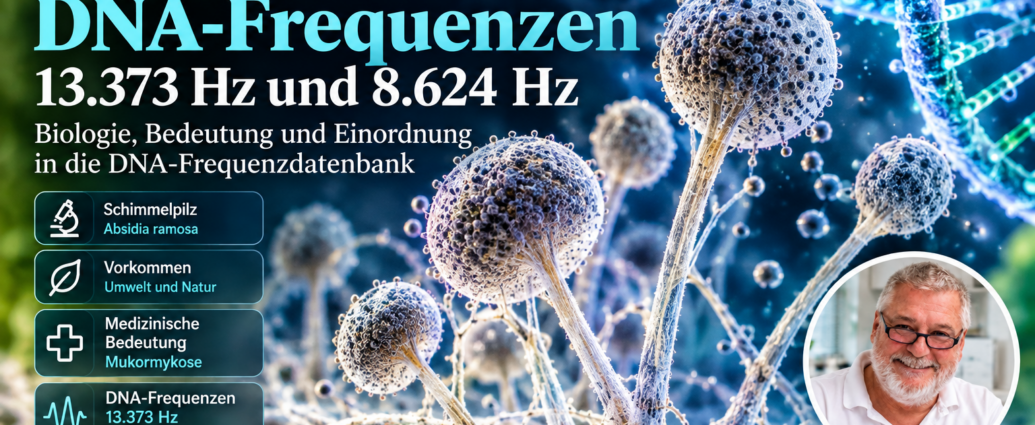
From Herbert Eder | Series of Articles DNA Frequencies
Absidia ramosa is in the format used for this series of articles DNA frequency database containing two frequencies: 13,373 Hz and 8,624 Hz. The entries are labeled „Absidia ramosa 1“ and „Absidia ramosa 2.“.
But what does this name actually mean? What characteristics does this organism have? And how can we interpret these two frequency values?
This article combines a description of the fungus with a clear presentation of its database entries. It focuses equally on the biological background and the significance of the Hertz values. The frequencies are given as Matches within a DNA frequency database presented. However, this alone does not prove that it is effective against the fungus.
Absidia ramosa in the DNA frequency database
The two entries can be summarized as follows:
| Name in the DNA frequency database | Assigned Frequency |
|---|---|
| Branched Absidia 1 | 13,373 Hz |
| Absidia ramosa 2 | 8,624 Hz |
Both values are stored in Hertz, abbreviated Hz, as indicated. The periods here serve as thousands separators: this refers to thirteen thousand three hundred seventy-three hertz and eight thousand six hundred twenty-four hertz, respectively.
The designations „1“ and „2“ distinguish between entries within the database. However, this numbering does not automatically imply a specific order of application. Nor does it indicate whether different fungal strains or developmental stages are being referred to.
For this series of articles, therefore, both terms will be retained. This makes it possible to clearly identify the values and compare them with one another.
What is Absidia ramosa?
Absidia ramosa is a mold. In the current biological classification, the species is known as Lichtheimia ramosa classified. It belongs to the order of the Mucorales. The older name, Absidia ramosa, is still documented as a synonym. NCBI
This dual naming convention is important for understanding: If you search for *Absidia ramosa* in a frequency database and come across *Lichtheimia ramosa* in a biological text, you are not dealing with two different organisms.
In this article, we use the original database name as the primary designation. This preserves the connection to the two frequency values. The name Lichtheimia ramosa supplements the biological classification.
Fungal hyphae, mycelium, and spores
Lichtheimia ramosa grows as a filamentous fungus. Its filamentous structures are Hyphens called; together they form a mycelium, the so-called Mycelium. The description also includes spore-bearing structures known as sporangia. Their structure and other microscopic characteristics help distinguish between related fungi. Genetic characteristics can also be used to ensure reliable species identification. ASM Journals
For conceptual purposes, therefore, a branched network is more appropriate than the image of individual rod-shaped bacteria. A symbolic featured image should also take this difference into account.
Where is Absidia ramosa found?
Species of the genus Lichtheimia are found, among other places, in soil and on dead plant material. They are considered saprotrophic defined as: They utilize organic material that is no longer alive. This makes them part of the group of fungi involved in natural decomposition processes. ASM Journals
Such an organism cannot be described solely as „harmful“ or „beneficial.“ What matters is the context in which it is viewed. Its role in the environment is a different matter from its potential significance in relation to a disease.
An example from enzyme research
For example, on a stem of *Lichtheimia ramosa*, a Xylanase was studied. This is an enzyme that can break down certain components of plant cell walls. The research focused on the properties of the enzyme and its activity toward plant material. PubMed Central (PMC)
This example shows just how versatile the study of a microorganism can be. Researchers can investigate its nutrition, growth, genetic characteristics, or medical significance.
The frequency assignments in a DNA frequency database are, in addition, a separate topic. An analysis of the fungus does not automatically confirm the significance of all the numerical values assigned to it in a collection.
What is the medical significance of Absidia ramosa?
Lichtheimia species are among the fungi that have a Mucormycosis can cause. This is a rare but serious fungal infection. People with certain pre-existing conditions or a significantly weakened immune system are particularly at risk. ZKPP
One distinction is essential here: Environmental exposure does not automatically lead to illness. The fungi that can cause mucormycosis are widespread in the environment. Most people come into contact with them without developing such an infection. ZKPP
When is there an increased risk?
Known risk factors for mucormycosis include, among others, poorly controlled diabetes, certain types of cancer, organ or stem cell transplants, and long-term treatment with corticosteroids. Severe injuries or burns may also play a role. This information applies to mucormycosis in general and is not limited exclusively to Lichtheimia ramosa. ZKPP
Therefore, a person's health status, treatment situation, and specific medical findings are crucial for an individual assessment.
An entry in a DNA frequency database does not contain this information. It does not indicate that a person is infected with the fungus, nor does it indicate that any existing symptoms are caused by this organism.
Which symptoms should be taken seriously?
Depending on the affected area of the body, symptoms may include fever, cough, shortness of breath, swelling on one side of the face, vision problems, or noticeable changes in a wound. These symptoms are not specific to mucormycosis and do not allow for a reliable self-diagnosis. Especially in individuals with a weakened immune system, rapidly worsening symptoms, shortness of breath, or vision problems require immediate medical evaluation. ZKPP
A diagnosed case of mucormycosis requires prompt treatment with appropriate antifungal medications. Depending on the findings, removal of infected tissue may also be necessary. Frequency therapy must not replace or delay this treatment. ZKPP
Understanding the DNA frequencies of Absidia ramosa
After classifying them biologically, we will take a closer look at the two values in the DNA frequency database.
Hertz describes the number of cycles of a recurring event per second. One hertz is equal to one period per second. The unit thus describes how often a process repeats—not how strong it is or what effect it has. NIST
Therefore, it is not just the number that is important for interpretation. It is also necessary to know which physical quantity is changing and in what context the value is being used.
Absidia ramosa 1: 13,373 Hz
The frequency of the first entry is 13,373 Hz assigned.
If a periodic technical signal with this value were generated, it would complete 13,373 periods in one second. In kilohertz, this corresponds to 13.373 kHz.
The statement in the documentation reads:
„In the DNA frequency database used, Absidia ramosa 1 is listed at 13,373 Hz.“
This wording accurately describes the existing assignment. It does not turn the numerical value into either a personal test result or a complete usage log.
The number „1“ should not be overinterpreted either. Here, it simply indicates the first of the two entries, without implying that it is of greater importance.
Absidia ramosa 2: 8,624 Hz
The second entry contains the frequency 8,624 Hz.
For a periodic signal generated in this way, that would be 8,624 periods per second. The conversion yields 8,624 kHz.
The corresponding database statement is:
„In the DNA frequency database used, Absidia ramosa 2 is listed at 8,624 Hz.“
A lower numerical value does not automatically mean a weaker effect. Similarly, the first, higher value is not „stronger“ simply because of that. The numbers describe different repetition rates; they do not imply any assessment of their effectiveness.
Both entries are therefore documented on an equal footing and are not ranked according to any assumed therapeutic significance.
Why are there two frequency values for one name?
These two entries show that the DNA frequency database used may contain multiple values under a single organism name.
However, based on the available information, it is not clear why these two specific frequencies were reserved. The numbering alone does not provide any insight into this.
Therefore, it would not be justified to assign the first value, for example, to a spore shape and the second to a fungal mycelium. Nor can it be inferred from this that both values must necessarily be used together.
For the description, a unique assignment is sufficient for now:
Absidia ramosa 1 corresponds to 13,373 Hz. Absidia ramosa 2 corresponds to 8,624 Hz.
This ensures that the presentation remains clear without adding unconfirmed meanings to the entries.
Are 13,373 Hz and 8,624 Hz related?
Both values correspond to the same name in the DNA frequency database. Mathematically, however, they are different fundamental frequencies.
Halving 13,373 Hz results in 6,686.5 Hz. Doubling 8,624 Hz results in 17,248 Hz. The two original values are therefore not simply an octave apart.
Even by repeatedly doubling or halving it, the original value cannot be converted exactly into the other.
This observation is useful for documentation purposes: The two entries should not be treated as mere spelling variations or as identical numbers that are simply represented differently.
What does octaving mean with these values?
In this context, we define "octaving" as the repeated halving or doubling of a frequency.
For example, the first database entry yields the following:
13,373 Hz → 6,686.5 Hz → 3,343.25 Hz
For the second value, the corresponding sequence is:
8,624 Hz → 4,312 Hz → 2,156 Hz
The conversion is mathematically verifiable. However, a clear distinction must be made between the original database value and the values calculated from it.
Furthermore, such a numerical relationship does not prove a consistent biological effect. The statement „The value was halved“ describes a calculation. The statement „The effect remains the same“ would require additional research.
What does „DNA frequency“ mean in this article?
The term DNA Frequency In this series of articles, this term refers to the classification within the DNA frequency database used.
This does not imply that the two values represent experimentally confirmed natural frequencies of the entire DNA of Absidia ramosa.
Likewise, it would be an additional step—one not substantiated by the classification itself—to infer a specific effect against the fungus from this.
To make it easier to understand, we can distinguish between three questions:
Which organism is being referred to?
This refers to Absidia ramosa, also known as Lichtheimia ramosa.
What values are stored in the DNA frequency database?
The two frequencies are 13,373 Hz and 8,624 Hz.
What effects have been proven for a specific application?
This question cannot be answered based solely on the database entry.
This distinction allows for an objective examination of the topic. It leaves room for further questions without presenting a documented figure as a confirmed mechanism of action.
What practical conclusions can be drawn from the entries?
First, the two values can be clearly identified and located within the series of articles. Together with the biological description, this provides a clear overview of the topic.
For a specific technical application, however, additional information would be required. A frequency value alone, for example, does not specify the signal shape, intensity, duration, or transmission path.
Nor can a treatment sequence be deduced from „Absidia ramosa 1“ and „Absidia ramosa 2.“.
The practical value of this article therefore lies primarily in the Orientation and Documentation: It explains the name, classifies the organism, and presents the corresponding frequency values in a clear and understandable way.
These database entries do not provide the basis for individual diagnoses or treatment decisions.
Frequently Asked Questions About Absidia ramosa and Its DNA Frequencies
What DNA frequencies have been recorded for Absidia ramosa?
The DNA frequency database used contains 13,373 Hz for Absidia ramosa 1 and 8,624 Hz for Absidia ramosa 2.
Why are both values discussed in a single post?
Both entries have the same organism name. A single entry makes it easier to compare them and avoids the need to explain identical biological contexts separately. The two frequency assignments remain clearly distinguishable, however.
Do I have to use Frequency 1 first and then Frequency 2?
Such an order cannot be inferred from the numbering. The suffixes distinguish between the entries, but do not constitute documented usage instructions.
Is a higher frequency generally stronger?
No. The frequency value describes the repetition rate and does not automatically indicate signal strength or greater utility. Therefore, it is not possible to establish a corresponding ranking based solely on the hertz value. NIST
Does the database entry indicate a fungal infection?
No. A DNA frequency database does not contain individual test results. It cannot detect an infection or determine the cause of personal symptoms.
Can these frequencies replace medical treatment?
No such recommendation can be justified based on the two database entries. In cases of a suspected or diagnosed fungal infection, medical evaluation and treatment are the determining factors.
Conclusion: *Absidia ramosa* and its two database occurrences
Absidia ramosa is recorded in the DNA frequency database used at 13,373 Hz and 8,624 Hz. The two values belong to separate entries and are documented accordingly.
However, simply looking at the numbers is not enough to understand this. It is just as important to consider which organism is being referred to and what the term „DNA frequency“ means within this context.
This article therefore combines the biological background with a clear presentation of the frequency values. It explains the correlations without inferring an unproven treatment from them.
The name describes the topic. The Hertz values document the database entries. Their classification makes the context clear.
Medical advice
This article is intended to provide information about a DNA frequency database. The frequencies mentioned are not proven treatment instructions and do not constitute a promise of healing. They are not a substitute for a medical diagnosis or necessary medical treatment. Prescribed therapies must not be altered, delayed, or discontinued on one’s own initiative due to the use of these frequencies.

Comments are closed, but trackbacks and pingbacks are open.