




1. introduction
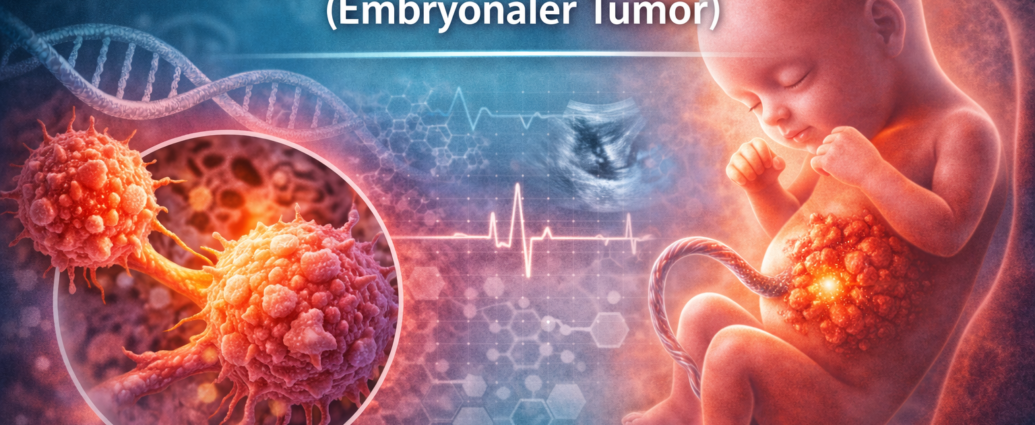
A blastoma - also known as an embryonal Tumor is a rare cancer that occurs predominantly in children.
The term describes tumors that arise from embryonic or immature cells that were formed during the early development of the body.
Depending on the tissue affected, a blastoma can occur in various organs, e.g. as
Nephroblastoma (Wilms tumor) in the kidney, neuroblastoma in the nervous tissue or hepatoblastoma in the liver.
2. medical background
Blastomas develop from pluripotent cells that have retained their ability to differentiate.
During normal development, these cells mature and lose their ability to divide; in blastomas, this mechanism remains uncontrolled.
The most common embryonal tumors are:
- Nephroblastoma (Wilms tumor)
- Neuroblastoma
- Hepatoblastoma
- Medulloblastoma
- Retinoblastoma
They are among the most important pediatric oncological diseases worldwide.
3. symptoms
The symptoms depend heavily on the organ affected, but are common:
- Abdominal swelling or palpable masses
- Abdominal pain or loss of appetite
- Blood in the urine (for kidney tumors)
- Dizziness, headaches, vomiting (with CNS tumors)
- Pallor, weakness, weight loss
As children compensate quickly, early stages often only become apparent late.
4. diagnostics
The following are used for diagnosis:
- Ultrasound, CT or MRI to the organ display
- Biopsy for precise histological determination
- Tumor markers (depending on type, e.g. AFP in hepatoblastoma)
- Urine and blood tests
- Molecular genetic tests to determine mutations and risk factors
The classification is based on stage, histology and degree of metastasis.
5. conventional medical therapy
The therapy depends on the type and location of the tumor:
- Surgical removal is usually the first step.
- Chemotherapy is often used before or after surgery.
- Radiotherapy for certain CNS tumors or Metastases.
- Long-term aftercare to avoid late complications.
The chances of recovery are high with early diagnosis - for many embryonal tumors over 75 %.
6. complementary approach: frequency therapy
Within complementary medicine, the Frequency therapy used as gentle, energetic support.
For blastomas (embryonal tumors), the following frequencies are mentioned in alternative frequency collections (informative):
Nephroblastoma (Wilms tumor)
CAFL (Hz)
- No own entry for Nephroblastoma or Wilms in the CAFL PDF that we use.
ETDFL / EDTFL (kHz)
- Nephroblastoma: 0.03, 0.24, 2.78, 78.85, 233.56, 475.87, 527, 667, 752.7, 990.62.
- Cancer: Wilms‘ tumor: 0.03, 0.46, 0.75, 0.85, 2.5, 7.5, 96.5, 328.85, 434.93, 451.17.
Neuroblastoma
CAFL (Hz)
- Cancer_neuroblastoma (exp): 7027, 6148, 5270, 4392, 3513, 2635, 1757, 878.
ETDFL / EDTFL (kHz)
- Cancer: Neuroblastoma: 0.06, 0.35, 0.62, 0.97, 12.5, 27.5, 142.5, 434.87, 623.01, 815.58.
- Neuroblastoma: 0.02, 0.97, 5.69, 32.5, 175.03, 434.17, 517.5, 683, 712.42, 995.38.
Hepatoblastoma
CAFL (Hz)
- No separate entry „Hepatoblastoma“ in the CAFL PDF; only the following are available Liver cancer placeholder:
- Cancer_liver: “use Cancer, carcinoma, liver”
- Cancer_liver_secondary: “use Hepatitis B ...”
ETDFL / EDTFL (kHz)
- No entry „Hepatoblastoma“ in the ETDFL PDF (0 hits).
Medulloblastoma
CAFL (Hz)
- No separate entry „Medulloblastoma“ in the CAFL PDF (0 hits).
ETDFL / EDTFL (kHz)
- Cancer: Brain Tumor, Medulloblastoma: 0.02, 0.03, 0.04, 5.03, 119.34, 350, 434.33, 691.27, 759.83, 927.1.
- Medulloblastoma: 0.16, 0.35, 0.93, 35.78, 112.5, 212.71, 434.79, 396.5, 597.5, 751.17.
Retinoblastoma
CAFL (Hz)
- No separate entry „Retinoblastoma“ in the CAFL PDF (0 hits).
ETDFL / EDTFL (kHz)
- Retinoblastoma: 0.07, 2.12, 5.69, 20, 93.5, 175.75, 434.5, 527, 667, 873.29.
7. conclusion
Blastomas are among the typical childhood tumors that arise from early developmental tissue.
Modern therapy has significantly improved the chances of survival.
In addition, holistic approaches - such as exercise, nutrition, psychological support and supportive frequency therapy - can have a positive influence on well-being.
⚠️ Disclaimer on frequency therapy
Frequency therapy is a complementary procedure whose effectiveness has not been scientifically proven.
It does not replace a medical examination, diagnosis or treatment.
All frequencies and notes mentioned here are for general information only. Information and must not be understood as a promise of salvation.
Patients should always consult qualified doctors or therapists before using alternative methods or changing treatments.