



How the psyche, nervous system and inner conflicts influence the body - and what you can do specifically
Abstract
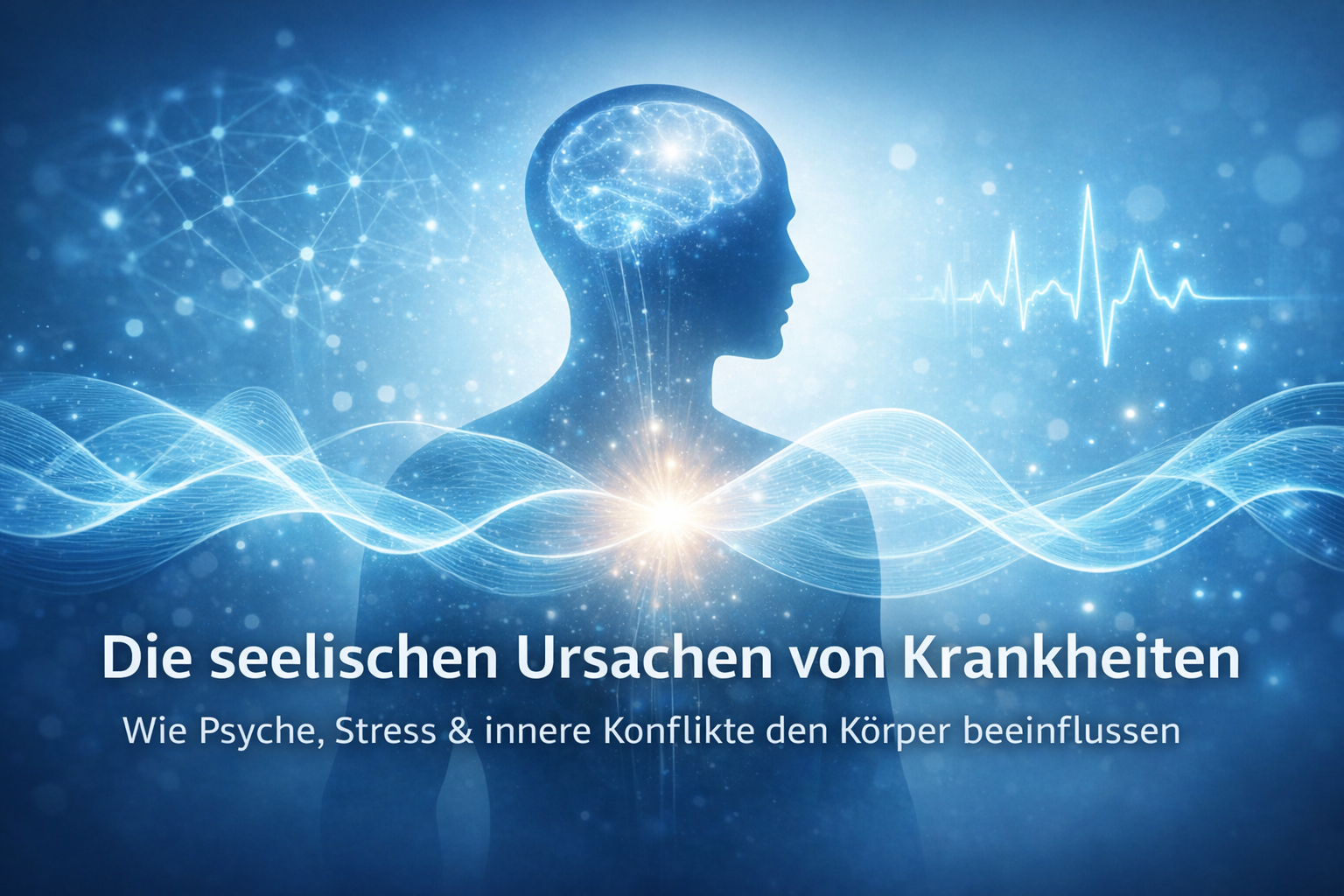
This article explains clearly and in detail how stress, trauma, unresolved conflicts and suppressed feelings can influence physical complaints. With chapters, practical exercises and holistic approaches - including classification of the Frequency therapy.
Author
NLS Information medicine Ltd. Herbert Eder
1. why „psychological causes“ have nothing to do with „imaginary“
At some point, many sufferers hear the sentence: „That must be psychosomatic.“ And it often feels like that: „Then it's probably not real.“ That is precisely the error in thinking. Physical symptoms are real - even if psychological factors are involved.
When we talk about psychological causes, we don’t mean that the body „lies.“ Rather, it means that the body reacts to chronic stress—much like a muscle that cramps when it has to work for too long. The mind is not a separate entity here, but rather part of the entire biological system. Emotions, thoughts, relationships, stress, and life circumstances have a measurable impact on hormones, the immune system, sleep, Digestion and coping with pain.
2. the biological mechanism - how emotions „land“ in the body“
To make the topic tangible, it is worth taking a look at three core systems: The nervous system, stress axes and body memory.
2.1 The nervous system: alarm mode or regeneration
Our nervous system has roughly two poles:
- Activation (fight/flight): Provide energy, tense muscles, sharpen focus.
- Regeneration (rest/connectedness): Digestion, healing, sleep, build-up.
Constant stress keeps us in alarm mode. Then the body is not „too sensitive“, but consistent: it prioritizes survival instead of repair. Many symptoms do not arise because the body is weak, but because it lacks the regeneration phase for too long.
2.2 Stress hormones and inflammation: When cortisol is no longer enough
In the short term, the release of stress hormones helps. In the long term, the system collapses:
- Sleep becomes lighter, more restless.
- Inflammatory processes can increase.
- The gut and microbiome react sensitively.
- Pain is perceived more strongly.
- Infections or chronic complaints occur more frequently.
2.3 Body memory: unprocessed emotion becomes tension
Repressed feelings do not simply disappear. They often become:
- Muscle tension (neck, jaw, back)
- Breathing constriction (flat chest, tightness)
- Digestive problems
- Skin reactions
- Exhaustion
The body is like a storehouse: what cannot be expressed emotionally sometimes finds a physical way.
3. typical mental stresses that can promote illnesses
Not every illness has a psychological cause - but many complaints have psychological amplifiers. Frequent triggers are
3.1 Chronic stress
Permanent stress is not only caused by work, but also by:
- Constant availability
- Perfectionism
- financial pressure
- Caring for relatives
- Conflicts in a partnership or family
- the feeling of „not being able to get out“
3.2 Unspoken conflicts
When we avoid conflict, we often pay with inner tension. This can manifest itself physically as:
- Chest pressure
- Abdominal problems
- Sleep disorders
- Headache
- Increased irritability
3.3 Grief, loss, powerlessness
Grief is not just crying. Grief is a whole biological process. If grief is not given space, it can manifest itself as:
- Exhaustion
- physical severity
- Immunodeficiency
- depressive symptoms
manifest itself.
3.4 Anger that must not be lived
Many people learned early on to swallow anger. The body often turns it into:
- Pine presses
- Tension
- Irritable bowel syndrome
- High blood pressure tendencies
- Inflammatory tendency (as an amplifier, not as the sole cause)
3.5 Anxiety and constant tension
Anxiety is a highly effective physical state. It influences breathing, heartbeat, bowel movements, sleep and muscle tension. Those who „function“ for a long time sometimes only notice anxiety through physical symptoms.
4. common symptoms - and what psychological issues may lie behind them
Important: These are not rigid classifications, but possible patterns. Every person is individual.
4.1 Stomach and intestines
Possible psychological backgrounds:
- Brooding, worries
- Need for control
- „I can't digest this“
- Conflicts that „lie in the gut“
Practical tip: Those with frequent gastrointestinal symptoms often benefit particularly from nervous system regulation (breathing, vagus exercises) plus conflict resolution.
4.2 Back, neck, shoulders
Common patterns:
- Assumed responsibility
- „I have to be strong“
- Inner pressure not to be enough
- Suppressed anger or frustration
A central question is: Where are you wearing something that should actually be shared?
4.3 Skin (e.g. neurodermatitis as a stress intensifier)
Possible topics:
- Overstimulation
- Boundaries, protection, „too close / too much“
- Shame or discomfort in your own body
- emotional tension
Stress often plays a role as an amplifier in skin issues. The focus is often on calming, stabilization and consistent boundary management.
4.4 Sleep disorders
Typical backgrounds:
- Nervous system remains on alert
- Unresolved issues become „loud“ at night“
- Perfectionism and control
- Suppressed emotions
Small, repeatable rituals often help more than big resolutions.
5 What about serious illnesses such as cancer?
Clarity is crucial here: cancer is multifactorial. It would be wrong and unfair to claim that cancer is caused exclusively by emotional conflicts.
What can be said with certainty:
- Constant stress can put a strain on the body and immune system.
- Lack of sleep, inflammation and a lack of regeneration are unfavorable conditions.
- Mental stabilization can help to better support treatment, quality of life and healing processes.
The most important attitude is: No apportioning blame. No simple explanations. Instead, support at all levels.
6 The inner conflict - when two needs work against each other
Very often there is an inner contradiction behind symptoms:
- I want closeness, but I fear injury.
- I want success, but I'm afraid of being judged.
- I want peace and quiet, but I don't think I can get out.
- I want to be healthy, but my everyday life is built against me.
If such conflicts persist for a long time, the body sometimes reacts like an emergency brake. Not to „annoy“, but to protect.
7. 10 concrete steps that can help immediately
This is not about perfect self-optimization, but about regulation and relief.
Step 1: Take symptoms seriously - but don't dramatize them
Say to yourself: „My body is showing me something.“ This takes away fear and gives you the ability to act.
Step 2: 5 minutes of nervous system calming every day
A simple exercise:
- Breathe in for 4 seconds
- Exhale for 6-8 seconds
- 10 breaths long
For many people, prolonged exhalation is the quickest way out of alarm mode.
Step 3: Name feelings instead of pushing them away
Two sets once a day:
- „I feel ...“
- „I need ...“
Example: „I feel overwhelmed. I need support.“
Step 4: Train boundaries on a small scale
A small „no“ or a clear „later“ every day. Boundaries are nervous system hygiene.
Step 5: Don't leave conflicts lying around forever
Unresolved conflicts are a constant source of stress. Sometimes a conversation is enough, sometimes distance or clear consequences are needed.
Step 6: Body expression instead of head grinding
Anger: walk briskly, shake, press into the pillow.
Grief: warming, writing, allowing to cry.
Fear: Feel your feet, press the floor, slow down your breathing.
Step 7: The writing exercise „If my symptom could speak ...“
10 minutes without censorship:
- „I'm here because...“
- „You ignore ...“
- „I want you to ...“
- „You need more ...“
Step 8: Treat sleep as medicine
30 minutes before sleep:
- Light down
- Cell phone gone
- warm drink
- Short breathing exercise
Step 9: Get support
Therapy, coaching, bodywork, psychosomatic medicine: this is not a „last resort“, but often the quickest way to real change.
Step 10: Add holistic support
Many people combine (in addition to medical clarification) regulation via:
- Breathwork, meditation
- Body therapies
- Relaxation
- and partly also frequency therapy as an accompanying concept
8. classification of frequency therapy in the context of „soul & body“
When mental stress overstimulates the nervous system, regulation becomes the key: relaxation, better sleep quality, subjectively more inner peace. This is exactly where many holistic concepts come in.
Some people report that they feel better with frequency-based applications:
- calmer,
- less overstimulated,
- more stable during sleep
feel. It is important to classify it correctly: frequency therapy is not generally recognized by conventional medicine and cannot replace medical treatment. It is used - if at all - as an adjunct.
Find it with therapists in your area:
https://frequenztherapeuten-suchen.com/listing/
Platform: Frequency therapist search
9. when you should definitely seek medical advice
Holistic means: taking physical AND mental health seriously. Please seek medical advice from:
- suddenly severe or new pain
- Shortness of breath, chest pain, fainting
- Blood in stool/urine
- unexplained weight loss
- persistent fever
- neurological deficits (vision, speech, paralysis)
- Lumps or new conspicuous changes
- severe depressive symptoms or suicidal thoughts
10 Conclusion - The soul is not a „cause“, but a part of the system
Many complaints are signals: too much pressure, too little space, too long an adjustment, too little protection. The body is not an opponent. It is an ally that says early or late: „We can't go on like this.“
When you start to listen to your symptoms, something very healing often emerges: Clarity. Boundaries. Relief. And step by step, more health.
Disclaimer
This contribution serves the Information and does not replace a medical diagnosis or treatment. If you have any complaints, please consult a doctor. Frequency therapy is not recognized by conventional medicine and cannot replace therapy by trained doctors or alternative practitioners.