





conventional medical basics, symptoms and complementary frequency information
Double parathyroid adenoma: what's behind it
A double parathyroid adenoma refers to the simultaneous occurrence of two benign adenomas of the parathyroid glands. This change can lead to primary hyperparathyroidism. In this case, parathyroid hormone is released in excessive quantities, although the body does not need this increased hormone production. The result is a disturbance of the mineral balance, particularly with increased calcium levels in the blood and reduced phosphate levels.
In a healthy organism, the parathyroid glands have the task of regulating calcium metabolism. They normally react to a low calcium level by releasing parathyroid hormone. This hormone influences the bones, kidneys and indirectly the intestines so that more calcium is available to the body. In the case of an adenoma, however, this regulation is no longer in balance. Excessive hormone production occurs, which can permanently shift the calcium balance.
The role of the parathyroid glands in calcium metabolism
The parathyroid glands are small hormone-active glands that are located in close proximity to the thyroid gland. Despite their small size, they play a central role in mineral metabolism. Parathyroid hormone ensures that calcium is mobilized from the bone stores, processed differently by the kidneys and made available to the body in greater quantities.
If this regulatory cycle is disrupted, this can have far-reaching effects on numerous organ systems. Calcium is not only important for bone metabolism, but also for muscle function, the transmission of nerve impulses, heart function and many enzymatic processes. A chronically elevated calcium level can therefore trigger a wide variety of complaints, which often appear unspecific at first.
Conventional medical view of primary hyperparathyroidism
From a conventional medical point of view, primary hyperparathyroidism is a hormonal regulation disorder in which the parathyroid glands produce too much parathyroid hormone. There is often only a single adenoma, but in some cases several glands are affected. Double parathyroid adenoma is a special constellation in which two adenomas affect hormone production at the same time.
The permanently increased release of parathyroid hormone leads to calcium being mobilized from the bones. This causes the calcium level in the blood to rise. At the same time, the phosphate level can fall. The resulting metabolic situation is considered to be the main cause of many symptoms and subsequent problems.
Possible complaints and clinical symptoms
The symptoms of a double parathyroid adenoma can vary greatly. Some sufferers have only minor symptoms for a long time, while others suffer significantly from the consequences of disturbed calcium metabolism. Typical symptoms are associated with bone loss, kidney stress and a general metabolic disorder.
Possible symptoms can be
Kidneys and urinary tract
An elevated calcium level can promote the formation of kidney stones. Recurrent kidney problems or unclear flank pain can therefore be an indication of a calcium imbalance.
Bones and joints
As parathyroid hormone can promote the release of calcium from the bones, bone pain, joint problems and a general weakening of the bone substance are possible consequences. Muscle pain can also occur.
Digestive system
Some of those affected develop gastrointestinal complaints. This can include increased irritability of the stomach, discomfort in the stomach and intestines and, in some cases, pancreatic problems.
Psyche and nervous system
Chronically elevated calcium levels can also affect the nervous system. Tiredness, exhaustion, concentration problems, depressive moods, inner restlessness or anxiety are repeatedly described in this context. In severe cases, mental changes can also occur.
Tissue calcifications
If metabolic imbalances persist for a long time, calcium deposits can form in various tissues. Such processes can place additional strain on the body and are an indication that the regulation of the mineral metabolism has been out of balance for a long time.
How a double parathyroid adenoma can develop
The exact causes cannot always be clearly determined. Genetic predispositions, changes at hereditary level and other biological stress factors are discussed. Complex regulatory disorders within the hormonal system can also play a role. As several glands can be affected at the same time, in such cases particular care is taken to determine whether it is an isolated event or a multi-gland disorder.
Diagnosis from a conventional medical perspective
The diagnosis is based on several components. Laboratory tests, in particular the determination of the parathyroid hormone and the calcium and phosphate metabolism, are in the foreground. Elevated parathyroid hormone levels in combination with hypercalcemia are an important indication.
Imaging procedures are also used. These include, among others:
Scintigraphy
This procedure can be used to visualize overactive areas of the parathyroid gland.
Ultrasound
Sonography is used to detect abnormal structures in the neck area and to obtain an initial orientation.
CT and MRI
If the findings are more complex or the location of the affected glands is unclear, further imaging procedures may be useful.
Histological clarification
In certain situations, a histological examination is carried out in order to classify the type of tissue more precisely.
Treatment of double parathyroid adenoma
The standard treatment in conventional medicine consists of the surgical removal of the affected parts of the gland or the adenomatously altered parathyroid glands. The aim of the operation is to stop the excessive production of parathyroid hormone and to normalize the calcium metabolism.
After the procedure, calcium, parathyroid hormone and the general metabolic process are usually monitored further. Careful follow-up is particularly important in the case of multiple affected glands. Conventional medical treatment thus remains the central basis of care.
Frequency therapy as a complementary approach
In the complementary field, double parathyroid adenoma is sometimes also considered from the perspective of regulatory stress. The aim is not to replace conventional medical diagnosis or therapy, but to support the organism on an energetic and informational level.
In the Frequency therapy The focus is often on the question of whether functional imbalances, interference fields, regulatory blockages, or stress patterns have an additional impact on the entire organism. This is particularly true in the case of chronic conditions, where complementary The goal is to identify individual responses related to metabolism, the endocrine system, and general regulation.
From a complementary perspective, it is not only the isolated organ that is important, but also the interaction between the parathyroid glands, bone metabolism, kidney function, nervous system and vegetative regulation. This is why frequency therapy is often considered holistically and not just locally.
Holistic approaches to regulatory disorders
In the complementary area, several levels are often considered together:
Endocrine regulation
As the parathyroid glands are part of the hormonal system, attention is often paid to the overriding regulatory capacity of the endocrine network.
Bone metabolism and mineral balance
Because the parathyroid hormone intervenes directly in the calcium and phosphate metabolism, complementary support can also focus on the overall balance of these systems.
Kidney load
Since elevated calcium levels can place a heavy burden on the kidneys, the excretory and relief function is often included in the complementary view.
Vegetative nervous system
Exhaustion, inner restlessness, depressive moods or general dysregulation are often seen in connection with vegetative overload.
Frequency therapy for double parathyroid adenoma in a complementary context
In the field of frequency therapy, resonance patterns that are assigned to such a stress pattern are used if the relevant literature data and empirical values are available. These frequencies are used in a complementary manner, i.e. in addition to conventional medical diagnostics, follow-up and, if necessary, surgical therapy.
The application takes place in the Practice usually not schematically, but embedded in a more comprehensive concept. Individual reaction situations, accompanying complaints, energetic stress and the person's general ability to regulate are taken into account.
Frequency info
According to the literature, the following resonance areas are mentioned particularly frequently in double parathyroid adenoma:
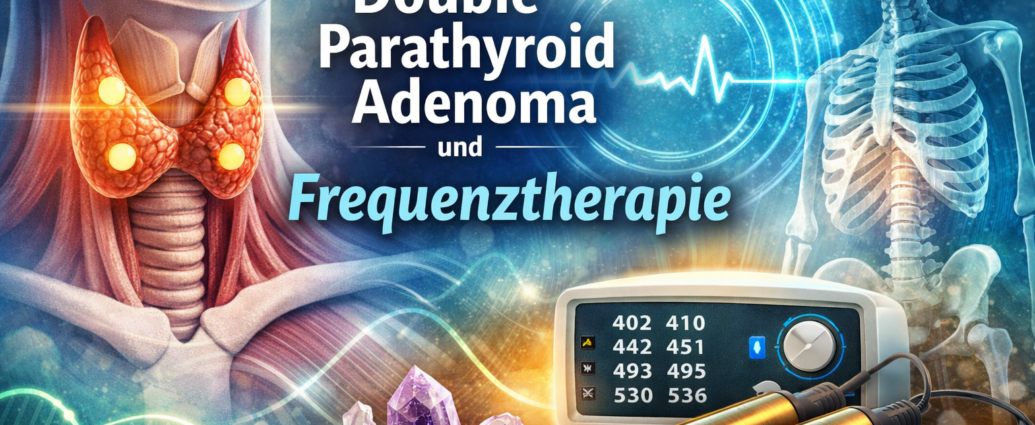
402-410 kHz
442-451 kHz
493-495 kHz
530-536 kHz
These frequency ranges are classified as complementary and considered as possible resonance patterns within frequency therapy. In practical application, they are often not evaluated in isolation, but in connection with the overall regulatory picture of the organism. Depending on the findings, it may also make sense to include mineral metabolism, endocrine balance, kidney function and overall energetic stress in the frequency concept.
Conclusion: A holistic view of double parathyroid adenoma and frequency therapy
From a conventional medical perspective, a double parathyroid adenoma is a relevant cause of primary hyperparathyroidism with elevated parathyroid hormone levels, hypercalcemia and a variety of possible symptoms. Diagnosis is based on laboratory tests and imaging, treatment is usually surgical.
Complementary frequency therapy can be used to support the organism holistically on a regulatory level. The focus is not only on the parathyroid glands themselves, but also on bone metabolism, kidneys, vegetative regulation and general energetic balance. The frequency ranges mentioned in the literature can be used as supplementary Frequency info be integrated into an individual complementary concept.


Comments are closed, but trackbacks and pingbacks are open.