




Forms, diagnostics and complementary frequency information
Author: NLS Information medicine Ltd, Herbert Eder
Introduction
Thyroid cancer comprises several different malignant tumor forms of the thyroid gland. Four main groups are described in the literature: papillary carcinoma, follicular carcinoma, anaplastic carcinoma and medullary thyroid carcinoma. Lymphomas and rare sarcomas of the thyroid gland can also occur. Precisely because these tumors differ significantly in their origin, growth, prognosis and treatment, it is particularly important to classify them precisely according to conventional medicine.
Nodules in the thyroid gland are common, but only a small proportion of them are malignant. This is one of the particular challenges: Benign nodules and malignant changes can be clinically similar, so careful diagnosis is necessary. For conventional medicine, the focus is on cell origin, hormonal behavior, imaging, histology and the extent of spread.
In the following WordPress post, the focus is first on the conventional medical basics of thyroid cancer. Only at the end follows the Frequency info with the complementary resonance frequencies mentioned in the literature.
What is thyroid cancer?
Thyroid cancer is a malignant neoplasm of the thyroid gland. The literature describes that thyroid carcinomas can essentially arise from two different cell types.
Follicular cells
The endodermally derived follicular cells mainly give rise to:
- papillary thyroid carcinoma
- Follicular thyroid carcinoma
- probably also anaplastic thyroid carcinoma
C-cells
The neuroendocrine, calcitonin-producing C-cells are the source of the protein:
- Medullary thyroid carcinoma
In addition Thyroid lymphomas arise from intrathyroidal lymphoid tissue, while Sarcomas arise from connective or vascular tissue of the thyroid gland.
Thyroid nodules - frequent, but usually benign
The literature emphasizes that benign thyroid nodules are common and that it is often not easy to distinguish them clinically from malignant changes. Only a small proportion of all thyroid nodules are actually malignant. This is precisely why the differentiated clarification of a nodule is crucial.
The aim of conventional medical diagnostics is to make a precise distinction:
- Benign lump
- Adenoma
- inflammatory change
- more malignant Tumor
- lymphatic or stromal neoplasia
This distinction determines the further procedure and treatment planning.
Important risk factors
The literature describes several factors that can play a role in the development of thyroid malignancies.
Radiation exposure
Relevant radiation exposure increases the risk of thyroid cancer, especially papillary thyroid carcinoma. Exposure to radiation at a young age is described as particularly significant.
Iodine deficiency
According to the literature, population groups with low iodine intake show an increased risk of follicular and anaplastic thyroid carcinomas.
Family burden
If there is a family history of thyroid cancer, the personal risk increases. This indicates a genetic susceptibility to certain forms of tumor.
Genetic changes
Depending on the type of tumor, different molecular changes play a role. It is precisely these differences that explain why the individual types of carcinoma behave so differently biologically.
Molecular basis of papillary thyroid carcinoma
Papillary thyroid carcinoma is the most common malignant tumor of the thyroid gland. The literature describes several molecular signaling pathways that may be involved in its development.
Important changes include
- RET/PTC
- TRK
- MET
- BRAF
- RAS
These signaling pathways influence the growth and differentiation processes of the follicular thyroid cells. The BRAF mutation called. Also RAS mutations play an important role. In addition, a correlation between papillary carcinomas and certain HLA-DR7 alleles described.
Papillary thyroid carcinoma
According to the literature, papillary thyroid carcinoma is the most common form of thyroid cancer and accounts for around 80 percent of cases. Women are significantly more frequently affected than men. The age of onset is often around the age of 40.
Together with follicular carcinoma, this type of tumor is one of the well-differentiated thyroid carcinomas. Typical features are
- Rather slow growth
- Origin from follicular cells
- Sensitivity to TSH
- Iodine intake
- Thyroglobulin production
Although the prognosis is often more favorable, the tumor can grow directly through the thyroid capsule and invade neighboring structures. Possible consequences are described in the literature:
- Ingrowth into the trachea
- Hemoptysis
- Airway obstruction
- Involvement of the recurrent laryngeal nerve
- hoarse or hoarse voice
- Dysphagia
Distant metastases occur less frequently, but can affect the lungs and bones in particular.
Follicular thyroid carcinoma
Follicular thyroid carcinoma is the second most common malignant thyroid neoplasm and accounts for around 10 percent of cases. This tumor also arises from follicular cells, is TSH-sensitive, absorbs iodine and produces thyroglobulin.
The differentiation from benign follicular adenomas is often challenging in conventional medicine. Decisive criteria are
- Capsule breakthrough
- Vascular invasion
This differentiation is not always easy, especially by cytology and frozen section. Compared to papillary carcinoma, follicular carcinoma more frequently shows distant metastases, particularly in:
- Lung
- Bones
Anaplastic thyroid carcinoma
Anaplastic thyroid carcinoma is one of the most aggressive forms of thyroid tumors. According to the literature, it accounts for less than 10 percent of thyroid carcinomas and mainly affects older women.
Characteristic features are
- Very rapid growth
- Highly invasive behavior
- Frequent necrosis
- Bleeding in the tumor
- Rapid overgrowth of the thyroid capsule
It is assumed in the literature that anaplastic carcinoma can arise from an existing well-differentiated thyroid carcinoma. This type of tumor has a particularly poor prognosis.
Medullary thyroid carcinoma
Medullary thyroid carcinoma develops from the calcitonin-producing C-cells of the thyroid gland. It is biologically distinct from tumors arising from follicular cells.
Typical special features are
- Production of calcitonin
- Partial production of other hormones or hormone-like substances
- Early spread via lymph channels
- Hematogenous metastasis
Metastases concern in particular:
- Lymph nodes
- Liver
- Lung
- Bones
The literature describes that medullary thyroid carcinoma can be associated with multiple endocrine neoplasia syndromes.
Familial forms of medullary thyroid carcinoma
Familial medullary thyroid carcinomas occur in the context of genetic syndromes. These include
- MEN 2A
- MEN 2B
- FMTC
These syndromes are inherited in an autosomal dominant manner. Children who inherit such a genetic constellation have a very high risk of developing medullary thyroid carcinoma.
MEN 2A
Typical components are
- Medullary thyroid carcinoma
- Pheochromocytoma
- Hyperparathyroidism
MEN 2B
Typical components are
- Medullary thyroid carcinoma
- Pheochromocytoma
- marfanoid habitus
- Ganglioneuromatosis
The literature describes that the familial form can be biologically particularly aggressive in the context of MEN 2B.
Primary thyroid lymphoma
According to the literature, primary thyroid lymphomas account for around 2 to 5 percent of thyroid malignancies. They are mostly Non-Hodgkin's B-cell lymphomas. Also described:
- MALT lymphomas
- Hodgkin's lymphoma
- Burkitt's lymphoma
- T-cell lymphomas
There is a close connection to the chronic lymphocytic thyroiditis, especially for Hashimoto's thyroiditis. Local expansion can result:
- Dysphagia
- Dyspnea
- Feeling of pressure in the throat
- Vocal fold paralysis
- Hoarseness
- Regional and distant lymph node enlargement
Sarcomas of the thyroid gland
Thyroid sarcomas are rare but highly aggressive. They arise from stromal or vascular tissue within the thyroid gland. In the literature, their prognosis is described as unfavorable. They have a high tendency to recur and respond only to a limited extent to conventional systemic therapies.
Symptoms of thyroid cancer
The symptoms depend greatly on the type, size and location of the tumor. Possible symptoms are
- Palpable lump in the neck
- Feeling of pressure
- Difficulty swallowing
- Shortness of breath
- Hoarseness
- Voice changes
- Lymph node swelling
- Cough or hemoptysis with tracheal involvement
Especially the ingrowth into the trachea, esophagus or nerve structures can lead to pronounced local discomfort.
Diagnostics for thyroid cancer
Conventional medical diagnostics comprises several levels. The literature mentions in particular
Depending on the type of tumor, specific markers also play a role, such as calcitonin in medullary thyroid carcinoma or thyroglobulin in differentiated tumors.
Conventional medical treatment of thyroid cancer
The therapy depends on the tumor form, stage and biological behavior. The following surgical procedures are mentioned in the literature:
- Lobectomy
- Isthmectomy
- total thyroidectomy
Surgical removal is a central component of treatment, especially for papillary and follicular carcinomas. The extent and additional measures depend on the type of tumor, size, invasion and lymph node status.
Why thyroid cancer is particularly interesting for frequency therapy
For the Frequency therapy thyroid cancer is particularly interesting because the thyroid gland is a hormonally highly active organ with clearly distinguishable cell lines. Papillary, follicular, anaplastic and medullary tumors show very different patterns not only clinically but also biologically. Information medicine therefore also asks whether these differences are reflected in characteristic complementary resonance fields.
Precisely because benign nodules, differentiated carcinomas, aggressive forms and rare lymphomas or sarcomas can occur in the same organ, this results in a multi-layered resonance picture. This is precisely where the Frequency info to.
Frequency info - complementary resonance frequencies for thyroid cancer
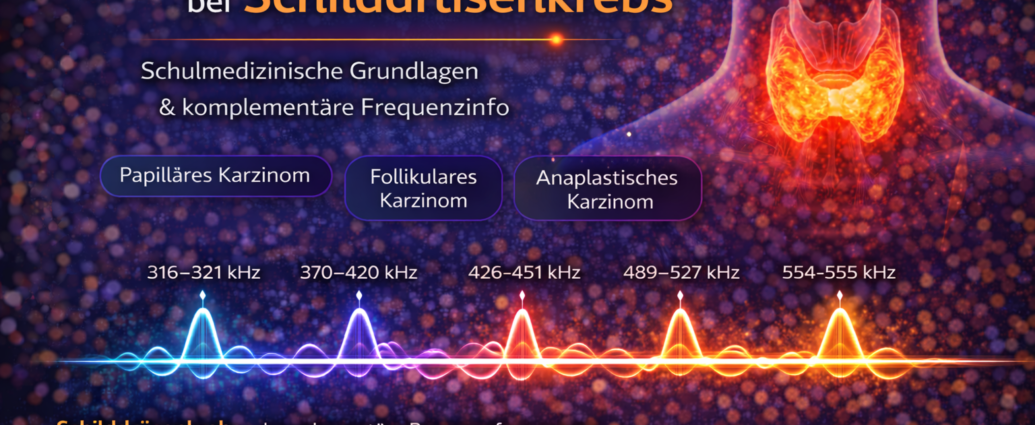
In the literature Thyroid cancer following Complementary resonant frequencies called:
316-321, 363, 370-374, 402-412, 416-420, 426-438, 439-448, 451, 489-493, 517-521, 525-527, 554-555 kHz
These frequencies can be divided into several characteristic resonance fields.
Lower resonance range
- 316-321 kHz
- 363 kHz
Medium resonance field
- 370-374 kHz
- 402-412 kHz
- 416-420 kHz
Upper central resonance field
- 426-438 kHz
- 439-448 kHz
- 451 kHz
Higher resonance ranges
- 489-493 kHz
- 517-521 kHz
- 525-527 kHz
- 554-555 kHz
Particularly striking is the concentration between 426 and 451 kHz, which appears as a central resonance field within the complementary frequency view.
Frequency info compact
Thyroid cancer - complementary resonance frequencies:
316-321, 363, 370-374, 402-412, 416-420, 426-438, 439-448, 451, 489-493, 517-521, 525-527, 554-555 kHz
Complementary classification of the resonance ranges
Within frequency therapy, thyroid cancer shows several conspicuous resonance areas:
- 316 to 321 kHz
- 370 to 420 kHz
- 426 to 451 kHz
- 489 to 527 kHz
- 554 to 555 kHz
The area between 426 and 451 kHz appears to be the central focus. Equally striking is the staggering in the middle areas between 402 and 420 kHz and the higher resonance zones above 489 kHz. In information medicine, such clusters are regarded as indications of related complementary tissue patterns.
Importance of frequency therapy in a complementary context
Within frequency therapy, thyroid cancer is not only seen as a local tumor of the thyroid gland, but also as an expression of altered regulation and information patterns in the organ and tissue area. The complementary frequency information supplements the conventional medical view with resonance spaces that are assigned to certain thyroid tumor patterns in the literature.
An organ with such strong hormonal, metabolic and regulatory significance as the thyroid gland has a particularly sensitive resonance field from the point of view of information medicine.
Conclusion
Thyroid cancer comprises several biologically very different tumor forms, including papillary, follicular, anaplastic and medullary carcinomas as well as rarer lymphomas and sarcomas. The conventional medical approach focuses on cell origin, molecular changes, imaging, histology and the individually appropriate surgical therapy.
The topic also opens up a complementary perspective for frequency therapy. The resonance frequencies described in the literature on thyroid cancer form a structured frequency information that can be viewed as complementary within information medicine. Particularly striking are the resonance clusters between 402 and 451 kHz and the higher ranges between 489 and 555 kHz.
Comments are closed, but trackbacks and pingbacks are open.