




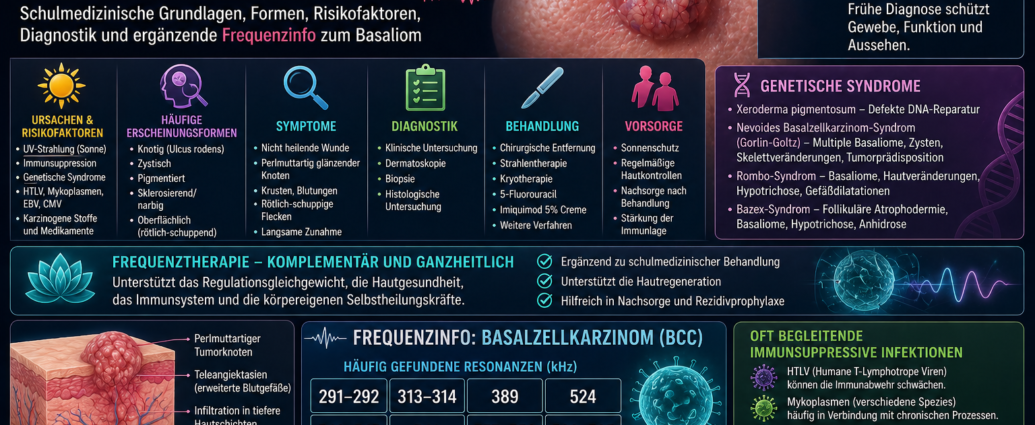
The Frequency therapy with Basal cell carcinoma is described in a complementary context as a supplementary consideration of conventional medical principles, risk factors, tumor forms, symptoms, diagnostics and possible resonance patterns. Basal cell carcinoma, also known as basal cell carcinoma, is the most common skin cancer and tends to develop on areas of the body that have been regularly exposed to sunlight over many years.
From a conventional medical point of view, basal cell carcinoma usually grows slowly and only rarely forms Metastases. Nevertheless, it can grow locally and be very destructive if it is not recognized and treated in time. Especially on the face, nose, eyelids, ears or scalp, an untreated basal cell carcinoma can damage surrounding tissue and cause visible disfigurement. The literature also describes certain resonance frequencies that can be used in frequency therapy as a supplementary treatment. Frequency info can be considered.
Frequency therapy for basal cell carcinoma: conventional medical overview
Basal cell carcinoma is a malignant tumor Tumor of the skin that originates from cells that resemble the basal cell layers of the epidermis or hair follicle structures. Although it is considered a malignant tumor, it differs significantly in its behavior from many other types of cancer. It usually grows slowly, often remains confined to the skin region and only rarely spreads to distant organs.
The greatest danger lies in local destruction. A basal cell carcinoma can grow into deeper layers of skin, cartilage, bone or adjacent tissue. Tumors around the eye are particularly problematic. If a basal cell carcinoma in the eye area remains untreated for a long time, it can grow into the eye socket and, in extreme cases, endanger vision.
Growth along nerve structures can also occur. This perineural spread can lead to pain, numbness, dysfunction or damage to affected nerves. Early diagnosis is therefore particularly important.
Frequency therapy for basal cell carcinoma and forms of skin cancer
Basal cell carcinoma is one of the non-melanocytic forms of skin cancer. It is often classified together with squamous cell carcinoma under the term „light skin cancer“. In contrast to black skin cancer, the malignant Melanoma, basal cell carcinoma metastasizes significantly less frequently.
Nevertheless, it should not be trivialized. If a basal cell carcinoma is ignored for a long time, it can penetrate deep into the skin and into neighboring structures. This can lead to considerable functional and cosmetic problems, particularly in the area of the face, nose, ears, lips and eyes.
Anyone who has already been diagnosed with non-melanocytic skin cancer has an increased risk of developing other skin tumors later on. Regular skin checks after basal cell carcinoma are therefore particularly important.
Common localizations of basal cell carcinoma
Basal cell carcinomas preferentially develop on sun-exposed areas of skin. The face, nose, forehead, temples, eyelids, ears, scalp, neck, throat and upper trunk are particularly frequently affected. The upper back can also be affected, especially in people with repeated intense sun exposure.
Many sufferers report a long history of recreational or occupational exposure to sunlight. Intensive sun exposure during childhood and adolescence is described in the literature as being particularly significant. The skin stores UV damage over many years, and visible tumors can often only develop decades later.
However, basal cell carcinomas can also occur in less sun-exposed areas. The decisive factor is the interaction between UV exposure, skin type, genetic predisposition, immune system and other stress factors.
Frequency therapy for basal cell carcinoma and tumor forms
Basal cell carcinoma can occur in various clinical forms. These differ in appearance, depth of growth and differentiation.
Nodular basal cell carcinoma
The nodular form is one of the most common variants. It usually appears as a skin-colored, pearly shiny papule or small nodule. Fine dilated blood vessels on the surface, so-called telangiectasias, can be typical.
Over time, the surface can break open and form an ulcer. This form was previously also described as „ulcus rodens“. It forms an ulcerating lump with a pearly edge, which can bleed repeatedly, crust over and appear to heal without actually disappearing.
Cystic basal cell carcinoma
The cystic form is rarer. It is similar to the nodular form, but contains a fluid-filled cavity inside. This can make it difficult to distinguish clinically from other benign or nodular skin lesions.
As the external appearance is not always clear, a dermatological assessment is particularly important in the case of unclear skin changes.
Pigmented basal cell carcinoma
Pigmented basal cell carcinoma contains darker pigments and can therefore be mistaken for melanoma. This form shows how important it is to closely examine conspicuous pigmented skin changes.
Not every dark skin change is a melanoma, and not every basal cell carcinoma is light. That is why dermoscopy, Biopsy and histological examination are crucial.
Sclerosing or scarring basal cell carcinoma
The sclerosing or scarring form can look like a pale, hardened, scar-like skin change. It is often more difficult to detect because it does not always stand out as a classic tumor lump.
This form can spread inconspicuously in depth and width. Precise differentiation is therefore particularly important during treatment.
Superficial basal cell carcinoma
The superficial form often appears as a reddish, scaly patch. It can resemble eczema, fungal infections or chronic skin irritation. This form can occur particularly on the trunk.
As it grows slowly and causes few symptoms, it is sometimes overlooked for a long time.
Development of basal cell carcinoma
Histologically, basal cell carcinomas develop from epithelial cells of the skin. These resemble the basal cells of the epidermis or cells of the hair follicle region. The literature also describes a development from pluripotent cells that are able to form hair-like structures.
Sebaceous glands and apocrine gland structures are also discussed as possible areas of origin. The tumors usually arise from the epidermis or from the outer root sheath of a hair follicle.
Under the microscope, the tumor cells often show small, uniform cell nuclei. At the edge of the tumor islands, the cells are often arranged in a palisade-like pattern. In the center, they may appear more irregular. There are often accompanying inflammatory reactions between tumor clusters and the surrounding stroma.
Frequency therapy for basal cell carcinoma and risk factors
The most important known risk factor for basal cell carcinoma is UV radiation. Repeated and intensive sun exposure in particular can cause DNA damage in skin cells. If this damage is not sufficiently repaired, tumors can develop in the long term.
Immunosuppression can also increase the risk. People after organ transplantation or stem cell transplantation have a higher risk of non-melanocytic skin tumors. A weakened immune system is less effective at controlling altered cells.
The literature also mentions viral loads, immunosuppressive factors, certain mycoplasmas, Epstein-Barr virus, cytomegalovirus, HTLV as well as carcinogenic substances and medication are discussed as possible accompanying factors. In complementary frequency therapy, such information is regarded as possible resonance patterns.
Genetic syndromes with basal cell carcinomas
In addition to the common UV-related forms, there are rare genetic diseases in which basal cell carcinomas can occur more frequently.
Xeroderma pigmentosum
Xeroderma pigmentosum is a hereditary disease in which UV-induced DNA damage can only be insufficiently repaired. Pigment changes occur early in life. Later, basal cell carcinomas, squamous cell carcinomas and sometimes malignant melanomas can develop.
Other possible symptoms include corneal clouding, visual impairment or even blindness and neurological impairments. This disease shows particularly clearly how important DNA repair mechanisms are for protection against skin cancer.
Nevoid basal cell carcinoma syndrome
Nevoid basal cell carcinoma syndrome, also known as Gorlin-Goltz syndrome, is a hereditary disease. It is characterized by the early development of numerous basal cell carcinomas, jaw cysts, pits on the palms of the hands and soles of the feet, calcifications inside the skull and changes to the ribs.
In addition, various tumors can occur, including medulloblastomas, meningiomas, fetal rhabdomyomas and ameloblastomas. A connection with the patched hedgehog signaling pathway is described in the literature. This signaling pathway plays an important role during embryonic development and later remains involved in the regulation of cell growth and differentiation.
If the inhibition of this signaling pathway is lost, uncontrolled cell growth can be promoted. This has been described both in sporadic basal cell carcinomas and in Gorlin-Goltz syndrome.
Rombo syndrome
Rombo syndrome is a rare hereditary disease. Basal cell carcinomas, atrophic skin changes, trichoepitheliomas, reduced hair growth, milia and peripheral vascular dilatation with bluish discoloration are described.
Here too, the focus is on the tendency to certain skin changes.
Bazex syndrome
Various clinical pictures are described under the name Bazex. A genetic form is associated with follicular atrophoderma, so-called „ice pick“-like skin signs, multiple basal cell carcinomas, reduced hair growth and locally reduced sweating.
These rare syndromes show that basal cell carcinomas can be promoted not only by sunlight, but also by genetic factors and disturbed cell regulation.
Common symptoms of basal cell carcinoma
Basal cell carcinoma often appears as a small skin lesion that does not heal. Many sufferers notice an area that repeatedly crusts over, bleeds or becomes slightly sore. Bleeding can occur particularly when washing the face, drying it with a towel or through slight mechanical irritation.
Typical signs can be
- Non-healing skin area
- pearlescent knot
- Fine visible blood vessels
- Recurrent crust formation
- Minor bleeding on contact
- reddish-scaly spot
- Scar-like hardening
- Dark pigmented lump
- Slowly increasing skin changes
The symptoms are usually minor. Pain often only occurs later when deeper structures, nerves or surrounding tissue are affected. It is precisely this lack of pain that can lead to basal cell carcinomas being underestimated for a long time.
Frequency therapy for basal cell carcinoma and conventional medical diagnostics
The diagnosis is initially made by clinical observation of the skin change. Dermatological experience, dermoscopy and precise inspection are important steps. As basal cell carcinomas can look very different, the external impression alone is not always sufficient.
The definitive diagnosis is made by means of a skin biopsy and histological examination. Tissue is removed and assessed microscopically. This makes it possible to determine whether it is a basal cell carcinoma and which subtype is present.
The exact histological classification is important because certain forms grow more infiltratively and may require a different therapeutic plan.
Conventional medical treatment options
Treatment depends on the size, location, subtype, depth of growth, age, general condition and cosmetic-functional significance of the affected region. Surgical removal is often the preferred treatment.
During the operation, the tumor is removed at a safe distance. A particularly precise surgical technique may be necessary, especially on the face or in critical areas, in order to preserve as much healthy tissue as possible while completely removing the tumor.
Other options include ionizing radiation, superficial X-ray therapy, cryotherapy, local medicinal procedures, 5-fluorouracil, immunomodulating local therapy with imiquimod and other dermatological procedures. Which method is suitable depends on the respective findings.
Check-ups are important after treatment because basal cell carcinomas can reappear. Recurrences in previously treated areas are also possible, especially if tumor cells have remained in deeper areas.
Frequency therapy for basal cell carcinoma in a complementary context
Frequency therapy looks at biological processes from the point of view of vibration, Resonance and regulation. In the case of basal cell carcinoma, the complementary focus is on the skin environment, UV exposure, immune status, possible viral resonance patterns, mycoplasmas and individual regulatory capacity.
The literature describes that certain pathogenic factors can still be detected as resonance patterns even after surgical treatment. In the complementary frequency context, therefore, not only the visible tumor is considered, but also the possible environment in which the skin change occurred.
The frequency lists are used as supplementary frequency information. They can be used for documentation, resonance analysis and individual frequency therapy work.
Frequency therapy and skin cancer in an expanded view
Skin cancer is often caused by a combination of UV damage, genetic predisposition, local skin stress, immune system and cell regulation disorders. In basal cell carcinoma, the focus is on local tissue destruction. Metastasis is rare, but not impossible.
When metastases occur, the literature mentions lymph nodes, lungs and bones in particular. Recurrences can also occur if tumor tissue has not been completely removed or if the skin environment is still contaminated.
Frequency therapy views these processes as part of a larger regulatory process. Immune-suppressing concomitant infections such as HTLV, mycoplasma, Epstein-Barr virus and cytomegalovirus can also be considered in a complementary context.
Frequency info: Basal cell carcinoma
The following frequencies are mentioned in the literature in connection with basal cell carcinoma. They are regarded as complementary resonance ranges in the complementary context of frequency therapy.
Frequency therapy for basal cell carcinoma
291-292 kHz,
313-314 kHz,
389 kHz,
524 kHz,
540-545 kHz,
541 kHz,
557-558 kHz,
582-585 kHz.
These frequencies are described in the literature as frequently found resonances in basal cell carcinoma. In the context of frequency therapy, they can be used as supplementary orientation for documentation, resonance observation and individual work.
Frequency information: immunosuppressive concomitant stresses
In the literature, immunosuppressive concomitant stresses are frequently mentioned in basal cell carcinoma. These include in particular human lymphotropic Viruses, mycoplasma, Epstein-Barr virus and cytomegalovirus.
Frequency therapy for accompanying resonance patterns
HTLV,
Mycoplasma,
Epstein-Barr virus,
Cytomegalovirus.
These accompanying patterns are not evaluated in isolation in the complementary view, but in connection with the skin environment, UV exposure, immune situation and individual regulatory capacity. The specific frequencies of these pathogen groups are described in separate chapters of the literature.
Frequency info: UV exposure and skin environment
UV light is described in the literature as a significant stress factor for the development of basal cell carcinomas. In complementary frequency thinking, UV exposure is not only understood as an external stimulus, but also as a possible influence on Cell communication, DNA stability, repair capacity and local immune balance of the skin.
Frequency therapy and skin regulation
In a complementary context, frequency therapy can be used to document resonance patterns of the skin, immunological stress and accompanying microbial fields. Particularly after surgical removal of a basal cell carcinoma, additional frequency observations can be used in the sense of aftercare and environmental observation.
Frequency therapy for basal cell carcinoma: comparison of frequency patterns
When comparing the above frequencies, several areas are noticeable that lie in higher resonance fields. Particularly noticeable are 524 kHz, 540-545 kHz, 557-558 kHz and 582-585 kHz. These frequencies are frequently described in the literature in connection with basal cell carcinomas.
The lower ranges 291-292 kHz, 313-314 kHz and 389 kHz can also be regarded as important documenting resonance points in frequency therapy.
In a complementary context, the combination of frequency ranges can provide indications of different levels: local skin changes, possible viral involvement, immunological stress and regulatory patterns of the tissue.
Frequency therapy for basal cell carcinoma: Summary
Basal cell carcinoma is the most common skin cancer. It mainly develops on sun-exposed areas of skin, usually grows slowly and rarely metastasizes. Nevertheless, it can grow locally and cause considerable tissue damage, particularly on the face, eyes, nose or ears.
In conventional medicine, early detection, skin biopsy and histological examination are crucial. Depending on the findings, treatment is carried out using surgery, radiotherapy, cryotherapy or local medication. Regular follow-up checks are important, as further skin tumors or relapses can occur.
Frequency therapy offers a supplementary level of consideration. In the literature, resonance frequencies such as 291-292 kHz, 313-314 kHz, 389 kHz, 524 kHz, 540-545 kHz, 541 kHz, 557-558 kHz and 582-585 kHz are mentioned for basal cell carcinoma. These frequency lists can be used in a complementary context for documentation, resonance observation and individual frequency therapy work.
Comments are closed, but trackbacks and pingbacks are open.