





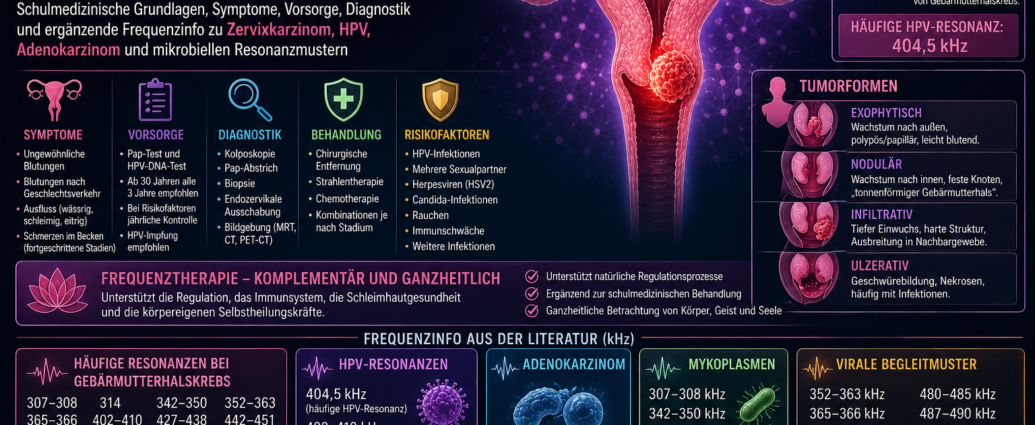
The Frequency therapy with Cervical cancer is described in a complementary context as a supplementary consideration to conventional medical principles, prevention, symptoms, diagnostics and possible microbial resonance patterns. Cervical cancer, also known as cervical carcinoma, develops on the cervix and often develops over several years from preliminary stages. The connection with human papillomaviruses, HPV for short, is particularly significant in the literature.
In conventional medicine, cervical carcinoma is one of the most important malignant tumor diseases in women. Compared to many other gynecological cancers, it occurs more frequently in younger women. It is characterized by the fact that the disease usually develops in stages: from cell changes to precancerous stages to invasive cancer. Tumor. Supplementary frequency therapy also considers frequency ranges that are associated with HPV in the literature, Adenocarcinomas, microbial contamination and advanced tumor processes.
Frequency therapy for cervical cancer: conventional medical overview
Cervical cancer develops in the lower section of the uterus, the cervix. This area connects the uterine cavity with the vagina. The so-called transition zone, where two different types of mucous membrane meet, is particularly important. This is precisely where many cell changes occur that can later lead to cervical cancer.
The tumor does not usually develop suddenly. The process often begins with dysplastic, i.e. malformed or altered cells. These cell changes may initially be limited. If they are detected in time, many precancerous stages can be treated before invasive cancer develops.
The literature describes that in many cases cervical cancer progresses via recognizable precursors. This makes prevention particularly important. If the disease is detected before the invasive stage, the treatment options are much more favorable.
Frequency therapy for cervical cancer and HPV
Human papillomaviruses are considered in the literature to be a particularly important factor in the development of cervical cancer. Certain HPV types can alter cervical cells and promote the development of precancerous lesions in the long term.
A frequently cited resonance value for HPV is 404.5 kHz. In connection with invasive tumor processes and various HPV groups, the frequency ranges 402-410 kHz and 427-438 kHz are particularly described in the literature.
HPV is often transmitted via sexual contact. Many HPV infections initially go unnoticed and can be controlled by the immune system. However, if an infection persists over a long period of time, it can have a permanent effect on the mucous membrane of the cervix. This can lead to cell changes that progress over the years.
Development of cervical carcinoma
The malignant process often begins at the boundary between the squamous epithelium and the glandular epithelium of the cervix. This transition zone is described as being particularly sensitive to cell changes. Initially, mild dysplasia can develop there, which can progress to moderate and severe precursors to carcinoma in situ.
In carcinoma in situ, the malignantly altered cells are still located above the basement membrane. As long as this natural boundary layer is not breached, it is not yet considered an invasive carcinoma. However, as soon as the tumor cells penetrate the basement membrane and grow into the underlying tissue of the cervix, the process is invasive.
In the literature, this transition is described as a decisive step. As soon as the stroma of the cervix is affected, the tumor can spread further and reach lymphatic channels, neighbouring tissue or distant organs.
Frequency therapy for cervical cancer and tumor forms
Cervical cancer can occur in different growth forms. These forms influence how the tumor looks, how it spreads and what symptoms can arise.
Exophytic tumor form
The exophytic form grows outwards towards the vagina. It can appear polypous or papillary and often originates from the outer cervix. Such tumors can grow larger, bleed easily and have a friable surface.
This form can appear as a visible, superficial mass that causes bleeding when touched or after sexual intercourse. The friable structure often causes noticeable bleeding.
Nodular tumor form
The nodular form tends to develop in the inner area of the cervix. It grows into the tissue and can form solid, confluent tumor masses. If the cervical canal is affected, the cervix as a whole can appear thickened and barrel-shaped.
This form may be less visible for a long time because it grows more strongly in the tissue. This is why palpation, colposcopy and tissue examination are particularly important.
Infiltrative tumor form
The infiltrative form spreads deep into the tissue. The cervix can become very hard as a result. The tumor can grow into the vaginal vault, the upper vaginal section, the uterine body and lateral pelvic structures.
This form is particularly significant because it can involve surrounding tissue at an early stage. Pain, a feeling of pressure or discomfort in the pelvic area can increase as a result.
Ulcerous tumor form
The ulcerated form can lead to tissue decay and necrosis. Secondary infections can develop. A watery, mucous, purulent or foul-smelling discharge is described in the literature.
This form shows particularly clearly how closely tumor growth, tissue damage, mucosal stress and accompanying microbial processes can be linked.
Common tissue types in cervical cancer
Most cervical carcinomas are squamous cell carcinomas. They develop from the squamous epithelium of the outer cervix. This type of tumor is histologically the most common.
If the tumor originates from glandular cells of the inner cervix, an adenocarcinoma can develop. According to the literature, adenocarcinomas account for a small proportion of all cervical cancers. Resonance ranges around 427-438 kHz are mentioned in particular for these forms.
There are also rarer forms of cervical tumors. These are classified separately depending on the cell type, growth pattern and histological findings.
Possible symptoms of cervical cancer
Early stages of cervical cancer often do not cause any noticeable symptoms. This is why screening is particularly important. When symptoms do occur, they often relate to bleeding or discharge.
Possible symptoms include unusual vaginal bleeding, bleeding after the menopause, irregular periods, very heavy periods, painless intermenstrual bleeding or bleeding after sexual intercourse.
Unusual discharge may also occur. This can be watery, mucousy, purulent or bloody. In advanced stages, pain in the pelvis, pain in the lower abdomen, discomfort when urinating or discomfort in the rectum can also occur.
If neighboring organs are affected, urinary tract problems, a feeling of pressure, pain, stool problems or drainage problems may occur. If the disease is more advanced, general symptoms such as tiredness, weight loss and reduced performance may occur.
Spread of cervical cancer
Invasive cervical carcinoma often spreads to regional lymph nodes first. Lymph nodes near the cervix and in the pelvic area are particularly affected. Subsequently, internal and external pelvic lymph nodes can be reached.
In some cases, the tumor can spread further into retroperitoneal, inguinal or thoracic lymph nodes. Via the bloodstream Metastases in the lungs, bones, urinary tract, rectum and liver.
The spread depends on tumor size, depth of invasion, tissue type, lymph node involvement and general biological behavior. These factors have a significant impact on treatment planning and prognosis.
Frequency therapy for cervical cancer and risk factors
The most important factor described in the literature is a persistent infection with certain human papillomaviruses. In particular, the resonance value 404.5 kHz and the ranges 402-410 kHz and 427-438 kHz are repeatedly mentioned in the complementary frequency analysis.
Other risk factors are multiple sexual partners, early and repeated HPV contacts and additional infections in the genital area. Herpes simplex virus 2 and recurring chronic Candida infections are mentioned in the literature.
Other microbial contamination can also play a role in certain risk groups. These include HIV, human lymphotropic Viruses, human B-lymphotropic virus, genital herpes, Mycoplasma genitalium and Mycoplasma fermentans. Such factors are primarily mentioned in connection with the need for increased monitoring and annual screening.
Prevention of cervical cancer
Early detection is particularly important for cervical cancer because many cases develop via preliminary stages. If conspicuous cell changes are detected early, progression to invasive carcinoma can be prevented or significantly limited.
In the literature, Pap tests and HPV DNA tests are mentioned as important examinations. Women over the age of 30 in particular can be checked for cell changes and HPV exposure through regular testing.
Closer monitoring may be advisable for certain risk factors. These include infections with HIV, human lymphotropic viruses, genital herpes, mycoplasma or particular hormonal or prenatal stress.
Prevention through HPV vaccination
Vaccination against human papillomaviruses is described in the literature as a preventive measure. There are vaccines against certain HPV groups. One available vaccine is associated with an HPV group whose resonance frequency is given as 404.5 kHz.
Multivalent vaccines cover several HPV groups. In the complementary frequency approach, these groups are often associated with the 402-410 kHz range.
Prevention is aimed at avoiding certain HPV infections and thus reducing the risk of subsequent cell changes in the cervix.
Conventional medical diagnostics for cervical cancer
The diagnosis begins with a gynecological examination. This includes examination, palpation and assessment of the cervix. Abnormal areas can be examined more closely with a colposcopy. This involves magnifying the cervix.
The Pap smear is used to assess cell changes. If the findings are abnormal, a tissue sample can be taken. The Biopsy is crucial in order to precisely determine the type and severity of the change.
Further examinations may include endocervical scraping, uterine endoscopy, cystoscopy, rectoscopy, intravenous imaging of the urinary tract and imaging examinations of the lungs and skeleton. Which examinations are required depends on the stage and the suspected spread.
Conventional medical treatment options
The treatment of cervical cancer depends on the stage of the disease. Early stages can be treated locally. For invasive tumors, surgery, radiotherapy, chemotherapy or combined procedures may be considered, depending on how far the cancer has spread.
In very early stages, limited surgery may be sufficient. For more advanced tumors, more extensive surgical measures may be necessary. Radiotherapy and chemotherapy are used if the tumor is locally advanced, lymph nodes are affected or surgery is not sufficient.
Treatment planning takes into account tumor size, tissue type, depth of penetration, lymph node status, age, desire to have children and general condition.
Frequency therapy for cervical cancer in a complementary context
Frequency therapy looks at biological processes from the point of view of vibration, Resonance and regulation. In the case of cervical cancer, the complementary focus is particularly on HPV resonances, the mucosal environment, the immune system, chronic concomitant infections and possible microbial resonance patterns.
The literature describes that the frequencies found can depend on the stage of the disease. In early stages, fewer different pathogenic frequencies are mentioned. In advanced stages, several microorganisms and resonance ranges can be described simultaneously.
In this context, the frequency lists serve as a supplementary Frequency info. They can be used for documentation, resonance analysis and individual frequency therapy work.
Frequency therapy and cancer in an expanded view
Cancers do not only develop at the level of individual cells. The tissue environment, immune response, chronic inflammation, hormonal factors, microbial stress and regulatory capacity can also play a role in the broader view.
In the case of cervical cancer, the link to HPV is particularly clear. At the same time, the literature mentions other concomitant stresses that may be of significance in the urogenital tract, in the mucosal environment and in immune regulation.
Frequency therapy views these relationships as resonance fields. Not only tumor cells are considered, but also viruses, mycoplasmas, herpes viruses, Candida contamination, the immune system and the regulatory capacity of the entire organism.
Frequency info: HPV in cervical cancer
The following frequencies are mentioned particularly frequently in the literature in connection with HPV and cervical cancer.
Frequency therapy for HPV resonances
404.5 kHz,
402-410 kHz,
427-438 kHz.
The single value 404.5 kHz is described in the literature as a frequent resonance value of human papillomaviruses. The ranges 402-410 kHz and 427-438 kHz are mentioned there in connection with more invasive processes, various HPV groups and certain tumor forms.
Frequency information: Adenocarcinoma of the cervix
Adenocarcinomas of the cervix arise from glandular cells of the inner cervix. The following resonance areas in particular are mentioned in the literature.
Frequency therapy for adenocarcinoma
427-438 kHz.
This area is considered in a complementary context as additional frequency information for adenocarcinomas of the cervix.
Frequency info: frequently found resonances
The following frequencies are mentioned particularly frequently in the literature in connection with cervical cancer. They are regarded as resonance ranges in the complementary context of frequency therapy.
Frequency therapy for cervical cancer
307-308 kHz,
314 kHz,
342-350 kHz,
352-363 kHz,
365-366 kHz,
402-410 kHz,
427-438 kHz,
442-451 kHz,
453-455 kHz,
480-485 kHz,
487-490 kHz,
493-495 kHz,
517-521 kHz,
525-527 kHz.
These frequencies are described in the literature as frequently found resonances in cervical cancer. Depending on the stage, fewer or more resonance areas may be present. In advanced stages, several microbial stress patterns are described simultaneously.
Frequency info: Mycoplasma and accompanying strains
In the literature, Mycoplasma genitalium and Mycoplasma fermentans are mentioned as possible additional strains in connection with cervical changes. The following frequency ranges overlap with the frequently mentioned resonances.
Frequency therapy for mycoplasma
307-308 kHz,
342-350 kHz,
442-451 kHz,
493-495 kHz.
These frequency ranges can be considered in a complementary context, particularly in cases of chronic urogenital stress, mucosal irritation and recurring complaints.
Frequency info: viral accompanying patterns
In addition to HPV, other viral strains are mentioned in the literature. These include herpes simplex virus 2, genital herpes, human lymphotropic viruses and human B-lymphotropic virus.
Frequency therapy for viral resonance patterns
352-363 kHz,
365-366 kHz,
402-410 kHz,
427-438 kHz,
453-455 kHz,
480-485 kHz,
487-490 kHz,
517-521 kHz,
525-527 kHz.
These frequencies can be documented as complementary resonance fields in the context of frequency therapy, especially if viral accompanying patterns are in the foreground in the complementary view.
Frequency therapy for cervical cancer: comparison of frequency patterns
When comparing the frequency lists, several recurring ranges stand out. Particularly significant are 402-410 kHz and 427-438 kHz, as they are repeatedly associated in the literature with HPV, invasive processes and certain types of tumors.
Also 307-308 kHz, 342-350 kHz, 442-451 kHz and 493-495 kHz occur repeatedly in the frequency observation and are often associated with mycoplasma and urogenital concomitant stresses.
The ranges 517-521 kHz and 525-527 kHz appear as additional resonance fields that can be documented in connection with more complex or advanced stress patterns.
Frequency therapy for cervical cancer: Summary
Cervical cancer often develops over several years from preliminary stages. The disease usually develops in the transition zone of the cervix and is closely associated with human papillomaviruses in the literature. Early detection, Pap test, HPV test, colposcopy and, if necessary, biopsy are particularly important.
Typical symptoms can include unusual bleeding, bleeding after sexual intercourse, bleeding after the menopause, heavy or irregular menstrual flow and conspicuous discharge. In advanced stages, pelvic discomfort, urinary tract problems, rectal discomfort and pain may occur.
Frequency therapy offers a supplementary level of observation. The literature describes resonance ranges for HPV, adenocarcinoma, mycoplasma, viral accompanying patterns and frequently found frequencies in cervical cancer. These frequency lists can be used in a complementary context for documentation, resonance observation and individual frequency therapy work.

Comments are closed, but trackbacks and pingbacks are open.